_1781464136662-DVw5IPjt.png)
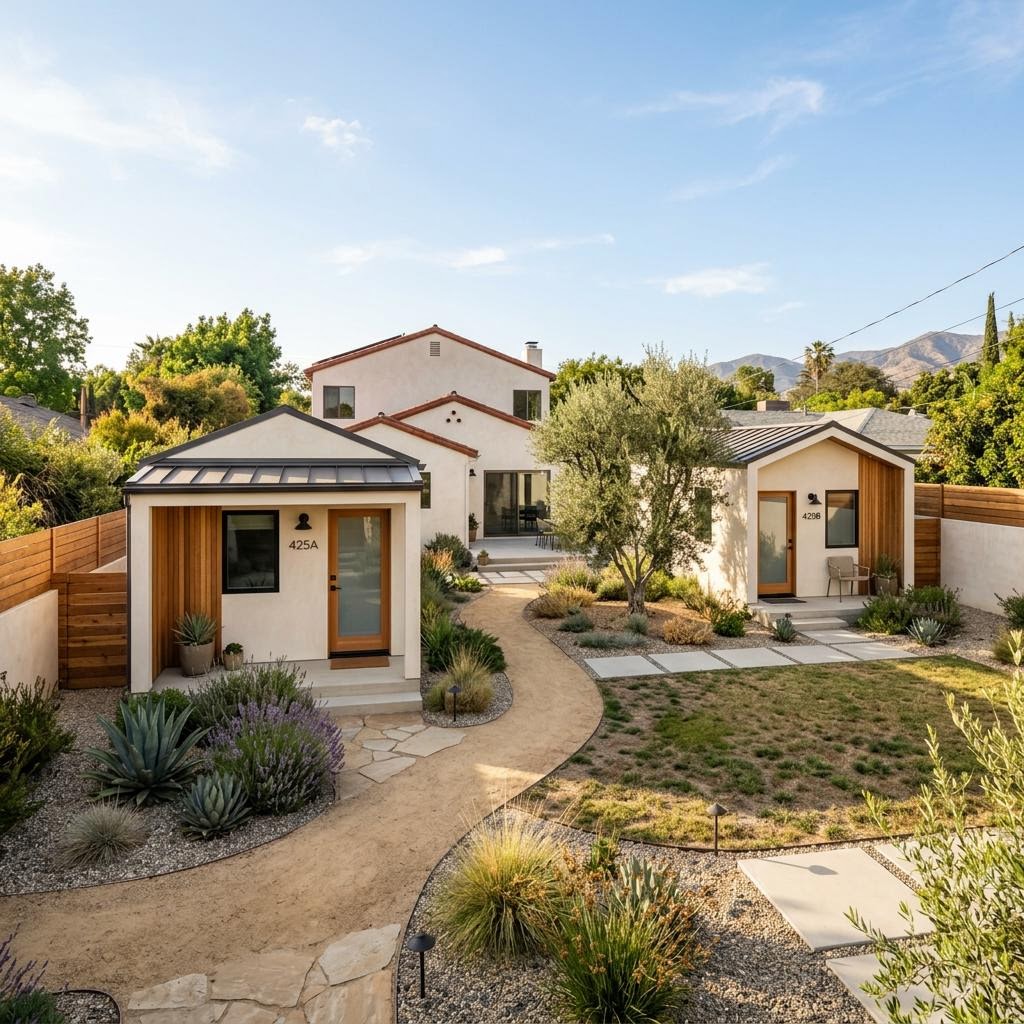
Quick answer: can I build two detached ADUs?
Starting January 1, 2027, AB 956 expands California’s ministerial approval pathway to two detached, new-construction ADUs on a lot with an existing or proposed single-family home, when the law’s conditions are met. It also strengthens the wording of HOA and private-covenant protections. It does not authorize permit-free building, unlimited unit sizes, or automatic approval of every two-unit layout.
AB 956 is signed law—but the new rules start in 2027
Governor Gavin Newsom approved Assembly Bill 956, authored by Assemblymember Sharon Quirk-Silva, on September 29, 2026. The Secretary of State filed it the same day as Chapter 791, Statutes of 2026. The final law amends Civil Code Sections 714.3 and 4751 and Government Code Section 66323. These are specific changes to ADU approvals and private restrictions—not a replacement for the entire California building or zoning code.
The chaptered bill has no urgency clause or special effective-date provision. Under California Constitution Article IV, Section 8(c), its effective date is January 1, 2027. That distinction matters if you are planning in fall 2026: you can start a feasibility review and design coordination now, but should not assume that an agency must approve the new two-detached-unit configuration before the law takes effect. Confirm filing and transition instructions with the reviewing agency.
For homeowners, the practical opportunity is an additional detached housing option for relatives or longer-term tenants. For a suitable lot, two separate small homes may work better than forcing one unit into the main house. However, eligibility, construction economics, and rental demand are property-specific; the legislation does not guarantee additional income or an increase in resale value.
What changes under AB 956?
| Topic | Before AB 956 takes effect | Under AB 956 |
|---|---|---|
| Detached new-construction units | One under the single-family Section 66323(a)(2) pathway. | Two under the amended pathway, subject to statutory conditions. |
| HOA and private-covenant wording | Protections refer to a lot zoned for single-family residential use. | Protections refer to a lot zoned to allow single-family residential use. |
| Unit size and setbacks | State-exempt pathway includes size, height, and setback conditions. | Not a blanket size increase: the agency may impose an 800-square-foot livable-area limit per detached unit; side/rear setbacks no greater than four feet under this pathway. |
| JADU with two detached ADUs | Different unit combinations require separate analysis. | The agency is not required to ministerially approve a JADU where the two detached units have been constructed under this pathway. |
| Building permits and safety | Permits, code compliance, and inspections are required. | Still required. Ministerial approval does not mean permit-free construction. |
Source: the chaptered AB 956 text, especially Government Code Sections 66323(a)(2) and 66323(b). Existing multifamily buildings have separate ADU provisions; this table is not a universal unit-count rule for every residential parcel.
Can an HOA block an otherwise legal ADU?
The amended Civil Code uses “a lot zoned to allow single-family residential use,” rather than “a lot zoned for single-family residential use.” This matters when a single-family home sits in a zone that also allows other residential uses. The protections are not limited simply by whether a zoning label is exclusively single-family.
Sections 714.3 and 4751 make restrictions void and unenforceable when they effectively prohibit or unreasonably restrict a qualifying ADU or JADU. They retain an allowance for reasonable restrictions. The final text of Section 714.3 also states that reasonable restrictions shall not include fees or other financial requirements. Do not simplify that into a claim that every HOA rule disappears or that a city must waive its permit fees.
Keep the discussion in writing. Compare an HOA’s requested conditions with the state-law pathway and the actual proposed design, rather than treating a generic architectural review checklist as the final answer. Ocean Permits can coordinate the agency permitting side; an attorney should advise on a contested covenant, threatened enforcement action, or other legal dispute.
Two detached ADUs: eligibility, size, setbacks, and JADU limits
Government Code Section 66323(a)(2) describes two detached, new-construction ADUs on a lot with an existing or proposed single-family dwelling. The section operates within residential or mixed-use zones and requires compliance with its conditions. It is not an entitlement to place two homes on any vacant parcel, regardless of the primary dwelling or the site’s legal status.
- Floor area: the local agency may impose a limit of not more than 800 square feet of livable space on a detached unit under this pathway. Do not market two large units as automatically protected by AB 956.
- Side and rear setbacks: the pathway uses setbacks no greater than four feet. This does not replace structural, fire-safety, easement, or other applicable site requirements.
- Height: the section refers to the applicable height limits in Government Code Section 66321(b)(4)(A)–(C). Verify the applicable category rather than assuming every site allows a two-story design.
- JADUs: Section 66323(b) says the local agency is not required to ministerially approve a JADU on the same lot where the two detached units have been constructed under paragraph (a)(2). Two detached ADUs plus a JADU is not an automatic package.
- Rental terms: rentals of units created under Section 66323 must be for terms longer than 30 days. The law is not a vacation-rental permit.
An existing garage conversion, attached ADU, or detached unit can change the analysis of the requested combination. Bring the approved permit history to your feasibility consultation. For related configurations, read our Los Angeles ADU permit guide and JADU permit guide. For parcel division, use the separate SB 9 lot-split and duplex guide.
Which agency handles an AB 956 project in Los Angeles?
City of Los Angeles: LADBS handles building permits, with applicable city clearances and utility coordination. A property in Tarzana, Encino, or Woodland Hills is not sent to LA County Building and Safety simply because it is in the San Fernando Valley. Use the actual parcel jurisdiction, not a mailing-address assumption.
Unincorporated LA County: a property in Altadena generally uses LA County Public Works Building and Safety, with the applicable county and fire reviews. Read our unincorporated county permit-process guide. Other incorporated cities use their own building departments; AB 956 is statewide, but the application portal and agency coordination differ.
Hillside and fire-rebuild properties: statewide ADU eligibility does not make grading, geotechnical work, fire-resistant construction, or utility reconstruction disappear. In Pacific Palisades and Altadena, coordinate the ADU proposal with the primary-home rebuild and the responsible agencies. Do not assume an added ADU qualifies for a like-for-like rebuild exemption. Our fire-rebuild permit team can help separate those review tracks.
How to plan and permit two detached ADUs
1. Confirm the jurisdiction and existing unit inventory
Start with the address, assessor parcel number, zoning, and legally approved structures. Identify whether the lot has an existing or proposed single-family dwelling, an existing detached ADU, a converted-space ADU, or a JADU. In Los Angeles, check parcel information and permit records before assuming that an advertised backyard unit is legally permitted. Ask the agency how it will treat existing units and staged applications; AB 956 should not be presented as two additional detached units regardless of what is already there.
2. Test a complete two-unit site layout
Have the design team show both units, property lines, side and rear setbacks, access paths, utilities, trees, and the primary dwelling on one coordinated site plan. A large yard alone does not establish feasibility. Easements, drainage, slope conditions, building separation, and service capacity can change the buildable layout. Confirm the Section 66323 size and applicable height rules before paying for a design that depends on a different entitlement.
3. Review private restrictions and resolve conflicts early
Collect the recorded covenants and HOA governing documents, then identify any design review or approval procedure. The amended statutory language protects qualifying units from prohibitions and unreasonable restrictions, but it is not a reason to discard all HOA correspondence. Request a written explanation of disputed conditions. A land-use or HOA attorney should handle enforceability disputes; permit expediting is not a substitute for legal representation.
4. Prepare the coordinated building and trade submittal
Your licensed design professionals prepare architectural, structural, energy, and other required documents. Coordinate foundations, drainage, electrical service, plumbing, sewer or septic, and access across both units. Ocean Permits organizes the permit package, tracks agency clearances, and coordinates responses to plan-check comments with the design team. The two buildings may need distinct permit records even when submitted as one coordinated project; confirm intake requirements with the agency.
5. Track corrections, issuance, inspections, and final approval
Ministerial review means the agency applies objective statutory requirements, not that it must issue a permit for an incomplete package. Maintain a correction log, return coordinated revisions, satisfy issuance conditions, and arrange construction inspections with the contractor. Do not occupy or rent a unit before the required final approval. Plan utility scheduling alongside permitting so a delayed service connection does not hold up completed buildings.
Documents to gather before design
- Property address, assessor parcel number, survey, and recorded easements.
- Permit history and approved plans for the home and any existing ADU or JADU.
- HOA governing documents and any written response about your proposal.
- A preliminary layout with both units and intended sizes, access, and rental or family use.
- Available sewer, water, electrical, and septic information, plus hillside or soils reports.
What should owners budget—and how long will approval take?
AB 956 does not set a construction price or make two-unit projects twice as profitable. A useful early budget separates professional design, engineering, agency charges, utility work, construction, and contingency. Two units can share some site coordination, but each creates its own building-system and inspection needs. Avoid relying on a generic cost-per-square-foot figure before confirming foundations, access, and utility capacity.
| Budget item | What to confirm |
|---|---|
| Design and engineering | Coordinated plans for both units, structural calculations, energy documentation, and any required soils work. |
| Agency fees | Current fees and applicable exemptions for the actual unit sizes and permit scope; city fees are distinct from HOA restrictions. |
| Utilities and site work | Water and sewer connections, electrical service capacity, trenching, grading, drainage, and service-provider scheduling. |
| Construction and closeout | Contractor scope, inspections, final approvals, contingency, and the time before lawful occupancy. |
Ministerial approval is not a guaranteed move-in date. Application completeness, revisions, other required approvals, construction, and utility connections all affect the schedule. Ask the agency which ADU processing deadlines apply to your complete application and whether a proposed primary dwelling changes the review sequence. See our ADU permit expediting service for submittal coordination and our permit-expediter cost guide for how administrative fees differ from construction costs.
AB 956 frequently asked questions
What does California AB 956 change for detached ADUs?
AB 956 changes Government Code Section 66323(a)(2) from one to two detached, new-construction ADUs on a lot with an existing or proposed single-family dwelling, when the statutory conditions are met. It also broadens the wording of private-covenant and HOA protections to lots zoned to allow single-family residential use.
When does AB 956 take effect?
AB 956 was approved and filed on September 29, 2026, as Chapter 791. As a regular-session, non-urgency statute without a special effective-date provision, it takes effect January 1, 2027. Signing the bill does not make its new two-detached-ADU entitlement immediately available in October 2026.
Can my HOA still impose rules on an ADU?
An HOA cannot effectively prohibit or unreasonably restrict a qualifying ADU under the amended Civil Code provisions. Reasonable restrictions remain possible. AB 956 does not eliminate every architectural rule, private covenant, or application step; disputed restrictions should be reviewed against Civil Code Sections 714.3 and 4751, with legal advice when needed.
Does AB 956 guarantee two 1,200-square-foot detached ADUs?
No. Under the Section 66323(a)(2) pathway, a local agency may impose a floor-area limitation of not more than 800 square feet of livable space on a detached ADU. Larger units need a separate analysis of the applicable state and local approval pathway; two 1,200-square-foot units are not a blanket entitlement under this amendment.
Can I add a JADU as well as two detached ADUs?
The amended Section 66323(b) expressly says a local agency is not required to ministerially approve a JADU on the same lot where two detached, new-construction ADUs have been constructed under Section 66323(a)(2). Do not assume that a JADU is automatically available in addition to the two detached units.
Do I still need LADBS permits for two detached ADUs?
Yes. Ministerial approval is an objective review pathway, not permission to build without permits. City of Los Angeles projects still need building and applicable trade permits, code-compliant plans, required clearances, inspections, and final approval. Unincorporated LA County properties use LA County Public Works rather than LADBS.
Can AB 956 ADUs be rented as short-term vacation rentals?
Section 66323(f) requires rentals of ADUs created under this section to be for terms longer than 30 days. AB 956 is not a short-term-rental authorization, and owners must also review other applicable rental rules.
Is AB 956 the same as SB 9 or a lot split?
No. AB 956 changes ADU approval and private-restriction rules. It does not itself divide your parcel or create separately saleable lots. An SB 9 lot split is a different application with different eligibility and mapping requirements.
What should I prepare for a two-ADU feasibility consultation?
Bring the property address or assessor parcel number, existing survey or site plan, permit history, any existing ADU or JADU approvals, HOA documents, utility information, and your intended unit sizes and uses. These establish the reviewing jurisdiction, site constraints, and the correct permit pathway before detailed design.
Sources and verification
This guide was checked against the final chaptered text on October 8, 2026. The statute controls if a promotional summary differs from the law.
- California Legislature: AB 956, Chapter 791, final text — unit count, size and setback conditions, JADU exception, and Civil Code amendments.
- California Constitution, Article IV, Section 8 — effective-date rule for regular-session legislation.
- California YIMBY: AB 956 overview and legislative timeline — sponsor’s summary and signing date.
This is general permitting information, not legal, tax, investment, or design advice. Eligibility and private-restriction questions depend on the parcel and the final project. Confirm current agency implementation before filing.
Is your property a candidate for two detached ADUs?
Ocean Permits & Development is a women-owned Los Angeles permitting firm. We help owners identify the reviewing jurisdiction, organize the submittal strategy, and coordinate plan-check corrections with their design team. Start with a property-specific feasibility conversation—not a promise that every backyard qualifies.