_1781464136662-DVw5IPjt.png)
Fire Debris Removal & Ash Remediation Permits
in Los Angeles
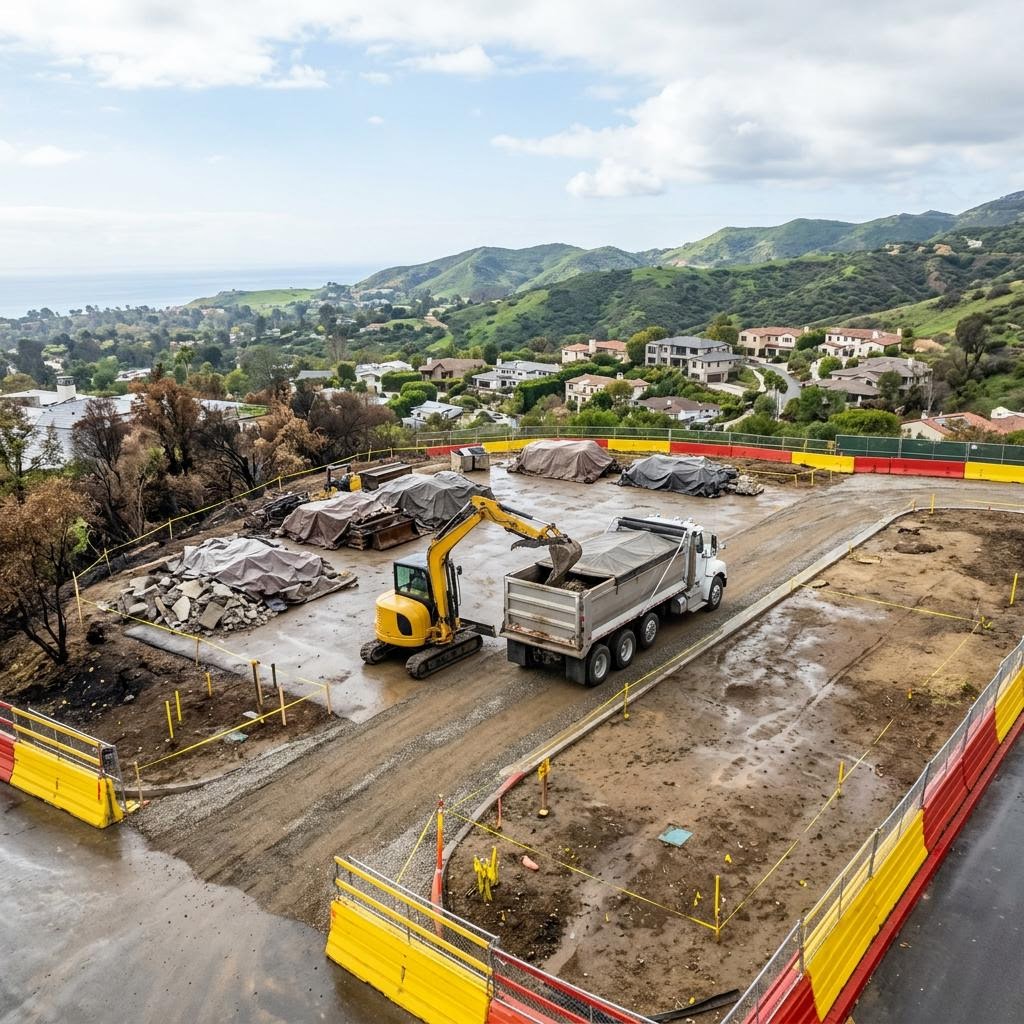
A rebuild permit starts with a documented, cleared lot. Whether your debris was removed through the 2025 public program or an approved private contractor, the cleanup record is what plan check, inspectors and lenders ask for next.
Ocean Permits & Development is a women-owned Los Angeles permit expediting firm. After the January 2025 Eaton and Palisades fires we have helped owners sort out which agency controls their parcel, which cleanup records exist, and which demolition, shoring, grading or utility permits still stand between a cleared pad and an issued rebuild permit. We coordinate paperwork and agency sequencing; licensed contractors, consultants and engineers perform the regulated field work.
This page explains how the 2025 debris removal programs worked, so you can reconcile your own file. Those programs were time-limited. As of October 2026, do not assume any public enrollment, right-of-entry or opt-out window is open; confirm current status with Los Angeles County Recovery or LADBS before relying on a program path.
Jurisdiction matters from the first call. Pacific Palisades parcels are in the City of Los Angeles and LADBS issues building and demolition permits there. Altadena is unincorporated Los Angeles County, so County Public Works and EPIC-LA records apply. Malibu, Pasadena and other cities run their own departments.
Phase 1 and Phase 2: how the 2025 cleanup was structured
Phase 1 was handled by the U.S. Environmental Protection Agency, which removed household hazardous materials such as batteries, propane cylinders, paints, pesticides and other chemicals from burned properties. Phase 1 was a federal activity and owners did not need to apply for it. Its completion was a prerequisite for Phase 2 debris work.
Phase 2 removed the remaining structural ash and debris. Owners chose one of two routes: the public program run by the U.S. Army Corps of Engineers through a Right of Entry form, or an approved private opt-out in which the owner hired a qualified contractor under County standards. Neither route was mandatory to the exclusion of the other, and many neighboring lots used different routes.
Under the County's published opt-out FAQ (revised February 13, 2025), a private opt-out required an approved opt-out application and an EPIC-LA Eaton/Palisades Fire Debris Removal permit. That FAQ stated there was no separate demolition permit within that program and no application fee in the published program. Those statements describe that 2025 program, not every later demolition or cleanup project.
- Public route: USACE Right of Entry, government-performed removal, no owner application fee in the 2025 program.
- Private route: approved opt-out application, EPIC-LA debris removal permit, owner-paid contractor, disposal and testing.
- Both routes: Phase 1 hazardous material removal by EPA first, then clearance documentation before rebuild.
What a private opt-out cleanup had to document
The County standard required removal of the ash footprint, generally including the upper six inches of soil within it, until the area was visually clean. Soil sampling and testing can be required where the visual result or the contractor's documentation is not sufficient to show the cleanup standard was met. Testing is a verification tool, not a universal requirement for every parcel.
Asbestos was handled separately. A California-certified asbestos consultant (CAC) prepares the asbestos survey report, and a licensed abatement contractor removes regulated material before general debris is hauled. The debris contractor needed the appropriate license with a hazardous substance removal (HAZ) certification, and loads had to go to approved disposal facilities with weight tickets and manifests retained.
We assemble these records into one clearance package: opt-out approval, EPIC-LA permit, asbestos report and abatement records, disposal tickets, photos, any sampling results and the County sign-off. Missing a single disposal ticket can stall a later inspection or financing draw.
LADBS demolition exemption inside the City of Los Angeles
LADBS Information Bulletin P/BC 2026-155 (formerly P/BC 2025-155), effective January 29, 2025, addresses demolition of structures damaged or destroyed by the January 2025 fires. Eligible damaged or destroyed structures may be exempt from a separate LADBS demolition permit if the owner completes the required prior online notification and the building footprint or pad slope is 20 percent or less.
Where the footprint or pad slope exceeds 20 percent, a demolition permit is required. Hillside lots in the Palisades often fall into this category, and a permit may bring geotechnical, shoring or erosion-control conditions with it. The exemption is narrow: it does not cover unrelated demolition, structures not damaged in the January 2025 fires, or partially damaged buildings the owner chooses to remove for other reasons without confirming eligibility.
Permits that cleanup does not replace
A cleared pad is not an approved site. Several separate scopes regularly appear between debris clearance and rebuild issuance, and each has its own reviewer and inspection.
For a damaged pool or underground cistern, establish whether the owner intends to retain, repair, partially abandon or completely remove the structure. Document its location, connections, condition and relationship to the proposed building pad before the contractor mobilizes. Ask the responsible City or County building official what demolition or abandonment documentation, engineered fill and compaction verification, and inspections apply to that specific scope; a debris completion record does not by itself approve a filled pool as a future foundation site.
Remaining pool chemicals and affected water need a disposal plan from the qualified environmental contractor, separate from the earthwork plans. Retaining a cistern for future firefighting also requires review of structural adequacy, water supply and the intended fire-protection design; it is not an automatic alternative to required access or other fire conditions. Coordinate these decisions with the geotechnical engineer, structural designer and relevant water or fire authority before ordering grading plans.
- Partial demolition of damaged-but-standing walls, chimneys or accessory structures outside the exemption criteria.
- Shoring and excavation where removal of foundations or slabs undermines adjacent property or slopes.
- Retaining walls and slope stabilization on hillside lots, often requiring engineered plans.
- Grading permits and erosion-control measures, particularly before rainy-season deadlines.
- Utility caps and abandonment: sewer cap, water service and gas meter coordination with LADWP, SoCalGas or the local provider.
- Pools and water cisterns: draining, fill, retention for fire use or demolition each follow a different path.
- Contaminated soil handling is an environmental matter; foundation and slope adequacy is a geotechnical engineering matter. One report does not substitute for the other.
Our process from burned lot to rebuild-ready
First we confirm jurisdiction by APN and pull the parcel's 2025 program status: Phase 1 completion, Right of Entry or opt-out records, and any County clearance letter. Next we compare the site against the LADBS exemption criteria or County requirements, identify remaining demolition, shoring, grading and utility scopes, and assign each to the right consultant.
We then file the remaining applications, maintain a single correction log, and assemble the cleanup documentation into the rebuild submittal so plan check sees a complete record. Throughout, you have one point of contact who answers at 213-277-8777.
Planning timeline and cost basis by path
These are nonbinding planning estimates based on typical project sequencing, not agency deadlines or guaranteed program availability.
| Step | Planning estimate | Cost basis |
|---|---|---|
| Phase 1 EPA hazardous material removal (2025) | Completed by agency schedule | Federal program; no owner application |
| Phase 2 public route via USACE (2025) | Several weeks to months, depending on queue | $0 owner application in the historical public program |
| Phase 2 approved private opt-out (2025) | Roughly 4 to 12+ weeks after approval | Contractor, asbestos, disposal and any testing quoted by scope; no application fee in the published program |
| Records reconciliation and clearance package | 1 to 4+ weeks | Expediting fee quoted per scope |
| LADBS demolition notification (slope 20% or less) | Days to a few weeks | Exemption path; confirm eligibility |
| Demolition permit (slope over 20%) with shoring or grading | 6 to 16+ weeks | LADBS fees per current schedule plus engineering and design |
| Rebuild plan check after clearance | Varies by scope | Per jurisdiction fee schedule |
Ranges are estimates only. Private contractor, disposal, testing, design and expediting costs are quoted for each property. We do not publish official prices or imply any 2025 program is currently accepting enrollment.
Frequently Asked Questions
Was Phase 2 debris removal only available through private contractors?
No. In 2025 owners could use the public U.S. Army Corps of Engineers program through a Right of Entry, or an approved private opt-out with a qualified contractor. The County published standards for the private route; it was an option, not the only path.
Can I still enroll in the public debris removal program in October 2026?
Do not assume so. The 2025 programs were time-limited. Confirm current status directly with Los Angeles County Recovery or LADBS before planning around any public program.
Did the County opt-out program require a demolition permit or application fee?
According to the County opt-out FAQ revised February 13, 2025, the program required an approved opt-out application and an EPIC-LA Eaton/Palisades Fire Debris Removal permit, with no separate demolition permit and no application fee in that published program. Contractor, disposal and testing costs were still owner-paid.
Is soil testing always required after ash removal?
No. The standard called for removing the ash footprint, generally the upper six inches of soil, to visually clean. Soil testing can be required where cleanup proof is insufficient, but it is not universally required.
Do I need an LADBS demolition permit for my fire-destroyed home?
Under LADBS Bulletin P/BC 2026-155, effective January 29, 2025, eligible structures damaged or destroyed in the January 2025 fires may be exempt with prior online notification if the footprint or pad slope is 20 percent or less. Over 20 percent, a permit is required. Other demolition is not covered.
Who handles asbestos before debris removal?
A California-certified asbestos consultant prepares the survey report and a licensed abatement contractor removes regulated material. The debris contractor should hold the proper license with HAZ certification and use approved disposal facilities.
Does Ocean Permits remove debris?
No. Ocean Permits coordinates permits, records and agency sequencing. Licensed contractors and consultants perform the field work. Call 213-277-8777 for a free initial consultation.
Relevant Ocean Permits Resources
Turn your cleanup file into a rebuild-ready record
Send us the address, your Phase 2 route and any clearance documents. We will identify what remains before your rebuild application.
Free Initial ConsultationCall 213-277-8777
Official references
Reviewed October 2026. Program descriptions are historical; confirm current requirements with the responsible authority.
Los Angeles County 2025 Wildfires Opt-Out Option FAQ (rev. February 13, 2025)
Los Angeles County Recovery: Phase 2 debris removal
LADBS Information Bulletin P/BC 2026-155: demolition of fire-damaged structures