_1781464136662-DVw5IPjt.png)
Quick Answer
Before a rebuild permit can be submitted for a Pacific Palisades or Altadena parcel destroyed in the January 2025 fires, the site has to complete debris removal and documented soil clearance. That happens through a two-phase government program — EPA household hazardous waste removal (Phase 1), then Army Corps of Engineers structural debris and soil removal (Phase 2) — authorized by a signed Right-of-Entry (ROE) form, or through an opt-out private contractor pathway that must meet the same clearance standard. LADBS and LA County will not issue a rebuild permit without documented clearance for that specific parcel.
For most Pacific Palisades and Altadena homeowners rebuilding after the January 2025 fires, the rebuild permit application isn't the first hurdle — debris removal is. Nothing about plan check, like-for-like eligibility, or fee waivers matters until the parcel itself has been cleared of fire-damaged structure debris, ash, and contaminated soil, and that clearance is documented.
Because this step runs through a federally coordinated program layered on top of local building departments, it's also one of the most confusing parts of the rebuild process for homeowners who have never dealt with a declared disaster before. This guide walks through how the two-phase government debris removal program works, what the private opt-out pathway involves, why building departments treat site clearance as a hard prerequisite rather than a parallel step, and how the timing interacts with your insurance claim and overall rebuild schedule.
This guide describes the debris removal process in general terms based on the framework typically used in federally supported wildfire disaster debris removal programs. Program specifics, current scheduling, and documentation requirements should always be confirmed directly with the coordinating agencies or your permit expediter for your specific parcel.
The Two-Phase Government Debris Removal Program
Following the January 2025 Palisades and Eaton Fires, debris removal across both fire footprints has generally proceeded in two distinct phases, run by two different federal agencies with two different scopes of work.
Phase 1 — EPA Household Hazardous Waste Removal
The U.S. Environmental Protection Agency removes materials that pose an immediate hazard if left in place — propane tanks, paints and solvents, pesticides, batteries (including lithium-ion systems from solar or EV equipment), compressed gas cylinders, and asbestos-containing material. This phase is performed on essentially every parcel in the disaster footprint, generally at no direct cost to the owner, and does not require a Right-of-Entry form since it's treated as an emergency public-health response rather than a property-specific election.
Phase 2 — USACE Structural Debris & Soil Removal
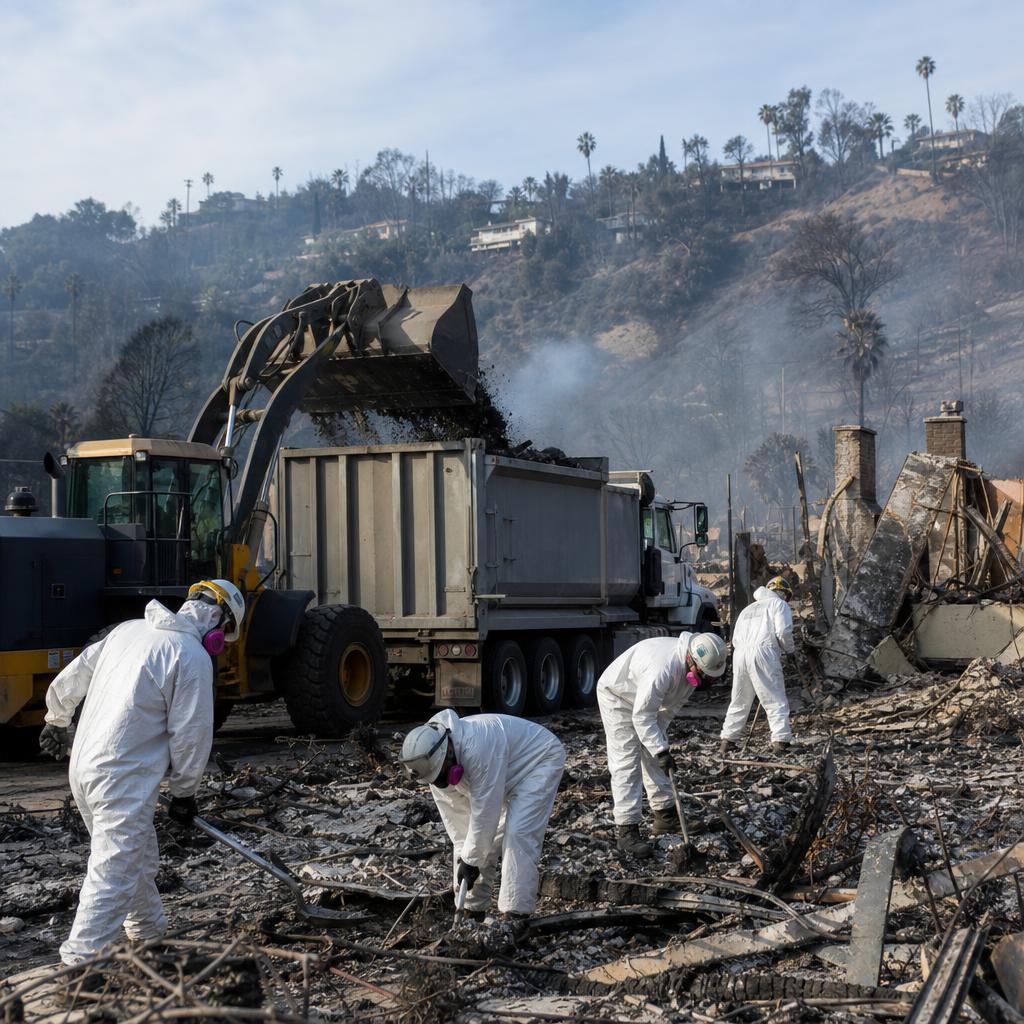
The U.S. Army Corps of Engineers, operating under a FEMA mission assignment and coordinating with LA County and the City of LA, removes fire-damaged structure debris, foundations, ash, and contaminated soil down to a specified depth. This is the phase that requires an owner-signed Right-of-Entry form, and it is generally performed at no direct cost to participating owners under the state and federal disaster assistance framework.
The Private Opt-Out Pathway
Instead of participating in the government-run Phase 2 program, an owner can hire their own state-licensed debris removal contractor. This route generally requires separately obtained local permits, a hazardous materials assessment, and disposal manifests documenting where debris was hauled — and the resulting site still generally has to meet the same soil-clearance standard before a rebuild permit will be issued.
The Right-of-Entry Form and the Opt-Out Decision
The Right-of-Entry (ROE) form is the legal authorization a property owner signs to allow USACE and its contractors onto the parcel to perform Phase 2 debris removal. It is a voluntary election, not a mandatory requirement — an owner who prefers to control the process directly can instead formally opt out and hire a private, licensed contractor to perform the equivalent work.
The decision carries real tradeoffs. The government program is generally offered at no direct cost to participating owners, with USACE selecting and managing its own contracted crews and carrying responsibility for the work and disposal while it's underway. The private opt-out pathway gives the owner direct control over contractor selection and scheduling, and may make sense where insurance debris-removal coverage is being used to fund the work — but it shifts the burden of obtaining permits, arranging a hazardous materials assessment, tracking disposal manifests, and standing behind the contractor's work onto the owner.
What owners should avoid is inaction: failing to sign an ROE and failing to formally register an opt-out within the program's window can leave a parcel unscheduled under either pathway, which stalls the rebuild timeline indefinitely without the owner necessarily realizing it until they try to submit a permit.
Government Program vs. Private Opt-Out — Side by Side
| Factor | Government Program (EPA / USACE) | Private Opt-Out |
|---|---|---|
| Direct cost to owner | Generally no direct cost to the participating owner under the state/federal disaster program | Owner pays contractor directly (may be offset by insurance debris-removal coverage) |
| Contractor selection | USACE selects and manages its own contracted crews | Owner selects and contracts directly with a state-licensed debris removal contractor |
| Authorization required | Right-of-Entry (ROE) form signed by the property owner | No ROE; owner executes a private contract and obtains local permits instead |
| Permits required | Handled under the federal mission assignment; owner generally does not separately permit the removal | Owner/contractor generally obtains local demolition/debris-removal permits directly |
| Hazmat assessment | Built into the coordinated EPA/USACE process | Owner typically arranges a separate hazardous materials assessment |
| Disposal documentation | Managed and tracked by USACE and its contractors | Owner/contractor responsible for waste disposal manifests to a licensed facility |
| Soil-clearance standard | Government program clears to the specified program standard | Generally must independently meet the same clearance standard before a rebuild permit is issued |
| Liability | Carried by the federal program and its contractors while on-site | Owner carries direct liability and responsibility for their contractor's work |
| Typical scheduling | Sequenced across the broader program's parcel queue | Owner controls scheduling directly, subject to contractor availability |
General guidance based on the typical structure of federally supported wildfire disaster debris removal programs. Confirm current terms for your specific parcel with the coordinating agencies before deciding. Not legal, financial, or insurance advice.
Why Soil Clearance Is a Hard Prerequisite for a Rebuild Permit
Fire debris and ash commonly contain contaminants — asbestos from older building materials, heavy metals, and other combustion byproducts — that can pose a health hazard if disturbed by excavation, grading, or foundation work before the site has been properly cleared. Both the City of Los Angeles and Los Angeles County require documented confirmation that a parcel has met the applicable soil-clearance standard before a rebuild building permit will be accepted or issued.
This is treated as a gate, not a parallel track: a rebuild application for a parcel without confirmed clearance is generally held regardless of how complete the architectural and structural plans are. That's precisely why homeowners benefit from using the debris-removal waiting period productively — finalizing the plan set, engaging a structural engineer, and preparing the full permit package — so the application is genuinely ready to submit the moment clearance clears for that specific parcel.
Confirming Your Parcel Is Cleared — and What It Means for Insurance and Timeline
Clearance is issued parcel-by-parcel, not as a single blanket determination for an entire fire area — so confirming that your specific address, not just the general neighborhood, has documented clearance is the practical step that matters. For government-program parcels, that documentation is generally tied to USACE's tracking and closeout process; for private opt-out parcels, it typically comes from the environmental contractor's soil clearance or closure report based on post-removal sampling.
Debris removal timing also intersects with your insurance claim. Most homeowners policies treat debris removal as a covered element of a total-loss fire claim, and how those proceeds are handled can depend on whether the government program (generally at no direct cost to the owner) or a privately paid contractor performed the work — a question worth working through directly with your insurance carrier or a public adjuster alongside, but separate from, the permitting process itself.
Because debris removal sits at the front of the timeline as a prerequisite, delays in scheduling or completing it push the entire rebuild's start date back correspondingly, and completion timing has varied parcel by parcel across both fire footprints based on access, hazard complexity, and program scheduling — it is not unusual for neighboring properties to clear at noticeably different times.
From Cleared Site to Rebuild Permit — Step by Step
Here is how debris removal and clearance feed into the rebuild permit process for both Pacific Palisades (City of LA) and Altadena (LA County) parcels.
- 01
Confirm Parcel Status and Program Enrollment
Determine whether your parcel has been enrolled in the government-run debris removal program, whether Phase 1 (EPA household hazardous waste removal) has been completed, and whether a Right-of-Entry (ROE) form has been signed or whether the owner has formally opted out in favor of a private contractor. This status should be confirmed for the specific parcel, not assumed from neighborhood-wide progress.
- 02
Decide: Government Program or Private Opt-Out
Weigh the government-run USACE Phase 2 pathway against the private opt-out pathway based on your circumstances — insurance coverage for debris removal, desired timeline control, and comfort managing a private contractor relationship, permits, and disposal manifests directly. This decision generally needs to be made within the program's registration window; failing to make an affirmative choice can leave a parcel unscheduled under either pathway.
- 03
Complete Phase 2 Structural and Soil Removal
Under the government program, USACE and its contractors remove fire-damaged structural debris, ash, and contaminated soil down to the specified depth. Under the private opt-out, the owner's licensed contractor performs equivalent work under separately obtained local permits, typically informed by a hazardous materials assessment of the site.
- 04
Obtain Documented Site Clearance
Secure written confirmation that your specific parcel — not just the general area — has met the applicable soil-clearance standard, whether that documentation comes through the government program's tracking and closeout process or through a private contractor's soil clearance/closure report from post-removal sampling.
- 05
Prepare the Rebuild Plan Set in Parallel
While debris removal and clearance are pending, use the waiting period to finalize architectural and structural drawings, coordinate Title 24 energy compliance, and assemble the rebuild permit package, so the application is genuinely ready to submit the moment clearance is confirmed rather than starting plan preparation only after the site clears.
- 06
Submit the Rebuild Permit Application
With documented clearance in hand, submit the rebuild application through the LADBS One-Stop Rebuild Center (City of LA / Pacific Palisades) or LA County's parallel rebuild program (unincorporated Altadena), attaching or referencing the parcel's clearance documentation as required by that jurisdiction's rebuild intake.
- 07
Coordinate Right-of-Way and Haul-Route Logistics
Where debris trucks, equipment staging, or temporary access affect the street or adjacent right-of-way, coordinate with LA County Public Works or the LA City Bureau of Sanitation on haul routes and any required right-of-way permits, so debris logistics don't create separate delays for the rebuild once permitting is underway.
- 08
Track Through to Plan Check and Issuance
Once submitted, the rebuild application proceeds through standard or streamlined plan check depending on like-for-like eligibility, with the debris-removal prerequisite already satisfied and off the critical path.
The State and Local Emergency Framework Behind This Program
The debris removal program following the January 2025 fires operates under the framework of the Governor of California's state of emergency proclamation covering the Palisades and Eaton Fires, together with local emergency declarations issued by the City of Los Angeles and Los Angeles County. That combined state and local emergency framework is what authorized the state and federal government to activate coordinated disaster debris removal assistance — bringing in EPA and USACE under FEMA coordination — at the scale needed across both fire footprints, rather than leaving debris removal solely to individual owners and private contractors as would typically be the case outside a declared disaster.
How Ocean Permits Helps With the Debris Removal Step
Ocean Permits & Development is a women-owned Los Angeles permit expediting firm, and fire rebuild coordination for Pacific Palisades and Altadena has been a specific focus of our practice since the January 2025 fires. We track your parcel's specific status through the government debris removal program — or, for opt-out projects, coordinate the private contractor's permits, hazardous materials assessment, and disposal manifests — and confirm when documented clearance has actually been issued for your address specifically, not just the surrounding area.
We also coordinate with LA County Public Works and the LA City Bureau of Sanitation on right-of-way and haul-route logistics where debris trucks or equipment staging affect the property or the surrounding street, and we use the debris-removal waiting period to get your rebuild plan set fully prepared, so your permit application is ready to submit the moment your parcel clears — timing your like-for-like rebuild permit submittal to start immediately rather than only beginning plan preparation after the site is already clear.
All initial consultations are free. Call +1 (213) 277-8777 or submit a project inquiry online.
Common Questions About Fire Debris Removal
What is Phase 1 of the government debris removal program?
Phase 1 is the household hazardous waste removal step, carried out by the U.S. Environmental Protection Agency (EPA) on every parcel in the disaster footprint regardless of whether the owner later opts into or out of the government-run structural debris removal that follows. EPA crews identify and remove materials that pose an immediate hazard if left in place or disturbed during later cleanup — items such as propane tanks, paints and solvents, pesticides, batteries (including lithium-ion battery systems from solar and EV setups), compressed gas cylinders, and asbestos-containing material. This phase is generally performed at no direct cost to the property owner and does not require the owner to sign a Right-of-Entry form, since it is treated as an emergency public-health response rather than a property-specific cleanup election.
What is Phase 2, and who runs it?
Phase 2 is the removal of fire-damaged structural debris, ash, foundations, and contaminated soil down to a specified depth. It is carried out by the U.S. Army Corps of Engineers (USACE) under a mission assignment issued through FEMA's disaster response authority, in coordination with Los Angeles County and the City of Los Angeles depending on where the parcel sits. For property owners who sign the Right-of-Entry (ROE) form authorizing USACE and its contractors onto the parcel, Phase 2 is generally performed at no direct cost to the participating owner under the state and federal disaster assistance program, consistent with how federally supported debris removal has been structured in prior California wildfire disasters.
What is the Right-of-Entry (ROE) form, and do I have to sign it?
The Right-of-Entry form is the legal authorization a property owner signs to allow the government-run Phase 2 debris removal program — USACE and its contractors — onto the parcel to remove structural debris, ash, and contaminated soil. Signing it is voluntary, not mandatory: an owner can instead opt out of the government program and hire a private, state-licensed debris removal contractor to perform the equivalent work. Owners who don't sign an ROE and don't formally opt out within the program's registration window risk their parcel simply not being scheduled for either pathway, which stalls the rebuild timeline indefinitely, so making an affirmative choice — one way or the other — matters more than which option is chosen.
What does the private opt-out pathway involve?
Opting out means declining the government-run USACE Phase 2 program and instead hiring your own state-licensed hazardous materials and debris removal contractor to clear the parcel. This route generally requires the owner to obtain separate local demolition/debris-removal permits, arrange a hazardous materials assessment of the site (since fire ash and debris can contain asbestos, heavy metals, and other regulated contaminants), and manage waste disposal manifests documenting that debris was hauled to an appropriately licensed disposal facility. Critically, an opt-out project is not exempt from the soil-clearance standard the government program applies — the parcel generally still has to demonstrate the same level of contaminant clearance before a rebuild permit will be issued, and the owner (rather than USACE) carries direct responsibility and liability for the contractor's work and disposal compliance.
Why won't LADBS or LA County issue a rebuild permit before debris removal is complete?
Fire debris and ash from a structure fire commonly contain contaminants — including asbestos from older building materials, heavy metals, and other combustion byproducts — that pose a health hazard if construction activity (excavation, grading, foundation work) disturbs contaminated soil before it has been properly cleared. Both the City of Los Angeles and Los Angeles County require confirmation that a parcel has met the applicable soil-clearance standard before accepting or issuing a rebuild building permit, treating debris and soil clearance as a prerequisite gate rather than a step that can run in parallel with plan check. This is why a rebuild application for a parcel without confirmed clearance is generally held rather than processed, regardless of how complete the building plans themselves are.
How do I get confirmation that my parcel has been cleared?
For parcels that went through the government-run program, USACE (or the coordinating county/city agency) documents completion of debris removal and, where applicable, confirmatory soil sampling, with the parcel's clearance status generally reflected in tracking tools and correspondence tied to the disaster recovery program. For opt-out parcels using a private contractor, the owner's hazardous materials consultant or environmental contractor typically issues a soil clearance or closure report based on post-removal sampling, which is then submitted to the applicable building department. In both cases, the practical step for a homeowner is confirming, in writing, that their specific parcel — not just the broader neighborhood — has documented clearance before assuming rebuild plan check can proceed, since clearance is issued parcel-by-parcel rather than as a single blanket determination for an entire fire area.
How does debris removal timing affect my rebuild timeline?
Debris removal sits at the front of the rebuild timeline as a prerequisite, not a parallel track — a rebuild permit application generally cannot move through plan check until the parcel's clearance is documented, so delays in scheduling or completing debris removal push the entire project's start date back by the same amount. Because Phase 1 and Phase 2 have been sequenced across many thousands of parcels in the Palisades and Eaton Fire footprints, completion timing varies parcel by parcel based on factors like access, hazard complexity, and program scheduling, and it is not unusual for neighboring properties to clear at noticeably different times. Homeowners who want to compress their overall timeline often use the debris-removal waiting period productively — finalizing architectural plans, engaging a structural engineer, and preparing the rebuild plan set — so the permit application is genuinely ready to submit the moment clearance is confirmed.
How does debris removal interact with my homeowners insurance claim?
Most homeowners insurance policies include debris removal as a covered element of a total-loss fire claim, and policy proceeds allocated to debris removal can factor into whether and how a homeowner chooses to opt out of the government-run program in favor of a private contractor. Because the government-run program has generally been offered at no direct cost to participating owners, some owners coordinate with their insurer regarding how debris-removal coverage funds are treated when the government program — rather than a privately paid contractor — performs the work. This is a claims and policy-interpretation question that should be worked through directly with the insurance carrier or a public adjuster; it sits alongside, but separate from, the permitting and site-clearance process itself.
What state and local declarations authorized this debris removal program?
The debris removal program following the January 2025 Palisades and Eaton Fires operates under the framework of the Governor of California's state of emergency proclamation covering the fires, together with local emergency declarations issued by the City of Los Angeles and Los Angeles County, which together enabled the state and federal government to activate coordinated disaster debris removal assistance. This state and local emergency framework is what allowed EPA and USACE to be brought in under FEMA coordination to perform Phase 1 and Phase 2 debris removal at the scale required across both fire footprints, rather than leaving debris removal solely to individual property owners and private contractors as would typically be the case outside a declared disaster.
Does debris removal apply the same way in Pacific Palisades (City of LA) and Altadena (LA County)?
The Phase 1 (EPA) and Phase 2 (USACE) debris removal framework applies across both fire footprints, but Phase 2 coordination runs through the jurisdiction the parcel sits in — the City of Los Angeles for most of Pacific Palisades, and Los Angeles County for unincorporated Altadena — which affects local right-of-way coordination, haul-route logistics, and which building department ultimately confirms clearance for rebuild permitting purposes. A property owner or their permit expediter should confirm which jurisdiction's rebuild program and clearance-documentation requirements apply to their specific parcel rather than assuming the Palisades and Altadena processes are administratively identical, even though the underlying federal debris removal program is the same.
Can construction or site work start before debris removal is finished?
Generally, no. Because debris removal includes clearing contaminated soil down to a specified depth, disturbing the site with excavation, grading, or foundation work before that clearance is confirmed risks re-exposing or spreading contaminants the removal program was specifically designed to address, and building departments generally will not authorize a rebuild permit — the trigger for legal site work — until clearance is documented. Site-adjacent activities that don't disturb the ground, such as finalizing architectural and structural drawings, ordering long-lead materials, and securing a contractor, can and often should proceed during the debris-removal wait so the project is ready to submit and build as soon as clearance and permit issuance allow.
How does a permit expediter help with the debris removal step?
A permit expediter tracks your parcel's specific status through the government debris removal program (or, for opt-out projects, coordinates the private contractor's permits, hazardous materials assessment, and disposal manifests), confirms when clearance documentation has actually been issued for your parcel specifically, and coordinates with LA County Public Works and the LA City Bureau of Sanitation on right-of-way and haul-route logistics where debris trucks and equipment access affects the property or surrounding street conditions. Most importantly, an expediter uses the debris-removal waiting period to get your rebuild plan set fully prepared and submission-ready, so the permit application goes in the moment clearance is confirmed rather than only starting that preparation after the site is already clear — which is often the single largest avoidable delay in a fire rebuild timeline.