_1781464136662-DVw5IPjt.png)
Quick Answer
Almost every demolition, and many renovations, in the Los Angeles area need a certified asbestos survey and a written notification to SCAQMD under Rule 1403 before work begins—separate from, and in addition to, the building department's demolition permit. Fire-damaged structures can follow a coordinated emergency program, but that should be confirmed directly with SCAQMD rather than assumed.
Demolition permits get most of the attention in a rebuild or teardown project, but a separate, equally mandatory process runs alongside it: confirming whether asbestos-containing material is present and notifying the South Coast Air Quality Management District before demolition or a qualifying renovation begins. Skipping or misunderstanding this step is one of the more consequential mistakes a property owner can make, both because it carries real health risk and because it can stall permit closeout.
This guide explains how SCAQMD Rule 1403 works, how it relates to the federal asbestos NESHAP and Cal/OSHA worker-protection rules, and how fire-damaged structures in events like the Palisades and Eaton fires are typically approached. Regulatory programs, thresholds, and emergency provisions can be updated, so always confirm the current requirement with SCAQMD, the applicable building department, or the responsible program office before scheduling demolition.
What SCAQMD Rule 1403 Actually Requires
Rule 1403 is the South Coast Air Quality Management District's regional rule addressing asbestos emissions from demolition and renovation activities across the greater Los Angeles air basin. At its core, it requires three things in sequence: a survey by a qualified asbestos inspector to identify suspect asbestos-containing material before disturbance, written notification to SCAQMD before demolition or a qualifying renovation begins, and specific work practices—removal by a licensed abatement contractor, wetting, containment, and proper disposal—if asbestos-containing material is found in an area that will be disturbed.
Rule 1403 implements, at the regional level, the federal asbestos NESHAP found at 40 CFR Part 61 Subpart M, which sets the baseline national framework for the same survey, notification, and work-practice concepts. Because Rule 1403 can include additional or more specific local requirements, both the federal and regional rules are relevant, and a compliant project needs to satisfy Rule 1403's current forms and timelines rather than relying only on a general NESHAP summary.
The Survey: Why It Comes Before Anything Else
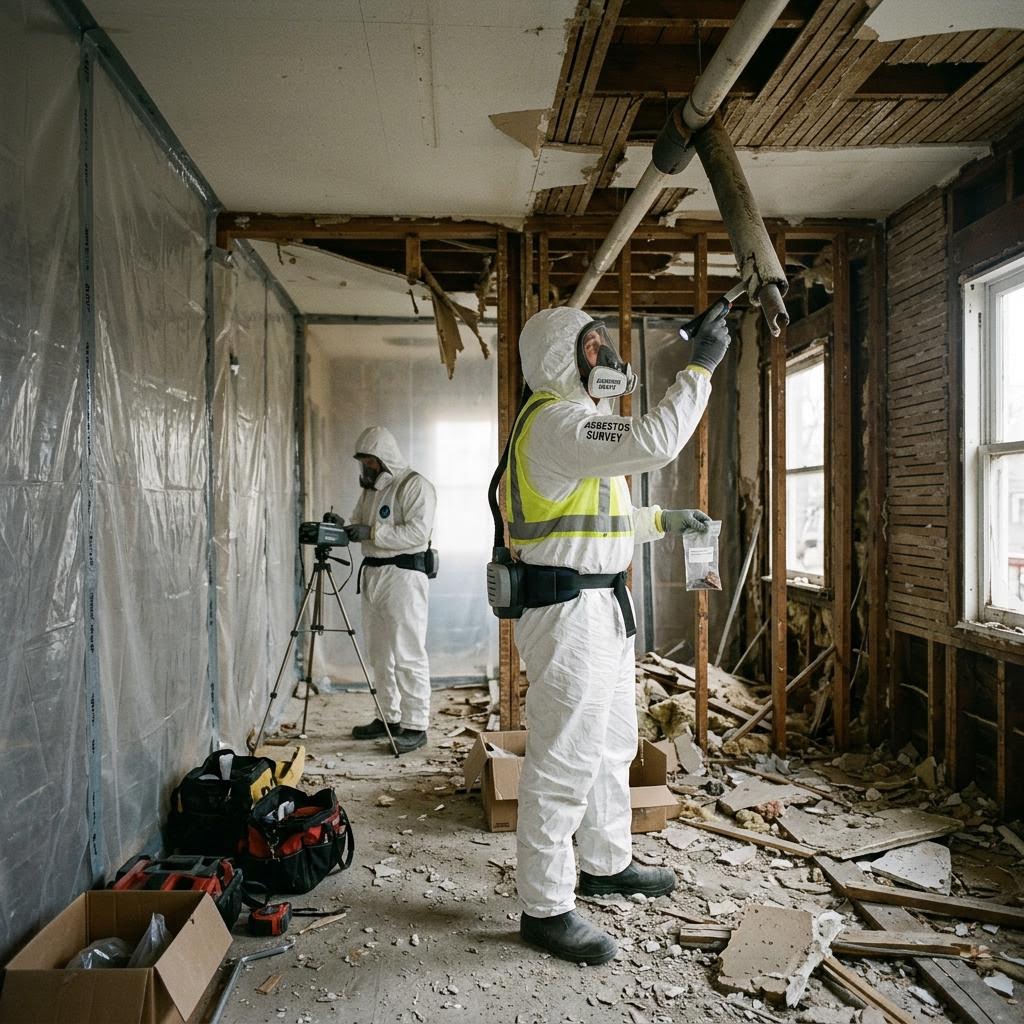
Before a demolition or qualifying renovation permit application is finalized, a certified asbestos inspector should survey the structure and any accessory materials that will be disturbed—flooring, pipe insulation, roofing, stucco, drywall joint compound, popcorn ceiling texture, and similar materials are common places asbestos historically turns up in homes built or remodeled before the 1980s. Suspect materials are sampled and analyzed by an accredited laboratory, and the results are documented in a survey report that becomes the basis for both the SCAQMD notification and any abatement scope.
This survey is not optional paperwork; it is the mechanism that determines whether abatement is required at all. A property owner who skips the survey and proceeds directly to demolition has no documented basis for asserting that no asbestos-containing material was present, which exposes both the owner and the demolition contractor to real regulatory and liability risk if material turns out to have been disturbed without controls.
Coordinating the survey early is especially important for projects already moving quickly, such as many fire-rebuild projects, since the survey needs to happen, and any abatement completed, before the demolition permit can typically be finalized and physical demolition can begin.
Notification Timing and Interaction With the Demolition Permit
Rule 1403 has historically required a set number of working days of written notice to SCAQMD before demolition or a qualifying renovation begins, with narrow exceptions such as an emergency order to demolish an unsafe structure. Because notification thresholds, forms, and lead times are subject to change, the current requirement should be confirmed directly with SCAQMD before a demolition date is set—not assumed from a prior project, a general online summary, or a neighbor's experience.
Many building departments, including LADBS and county building and safety divisions, coordinate demolition permit issuance or finalization with proof that the required survey and SCAQMD notification are on file, consistent with the demolition permit framework under LAMC Section 91.8000 et seq. That means the asbestos process and the demolition permit process need to be tracked together on the same project schedule, with a clear understanding of which document has to exist before the other agency will move forward. On a fire-rebuild lot, this schedule often runs alongside a separate FEMA 50% Rule determination, so both should be tracked on the same timeline rather than treated as sequential.
A renovation that stops short of full demolition is not automatically exempt. If the scope disturbs a regulated quantity of asbestos-containing material—a kitchen or bathroom remodel that removes old flooring or textured ceilings, for example—the same survey and notification questions apply, even though no structure is coming down. Confirm the applicable threshold for the specific scope before removal work starts.
Survey and Notification by Project Type
| Project scope | Survey expectation | Notification | Notes |
|---|---|---|---|
| Single-family home, full demolition | Certified asbestos survey required before demolition | Written notification to SCAQMD, generally required in advance of demolition | Timing and required lead time should be confirmed directly with SCAQMD for the current filing. |
| Renovation disturbing a regulated quantity of material | Survey of the specific area to be disturbed | Notification threshold depends on quantity and material type | Small cosmetic work may fall under different thresholds than a gut renovation; confirm before disturbing suspect material. |
| Fire-damaged residential structure (e.g., Palisades, Altadena) | Survey still expected, though sequencing may follow an emergency debris-removal program | Coordinated through the applicable emergency program and/or standard SCAQMD notification | Confirm current program status directly with SCAQMD, CalRecycle, or the responsible agency for the specific fire event. |
| Commercial or multifamily demolition | Comprehensive survey typically required, often more extensive scope | Standard SCAQMD Rule 1403 notification process | Larger buildings often have multiple ACM types requiring separate abatement scopes. |
General orientation only, not a legal determination or a substitute for SCAQMD's current rule text and forms. Confirm requirements directly with SCAQMD, the applicable building department, and any active emergency program before scheduling demolition.
Typical Timeline by Project Type
Actual timelines depend on whether asbestos-containing material is found and how it interacts with the broader demolition schedule, including any FEMA 50% Rule determination running on the same rebuild lot.
| Project type | Survey & lab timeline | Notification timing | Notes |
|---|---|---|---|
| Single-family home, no ACM found | Survey and lab results often turn around within about a week | Standard SCAQMD notification lead time applies once survey is clean | Demolition permit finalization can often proceed on the standard project timeline. |
| Single-family home, ACM identified | Survey timeline similar, but abatement scheduling adds time before notification can be filed | Notification typically follows abatement completion and clearance documentation | Abatement contractor availability is often the longer pole in the timeline, not the survey itself. |
| Fire-damaged structure under an emergency program | Sequencing may follow the program's own schedule rather than a standalone survey timeline | Coordinated through the applicable emergency program | Confirm current program timing directly with SCAQMD or the responsible program office. |
| Commercial or multifamily demolition | Larger scope often takes longer due to multiple building areas and ACM types | Standard Rule 1403 lead time applies, but larger abatement scopes extend overall schedule | We build extra schedule buffer into commercial demolition timelines for this reason. |
General orientation only, not a quoted timeline. We confirm current survey, lab, and SCAQMD scheduling for your specific project during a free consultation.
Fire-Damaged Structures: Palisades, Altadena, and Emergency Debris Programs
Large wildfire events that destroy many structures at once, such as the fires affecting Pacific Palisades and Altadena, have in some cases been addressed through coordinated emergency debris-removal programs involving federal agencies, the state, and county government. These programs can modify the typical sequencing of survey, notification, and removal for severely fire-damaged structures, sometimes handling hazardous-material assessment and removal at a program level rather than through each individual owner's standard Rule 1403 filing.
Because these programs are specific to a given fire event, evolve as they proceed, and can have eligibility and timing rules distinct from the standard Rule 1403 process, property owners rebuilding after a major fire should confirm the current status directly with SCAQMD, the county, or the responsible program office rather than assuming either the standard process or a prior fire event's program applies unchanged. This is an area where relying on general online guidance—including this article—without a current confirmation is a genuine risk.
Once a fire-damaged lot is cleared and rebuilding begins, standard survey and notification obligations for any remaining renovation or new demolition on the site typically resume, which is why we track this alongside our broader fire debris removal guidance for rebuild clients.
Cal/OSHA Worker Protection: A Parallel, Not a Substitute
SCAQMD Rule 1403 focuses on air-quality protection—keeping asbestos fibers out of the surrounding air during demolition and renovation. California's Division of Occupational Safety and Health, under Title 8 of the California Code of Regulations, Section 1529, separately regulates worker exposure to asbestos during construction-related work, covering exposure monitoring, respiratory protection, protective clothing, decontamination procedures, and recordkeeping for workers performing abatement or disturbing asbestos-containing material.
A licensed abatement contractor needs to satisfy both frameworks simultaneously; complying with Cal/OSHA's worker-safety rules does not substitute for SCAQMD's survey and notification requirements, and vice versa. Property owners do not typically manage Cal/OSHA compliance directly, but confirming that the retained abatement contractor holds current licensing and follows both sets of requirements is a reasonable and important diligence step before work begins.
Sequencing Survey, Abatement, and Permit Issuance
A workable sequence looks like this: retain a certified asbestos consultant to survey the structure as soon as demolition or a significant renovation is being planned; if asbestos-containing material is found in an area to be disturbed, retain a licensed abatement contractor to remove it and obtain clearance documentation; file the SCAQMD Rule 1403 notification with the required lead time before demolition; and provide the resulting documentation to the building department alongside the demolition permit application or finalization request.
Ocean Permits & Development coordinates this sequence—tracking the survey, any abatement, the SCAQMD notification, and the demolition permit so the project does not stall waiting on a document that was never requested. Ocean Permits is a women-owned Los Angeles permit-expediting firm with particular experience in Pacific Palisades and Altadena fire-rebuild sequencing. For a free consultation, call 213-277-8777 before scheduling demolition.
Common Questions About Asbestos Surveys and Rule 1403
What is SCAQMD Rule 1403?
South Coast Air Quality Management District Rule 1403 is the regional rule governing asbestos emissions from demolition and renovation activities in the greater Los Angeles air basin. It requires an asbestos survey by a qualified inspector before most demolition or renovation work, proper notification to SCAQMD before the activity begins, and specific work practices and disposal requirements when asbestos-containing material is present. It implements, at the regional level, the federal NESHAP asbestos program.
How is Rule 1403 related to federal NESHAP rules?
The National Emission Standards for Hazardous Air Pollutants, at 40 CFR Part 61 Subpart M, is the federal asbestos NESHAP that establishes baseline survey, notification, and work-practice requirements for demolition and renovation nationwide. SCAQMD Rule 1403 is the local implementing rule for the South Coast air basin, and it can include additional or more specific requirements layered on top of the federal framework. Both should be treated as applicable, not as alternatives to choose between.
Who is qualified to perform the asbestos survey?
Surveys are generally performed by a qualified or certified asbestos inspector, often referred to in California as a Certified Asbestos Consultant (CAC) or a comparably qualified professional, depending on the project and current state certification requirements. The surveyor identifies suspect asbestos-containing materials, has samples analyzed by an accredited laboratory, and documents findings in a survey report that supports the demolition or renovation notification.
How much advance notice does SCAQMD require before demolition?
Rule 1403 has historically required written notification to SCAQMD a set number of working days before demolition or a qualifying renovation begins, with limited exceptions for emergencies such as an order to demolish an unsafe structure. Because notification timing, thresholds, and forms can be updated, the current lead-time requirement should be confirmed directly with SCAQMD before a demolition date is scheduled, rather than relied upon from a prior project or an outdated summary.
Does a small renovation need an asbestos survey too?
Potentially, yes. Rule 1403 and the federal NESHAP framework are not limited to full demolitions; renovations that disturb a regulated quantity of asbestos-containing material can trigger survey and notification obligations even when no building is being torn down. A kitchen or bathroom remodel that disturbs old flooring, popcorn ceiling texture, or pipe insulation is a common example where the question needs to be asked before demolition or removal work starts, not after.
What happens if asbestos-containing material is found?
If the survey identifies asbestos-containing material in an area that will be disturbed, it generally must be abated by a licensed asbestos abatement contractor, following applicable removal, containment, and disposal procedures, before the demolition or renovation work proceeds in that area. The abatement contractor typically provides clearance documentation once the work is complete, which supports both the SCAQMD file and, often, the local building department's demolition permit process.
Does Cal/OSHA also regulate asbestos work?
Yes. California's Division of Occupational Safety and Health regulates worker exposure to asbestos under Title 8 of the California Code of Regulations, including Section 1529 for construction-related asbestos work. These worker-safety requirements—covering exposure monitoring, respiratory protection, protective clothing, and decontamination procedures—operate alongside SCAQMD's air-quality-focused Rule 1403 requirements rather than replacing them; a compliant abatement contractor needs to satisfy both frameworks.
How are fire-damaged structures handled, such as after the Palisades and Eaton fires?
Large-scale fire events have in some cases been handled through coordinated emergency debris-removal programs involving federal, state, and local agencies, which can modify the typical sequencing of survey, notification, and removal for severely fire-damaged structures. Because these programs are event-specific and can change as they proceed, property owners rebuilding after a major fire should confirm the current process directly with SCAQMD, the county, or the responsible program office rather than assuming the standard Rule 1403 timeline applies unchanged.
Will LADBS or the county issue a demolition permit without proof of the asbestos notification?
Many building departments coordinate demolition permit issuance or finalization with proof of the required asbestos survey and SCAQMD notification, precisely because the two processes are meant to work together rather than separately. Do not assume a demolition permit can be finalized, or that demolition can legally proceed, without confirming what documentation the specific building department and SCAQMD require to be on file first.
What are the risks of skipping the survey or notification?
Demolishing or renovating without a required survey or notification exposes a property owner and contractor to potential SCAQMD enforcement action, and it can also create genuine health risks for workers and neighbors if asbestos-containing material is disturbed without proper controls. It can additionally complicate or delay permit closeout if a building department later asks for documentation that was never generated. Confirming the requirement before demolition begins is far less costly than addressing it after the fact.
Can Ocean Permits arrange the asbestos survey and file the SCAQMD notification?
Ocean Permits & Development coordinates the timeline between the certified asbestos survey, any required abatement, the SCAQMD notification, and the demolition or building permit so the pieces move in the right order. We do not perform the survey or abatement ourselves; that work is done by a certified asbestos consultant and a licensed abatement contractor. Ocean Permits is a women-owned Los Angeles permit-expediting firm, and consultations are free at 213-277-8777.
What does LAMC say about demolition permits and hazardous material documentation?
Los Angeles Municipal Code Section 91.8000 et seq. governs demolition permits within the City, and LADBS practice generally coordinates demolition permit finalization with proof that required hazardous-material surveys and clearances—including the SCAQMD Rule 1403 survey and notification—are on file. Confirm the current documentation LADBS requires for your specific demolition permit, since practices can be updated.
How does the FEMA 50% Rule interact with asbestos survey requirements on a rebuild?
The FEMA 50% Rule, which determines whether storm or fire damage triggers a substantial-improvement standard for a rebuild, is a separate determination from the asbestos survey and notification requirement—a structure can trigger both, either, or neither depending on its condition and the scope of work. See our FEMA 50% Rule guide for how that determination is made, since it often runs on a parallel track alongside the Rule 1403 process on the same rebuild lot.
Does asbestos survey and abatement affect a project's overall cost?
Yes, and the range varies significantly by structure size, age, and how much suspect material is identified during the survey—a small single-family survey with no material found costs far less than a project requiring full abatement of multiple ACM types. We provide a project-specific estimate range once the survey scope and any abatement need are known, rather than a generic figure that doesn't reflect the specific structure.