_1781464136662.png)
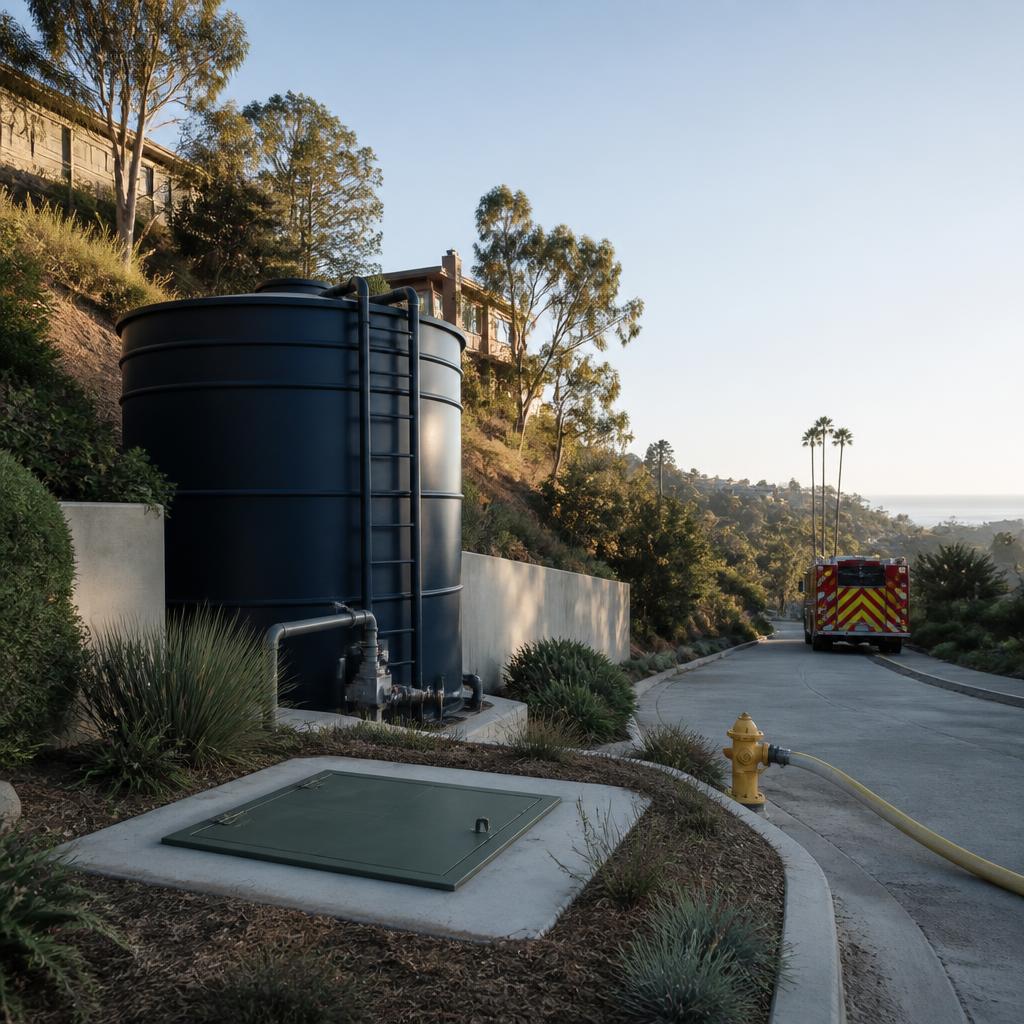
When hillside water pressure or fire flow is inadequate, a Pacific Palisades or Altadena rebuild may need a private fire-water tank, cistern, private hydrant, or other approved water supply. This guide explains LAFD and LA County Fire review, NFPA 1142, sizing, access, permits, costs, inspections, and maintenance.
A fire-rebuild plan can be code-compliant and still be unable to move forward if the site does not have an accepted water supply for firefighting. That problem is common on steep roads, canyon parcels, and high-elevation neighborhoods where hydrants are far away, lines are undersized, elevation reduces pressure, or the public system cannot deliver the required fire flow at the property. After the Pacific Palisades and Eaton fires, owners are also discovering that a rebuilt home may need a different fire-water strategy than the structure that stood there before.
The solution may be a private water tank, an underground cistern, a dedicated fire reserve, a private hydrant, a standpipe, a fire-department connection, a pump, or a combination of those elements. It is not one universal “fire tank permit.” The responsible fire authority must accept the water-supply design, while LADBS or Los Angeles County Building and Safety reviews the permanent construction. This guide separates those roles and explains how to coordinate them before ordering equipment or pouring a foundation.
Local fire-rebuild experience: Ocean Permits & Development is a women-owned Los Angeles permit expediting firm offering free consultations for complex rebuilds. We specialize in coordinating Pacific Palisades and Altadena projects across fire, building, grading, utility, and site approvals. Call 213-277-8777 or send the address and any LAFD or County correction notice before the water-supply design is finalized.
When a fire authority requires stored water
LAFD or LA County Fire can require an alternative or supplemental water source when the public system does not satisfy the fire-protection conditions for a proposed project. The trigger is not simply that a parcel is in a Very High Fire Hazard Severity Zone (VHFHSZ). VHFHSZ designation increases wildfire exposure and can bring additional fire-safety review, but the water-supply decision is still based on the particular parcel, building, road, hydrants, flow test, access, and adopted fire code.
Common triggers include an inadequate hydrant flow test, low static or residual pressure, a long or narrow apparatus route, a dead-end road, a private driveway that cannot support fire apparatus, a remote hillside location, a new or enlarged home, a sprinkler or standpipe demand, or a public system that is not yet restored after a wildfire. A like-for-like rebuild may benefit from an expedited review path, but that does not guarantee that a life-safety water-supply deficiency is waived.
Ask the fire reviewer to state the required flow, duration, usable storage volume, connection type, refill assumptions, access dimensions, and testing conditions in writing. “Install a tank” is not enough information to select a system. The design must answer how firefighters obtain water when power is out, a pump fails, a road is blocked, or the tank is partially full.
The four systems people call a “fire cistern”
Dedicated storage tank
An above-ground steel, fiberglass, or other approved tank holding water reserved or allocated for firefighting. It may connect to a pump, private hydrant, fire-department connection, or suction point.
Underground cistern
A buried concrete or prefabricated vault that preserves usable site area but adds excavation, waterproofing, structural, drainage, access, and maintenance requirements.
Private hydrant or standpipe
A fixed outlet and piping network near the structure or apparatus position. It is a delivery point, not automatically a water source; the tank, pump, or public main must be adequate.
Dry suction connection
A connection that lets a fire apparatus draft from a tank or cistern. It needs the correct location, diameter, fittings, signage, protection from vehicles, and unobstructed apparatus access accepted by the fire authority.
The distinction affects the permit set. A private standpipe can be useful for a building, while a suction cistern may be intended for a pumper or water tender. A tank can satisfy storage but fail the project if the apparatus cannot reach the connection. A domestic pressure tank can serve plumbing equipment but cannot be counted as a fire reserve unless the responsible fire authority accepts the entire arrangement.
NFPA 1142, the Los Angeles Fire Code, and local approval
NFPA 1142, Standard on Water Supplies for Suburban and Rural Fire Fighting, is a key reference for evaluating water supplies where municipal infrastructure is limited. It addresses the planning and performance of water sources, access, connections, and related firefighting considerations. It does not replace the adopted Los Angeles Fire Code, City amendments, County requirements, LAFD policy, or a project-specific fire-flow determination.
In the City, the LAFD Fire Prevention Bureau reviews fire-protection conditions under the Los Angeles Fire Code and applicable California Fire Code provisions. Depending on the system, the Materials and Devices Unit may review equipment, tanks, fittings, valves, pumps, or other materials and devices. A listed product and a manufacturer’s cut sheet are not the same as project approval; the submittal must show that the equipment works in the proposed location and configuration.
For an unincorporated County site, the Los Angeles County Fire Department and the County building authority apply their own adopted code and review path. A Pacific Palisades property in the City and an Altadena property outside the City can have different forms, reviewers, connection details, inspection sequences, and fee structures. Confirm jurisdiction at the address level before relying on a City standard.
How much storage is typical?
Hillside and wildland-urban interface projects commonly discuss storage in the tens of thousands of gallons, but there is no safe universal number. Required capacity can be based on the fire-flow rate multiplied by the required duration, plus sprinkler, standpipe, exposure, or other demands. The authority may count only usable water above an intake level, require a reserve below a domestic draw, or require a refill and testing plan. The table below is a planning range, not an approval schedule.
Costs can rise quickly when a tank is on a steep slope or far from the road. Excavation, crane access, a structural pad, retaining walls, geotechnical work, electrical service, a standby generator, a fire pump, private hydrant piping, fencing, bollards, landscape screening, traffic control, and road restoration may exceed the tank itself. Get a coordinated design and a contractor estimate after the fire authority identifies the required performance.
Apparatus access, signage, and connections
A full cistern that a fire truck cannot reach is not a dependable fire-water supply. The site plan should show the apparatus route, turning or backing condition, grades, clear width, overhead clearance, load capacity, gate operation, and all-weather surface. The tank connection should be visible, protected from impact, and placed where crews can connect without moving vehicles, stored materials, landscape, or fences.
Expect the fire reviewer to ask for durable signs identifying the tank, usable capacity, connection type, valves, pump controls, and any “no parking” or access restriction. A private hydrant may need bollards or a protected setback. A dry suction connection needs compatible fittings and a direct route to the tank. A fire-department connection needs clear labeling and enough working space for hose operations. The exact sign, fitting, and clearance detail is determined by the fire authority and adopted code.
Show these details in the architectural, civil, plumbing, and fire plans instead of relying on a vendor sketch. The reviewer must be able to locate the water supply from the street and understand how it works during a power outage or emergency response. Keep the access route clear after construction; final inspection can fail because a permitted connection is blocked by a gate, parked car, or permanent landscaping.
Hillside placement, foundation, and seismic design
Water weighs about 8.34 pounds per gallon before the tank, pad, piping, and equipment are counted. A 25,000-gallon tank therefore creates a major permanent load on the hillside. A geotechnical engineer should evaluate the slope, bearing conditions, settlement, drainage, and the effect of excavation. A structural engineer should design the foundation, slab, ring wall, anchorage, restraint, connections, and seismic resistance for the actual tank and site.
Above-ground tanks can require a level pad, cut-and-fill limits, retaining or shoring, erosion control, overflow routing, and protection from falling rock or vehicles. Underground cisterns can reduce visual impact but create their own excavation and waterproofing risk. A tank near a driveway may simplify apparatus access but conflict with a slope, utility, setback, or fire-truck turning area. A tank lower on the property may have better access but require a pump and longer piping.
Coordinate this decision with the hillside team early. Our hillside grading and retaining-wall guide explains why grading, walls, drainage, geotechnical reports, and building permits are separate but connected reviews. A tank should not be added to a finished plan as an afterthought.
The real approval process: fire plus building
Fire authority
LAFD Fire Prevention Bureau or LA County Fire confirms the required water supply, fire flow, connection, apparatus access, signage, and inspection conditions.
Building and structural
LADBS or County Building and Safety reviews the tank, foundation, anchorage, seismic design, plumbing, electrical, grading, and permanent installation.
Site and hillside
Planning, Public Works, grading, geotechnical, drainage, coastal, and utility approvals may apply based on the tank location and construction access.
Operation and maintenance
The owner must keep the required volume available, maintain valves and pumps, protect access, test the system, and preserve inspection records.
- 01
Confirm the jurisdiction and deficiency
Get the hydrant flow result, fire-flow requirement, VHFHSZ condition, apparatus-access issue, and reviewer contact. Determine whether LAFD or LA County Fire controls the fire decision.
- 02
Select the water-supply strategy
Compare a tank, cistern, private hydrant, suction connection, pump, standpipe, or combination based on the accepted performance requirement—not on a vendor’s standard package.
- 03
Coordinate civil, geotechnical, and structural design
Locate the tank and access route, engineer the pad or vault, show grading and drainage, and design seismic anchorage and piping supports.
- 04
Submit fire plans and equipment information
Include calculations, tank data, usable capacity, fittings, pump curves, controls, signage, access, protection, and maintenance provisions for LAFD Fire Prevention Bureau or County Fire review.
- 05
Submit building and trade permits
LADBS or County Building and Safety may require structural, plumbing, electrical, mechanical, grading, foundation, and related permits for the permanent installation.
- 06
Build, inspect, test, and close out
Coordinate foundation, tank, piping, pump, pressure or flow tests, fire inspection, plumbing inspection, final access, signage, and owner maintenance documentation.
Inspections and long-term maintenance
The permit is not finished when the tank arrives. Inspectors may need to see the foundation reinforcement or forms, anchorage, tank placement, underground piping, pressure testing, pump installation, electrical controls, backflow protection, and fire-department connection. Keep the fire plans on site and do not cover work that requires a scheduled inspection. The fire authority may require a final flow or operational test before the rebuild can reach final approval or occupancy.
The owner also inherits an operating obligation. Maintain the required water level, protect the tank from corrosion and damage, exercise valves, test pumps and alarms, inspect suction screens, keep the apparatus route open, replace faded signs, control vegetation, and document each service visit. If a domestic or irrigation use shares the tank, install controls that preserve the fire reserve accepted by the authority.
Add the tank to the property’s emergency information. A future owner, landscape contractor, fire inspector, or rebuild team should know the capacity, shutoffs, refill method, testing schedule, connection location, and required clear zone. An abandoned or empty cistern can become a safety liability even if it was once approved.
How this connects to the rest of a fire rebuild
A water tank is one layer in a larger fire-rebuild package. It does not replace residential sprinklers, ignition-resistant construction, defensible space, debris clearance, emergency access, or utility coordination. Review our NFPA 13D sprinkler permit guide for the difference between a building sprinkler demand and an exterior fire-water supply. Our VHFHSZ building-code guide and Chapter 7A construction guide cover ignition-resistant materials and fire-zone plan check.
For owners in Pacific Palisades, start with our Pacific Palisades permitting resources and fire-rebuild overview. For an Altadena parcel, use our Altadena permitting resources and confirm whether the property is in the City, unincorporated County, or another service area. Jurisdiction changes the reviewer and the forms.
The earlier the water-supply deficiency is identified, the more options the design team has. A tank location can influence the driveway, retaining walls, landscape, utilities, grading quantities, and home footprint. Solving it at concept design is usually less expensive than redesigning after LAFD or County Fire rejects a finished permit set.
Water tank and fire cistern permit FAQs
When does a Los Angeles fire rebuild need a private water tank or fire cistern?
A private tank or cistern can be required when the responsible fire authority determines that the available public water supply, pressure, flow, hydrant spacing, or apparatus access does not provide the fire-protection water needed for the proposed rebuild. The condition is site-specific and may arise in a Very High Fire Hazard Severity Zone, on a hillside road, at a remote parcel, or where the public system was damaged or cannot deliver the required fire flow. LAFD or LA County Fire must identify the approved solution; a homeowner should not select a tank size from a generic chart and assume it will be accepted.
Is a fire cistern the same thing as a private hydrant or standpipe?
No. A private hydrant or standpipe is an outlet and piping arrangement that lets firefighters connect to water near a building or apparatus position. A cistern is the stored water source. A project may need a storage tank connected to a private hydrant, a fire-department connection, a standpipe, a pump, or a dry suction connection. The fire authority evaluates the complete system, including capacity, connections, access, labeling, testing, and reliability.
Does NFPA 1142 set one mandatory tank size for every hillside property?
No. NFPA 1142, Standard on Water Supplies for Suburban and Rural Fire Fighting, provides guidance and criteria for water supplies where municipal systems are limited, but the adopted Los Angeles Fire Code, local amendments, and the fire authority's project conditions control. A required capacity can depend on occupancy, construction, fire-flow calculation, building size, access, exposure, sprinkler demand, response strategy, and available public water. Use NFPA 1142 as a design reference, not as permission to install a one-size-fits-all tank.
Who approves a private fire cistern in the City of Los Angeles?
The LAFD Fire Prevention Bureau is the fire-review authority for City projects, with the Materials and Devices Unit or another designated LAFD reviewer involved when the equipment, tank, connection, or system requires that review. LADBS separately reviews the building, structural, plumbing, grading, and related construction permits. A tank cannot be approved by LADBS alone if LAFD has not accepted the fire-water design.
Who approves a fire-water tank in unincorporated Altadena?
For an unincorporated Los Angeles County parcel, the responsible fire and building authorities are generally LA County Fire Department and LA County Department of Public Works or Building and Safety, rather than City of Los Angeles departments. The exact route depends on the parcel, service area, fire district, and project scope. Confirm jurisdiction before ordering equipment because a City LAFD detail or form may not satisfy a County condition.
How large does a private emergency fire-water tank need to be?
There is no universal answer. Hillside and rural fire-water storage can involve tens of thousands of gallons, but the accepted capacity is calculated from the authority's required fire flow, duration, sprinkler or standpipe demand, refill assumptions, and site conditions. Some projects use a dedicated tank, while others use a cistern, pond, or approved combination. The fire plan should identify usable volume, not just nominal tank volume, and show how firefighters can access it during an incident.
Can a normal residential water tank serve as a fire cistern?
Usually not without specific approval. Domestic storage, irrigation tanks, and rainwater systems may not provide the dedicated volume, outlet, reliability, pump, suction connection, structural certification, or separation required for firefighting. A combined system can sometimes be designed, but the fire authority must accept the configuration, reserve volume, controls, backflow protection, and maintenance protocol. Do not count household water storage toward fire flow without written acceptance.
Does installing a tank require a building or plumbing permit?
Typically, yes. A permanent tank or cistern can require structural, plumbing, mechanical, electrical, grading, foundation, and sometimes public-works permits in addition to fire approval. The permit set should show the tank, foundation or pad, anchorage, piping, pump, controls, overflow, drainage, seismic restraint, access, fencing, and connection details. A prefabricated tank is not automatically exempt from permits when it is permanently installed or connected to a fire-protection system.
Can a fire cistern be placed on a steep hillside?
It may be possible, but the location must be engineered. A full tank is heavy, so the project can require geotechnical review, a structural foundation, slope-stability analysis, retaining or shoring design, drainage control, seismic anchorage, and construction access. The tank must also be reachable by fire apparatus or connected to an approved suction or hydrant arrangement. Placing it near the street may improve access but create right-of-way, setback, visual, and utility conflicts.
How long does a private fire-water tank permit take?
A straightforward tank with a complete fire design and a stable site can take several weeks for coordinated fire and building review. A hillside rebuild with a large cistern, new foundation, grading, pump, private hydrant, or correction cycle can take two to six months or more. The largest schedule risks are incomplete fire-flow calculations, an uncoordinated site plan, missing geotechnical information, a tank that cannot be accessed by apparatus, and changes requested after the equipment has already been ordered.
Need to resolve a fire-flow deficiency?
Send the address, hydrant flow information, fire correction, site plan, and rebuild scope. We will help coordinate LAFD or County Fire with building, plumbing, structural, grading, and inspection requirements.
Get a Free Consultation