_1781464136662-DVw5IPjt.png)
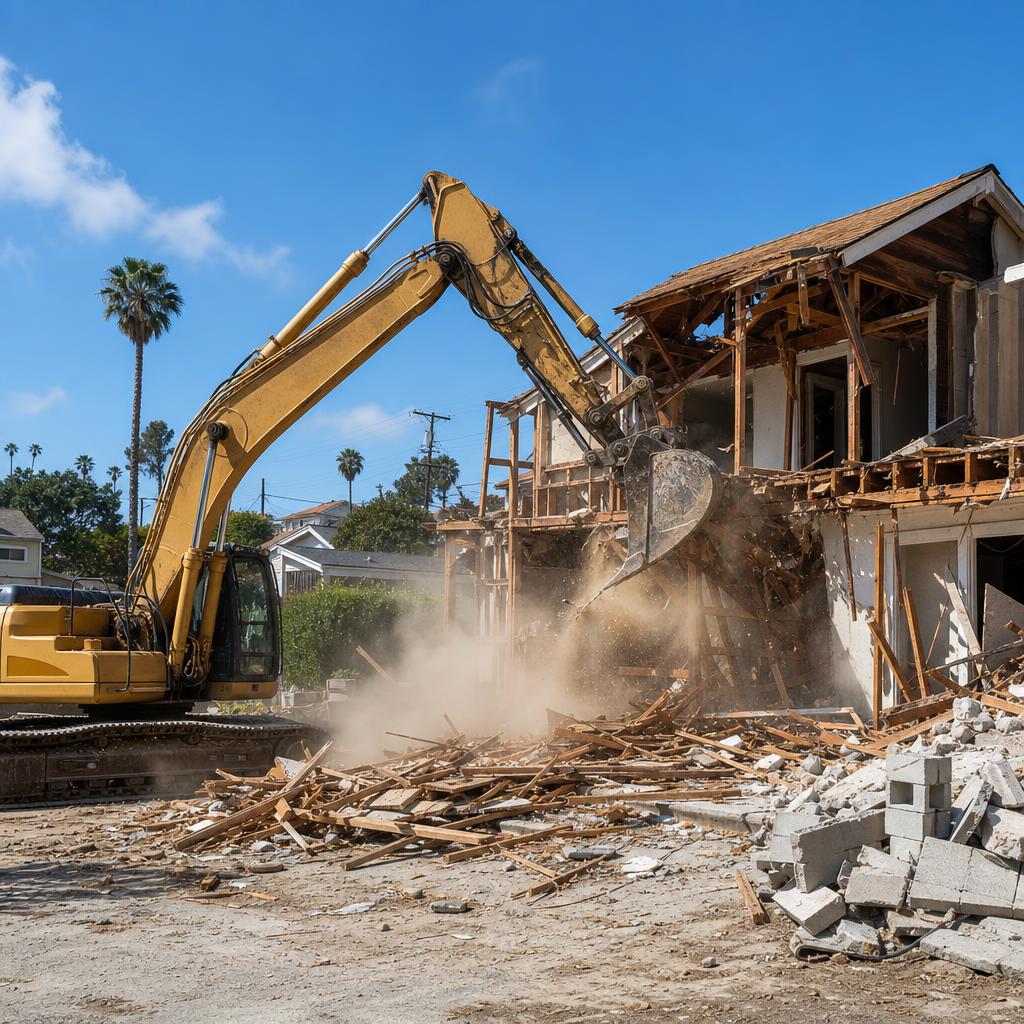
Quick Answer
A full or partial demolition in the City of Los Angeles requires a demolition permit from LADBS, preceded by a mandatory asbestos survey and written notification to the South Coast AQMD at least 10 working days before work begins. Before the wrecking crew can start, gas, electric, and sewer connections have to be disconnected and capped, and debris hauling has to comply with the City's Construction and Demolition Debris Recycling Ordinance. This is a separate, standard process from the government-run debris removal program used for many 2025 fire-damaged properties.
Whether you're tearing down a garage, removing part of an existing structure ahead of a remodel, or clearing a lot entirely for new construction, demolition in Los Angeles is its own regulated process — not a step you can fold quietly into a building permit or skip because the structure "isn't worth much." LADBS treats demolition as a distinct scope of work with its own permit, its own environmental prerequisites, and its own inspection checkpoints.
This guide walks through what a standard LADBS demolition permit actually requires — separate from the wildfire debris removal programs some homeowners in Pacific Palisades and Altadena used after the January 2025 fires — including the asbestos survey and AQMD notification, utility disconnects, the City's debris recycling ordinance, and the typical costs and timeline you should plan around.
This guide describes the demolition permit process in general terms. Fees, exact review times, and specific documentation requirements change, so confirm current figures directly with LADBS, South Coast AQMD, and the relevant utilities for your specific project before budgeting or scheduling.
Full vs. Partial Demolition — Both Need a Permit
A full demolition — removing an entire structure down to the foundation, or the foundation itself — always requires an LADBS demolition permit. What surprises many owners is that partial demolition often does too: removing a significant portion of a building's structure, a large section of exterior wall, or major structural elements as part of a remodel typically needs to be permitted as demolition, either as its own permit or as a clearly scoped demolition component folded into the related building permit application. Treating a partial teardown as routine remodeling work, without addressing it as demolition, is one of the more common ways a project runs into a stop-work order mid-construction.
Because the line between "extensive remodel" and "partial demolition" isn't always obvious from the drawings alone, we recommend confirming scope classification with LADBS or an experienced permit expediter before finalizing construction documents, rather than discovering the distinction after demolition work has already started.
The Asbestos Survey and South Coast AQMD Notification
Before a demolition permit application can meaningfully move forward, federal NESHAP regulations — 40 CFR Part 61, Subpart M — require a thorough asbestos survey of the structure, conducted by a qualified inspector. This applies to essentially all demolitions and many renovations that disturb building material, regardless of the structure's age or apparent condition, and regardless of whether the project is a full teardown or a partial demolition tied to a remodel.
Once the survey is complete, written notification has to be filed with the South Coast Air Quality Management District (South Coast AQMD) at least 10 working days before demolition activity begins. This AQMD notification is a distinct regulatory requirement from the LADBS demolition permit itself — filing one does not substitute for the other — and the responsibility for ensuring it's filed correctly and on time ultimately rests with the project's owner and operator, even when a contractor or environmental consultant handles the paperwork.
Because the 10-working-day notice period is a hard floor, not a target, this is usually the single biggest driver of how far in advance a demolition needs to be scheduled — starting the asbestos survey late is the most common reason a planned demolition date slips.
Utility Disconnects: Gas, Electric, Water, and the Sewer Cap
Gas Disconnect (SoCalGas)
Gas service to the structure has to be disconnected and physically capped by SoCalGas before demolition work begins, eliminating the risk of a ruptured gas line during teardown.
Electrical Disconnect (LADWP)
Electrical service is disconnected by LADWP or the applicable utility serving the property, removing live power from the structure before it's torn into.
Water Service
Water service is shut off and addressed at the meter, consistent with the scope of the demolition and whether water service will be needed again for the site.
Sewer Cap (LA Sanitation)
The sewer lateral connecting the structure to the City sewer main has to be located, cut, and capped, with the cap inspected by LA Sanitation before it's backfilled — an inspection step that's easy to overlook but is generally a hard prerequisite to closing out the demolition permit.
The Construction and Demolition Debris Recycling Ordinance
The City of Los Angeles's Construction and Demolition (C&D) Debris Recycling Ordinance requires that covered projects divert a specified percentage of demolition debris away from landfill disposal through recycling or reuse. Compliance is generally tied to a refundable deposit posted for the project, with the deposit returned once the diversion requirement is documented — typically through weight tickets or receipts from certified recycling and disposal facilities showing exactly where debris was hauled.
Keeping organized hauling records from day one of the demolition — not reconstructing them afterward from memory — is the difference between a smooth deposit refund and a forfeited one. This is a detail we track closely for every demolition project we manage.
Site Protection, Dust Control, and Rodent Inspections
Beyond the environmental and utility requirements, LADBS expects reasonable protection of adjacent properties during demolition and dust control measures appropriate to the scope of work. For larger structures in particular, a rodent or vermin inspection can be required before demolition begins, with abatement completed first where an infestation is found — since disturbing a structure that harbors rodents can push them directly into neighboring properties rather than eliminating the problem.
How This Differs From the 2025 Fire Debris Removal Program
For many properties destroyed in the January 2025 Palisades and Eaton Fires, structural debris removal was handled through the government-run Consolidated Debris Removal Program, coordinated with the Army Corps of Engineers and the affected city or county. Participating owners in that program generally did not need to separately obtain an individual LADBS demolition permit for the program-managed removal of their destroyed structure — that program operated under its own federal and state disaster-response framework rather than the standard LADBS demolition permit process described in this guide.
A standard demolition permit — with its own asbestos survey, AQMD notification, and utility disconnect requirements — is still needed for a partial demolition, for a structure that didn't participate in the government debris removal program, or for any demolition unrelated to the 2025 fires. If you're rebuilding after fire damage and aren't sure which category applies to your project, see our fire debris removal guide for how the government program works, or reach out and we'll help you confirm your specific parcel's status before you plan a demolition timeline around the wrong process.
Typical Demolition Costs and Timelines
| Item | Typical Cost | Typical Timeline |
|---|---|---|
| LADBS demolition permit fee (accessory/small structure) | Roughly a few hundred dollars | Permit issuance often same-day to a few days once complete |
| LADBS demolition permit fee (single-family residence) | Typically several hundred to low thousands of dollars, size-dependent | Days to a couple weeks for plan check/issuance |
| Asbestos survey (pre-demolition inspection) | Commonly several hundred to low thousands of dollars, depending on structure size | Days to schedule and complete; must precede AQMD notice |
| South Coast AQMD notification processing | Modest filing fee, tiered by project size | Minimum 10 working days before demolition may begin |
| Utility disconnects (gas, electric, sewer cap) | Varies by utility; sewer cap often has a City permit/inspection fee | Days to a few weeks depending on utility scheduling |
| C&D recycling deposit | Refundable deposit, often calculated per project valuation | Refund processed after diversion documentation is submitted |
Estimated ranges for general planning purposes only, subject to change based on structure size, current fee schedules, and project-specific conditions. Confirm current fees and timelines directly with LADBS, South Coast AQMD, and the relevant utilities before budgeting.
Demolition Permit Process — Step by Step
Here's the practical sequence from first phone call to a cleared, permit-closed lot.
- 01
Order the Asbestos Survey
Before anything else is scheduled, retain a qualified asbestos inspector to survey the structure. This applies to full teardowns and partial demolitions alike under NESHAP, and the findings drive everything downstream — the AQMD notification, any required abatement, and the demolition contractor's scope.
- 02
File the South Coast AQMD Notification
Submit written notification to South Coast AQMD at least 10 working days before demolition activity is scheduled to begin, reflecting the asbestos survey findings. Confirm in advance which party — owner, contractor, or environmental consultant — is the party of record on the filing.
- 03
Submit the LADBS Demolition Permit Application
Apply for the demolition permit through LADBS, including the scope of work, structure details, and any required supporting documentation. Partial demolitions tied to a larger remodel or rebuild may be reviewed alongside the related building permit rather than in isolation.
- 04
Schedule Utility Disconnects
Coordinate gas disconnection and capping with SoCalGas, electrical disconnection with LADWP, and locate, cut, and cap the sewer lateral with LA Sanitation inspection. LADBS generally requires confirmation of these disconnects before demolition work can proceed on site.
- 05
Address Rodent/Vermin Inspection (Where Applicable)
For larger structures, confirm whether a rodent or vermin inspection is required before demolition, and complete any required abatement so pest activity isn't displaced into neighboring properties once demolition begins.
- 06
Set Up Site Protection and Dust Control
Establish protective fencing and measures for adjacent properties, along with dust control practices for the demolition itself, consistent with LADBS and South Coast AQMD expectations for work of this kind.
- 07
Perform the Demolition and Track Debris Diversion
Once the permit is issued and all prerequisite confirmations are in hand, the demolition contractor performs the work, hauling debris to certified recycling and disposal facilities and keeping the receipts and weight tickets needed to document compliance with the City's C&D Debris Recycling Ordinance.
- 08
Submit Diversion Documentation and Close Out
Submit the waste management/recycling report and supporting documentation to recover the C&D recycling deposit, and obtain final sign-off on the demolition permit — clearing the way for excavation, grading, or new construction permitting on the now-vacant lot.
How Ocean Permits Manages Demolition Permitting
Ocean Permits & Development is a women-owned Los Angeles permit expediting firm. We coordinate the full demolition sequence — asbestos survey scheduling, the South Coast AQMD notification and its 10-working-day clock, the LADBS demolition permit application, and utility disconnect confirmations with SoCalGas, LADWP, and LA Sanitation — so nothing stalls your project waiting on a step nobody scheduled in time.
Our Pacific Palisades and Altadena fire rebuild work has given us direct, current experience distinguishing when a property's debris was handled through the government program versus when a standard demolition permit is still required — a distinction that matters for scheduling your rebuild permit correctly. See our broader LADBS permit process guide and permit timeline guide for how demolition fits into a larger construction project's overall schedule.
All initial consultations are free. Call +1 (213) 277-8777 or submit a project inquiry online.
Common Questions About Demolition Permits in LA
Do I need a permit to demolish a house in Los Angeles?
Yes. Any full demolition of a structure in the City of Los Angeles requires a demolition permit from the Los Angeles Department of Building and Safety (LADBS), regardless of the structure's size or age. Partial demolitions — removing a portion of a building, an interior structural element, or a significant part of the exterior — typically also require a demolition permit or a demolition scope folded into the related building permit, rather than being treated as routine remodeling work.
Do I need an asbestos survey for a partial demolition?
Generally, yes. Federal NESHAP regulations (40 CFR Part 61, Subpart M) require a thorough asbestos survey before nearly any demolition or renovation activity that disturbs building material, and this requirement applies regardless of whether the work is a full teardown or a partial demolition. The survey has to be conducted by a qualified, typically certified, asbestos inspector before the demolition permit application and South Coast AQMD notification move forward — skipping it because a project is 'only partial' is one of the most common compliance mistakes we see.
What is the South Coast AQMD notification, and how far in advance do I need to file it?
Under NESHAP (40 CFR Part 61, Subpart M) as implemented locally by the South Coast Air Quality Management District (South Coast AQMD), most demolitions — including many renovations that disturb a regulated amount of asbestos-containing material — require written notification to South Coast AQMD at least 10 working days before demolition activity begins. This notification is separate from, and in addition to, the LADBS demolition permit itself, and it generally has to reflect the findings of the asbestos survey. Missing the notice window is one of the most common reasons a scheduled demolition gets delayed.
Who is responsible for filing the AQMD notification — the owner or the contractor?
In practice, either the property owner, the demolition contractor, or an environmental consultant handling the asbestos survey can be the party of record on the South Coast AQMD notification, but the underlying legal responsibility to ensure a compliant notification is filed rests with the owner and operator of the demolition. We recommend confirming in writing, before demolition is scheduled, exactly which party on your project is submitting the notification so it doesn't fall through the cracks between the survey firm and the demolition contractor.
What utility disconnects are required before demolition can start?
Before a demolition permit will be finaled for start of work, gas service generally has to be disconnected and capped by SoCalGas, electrical service disconnected by LADWP (or the applicable utility), and water service addressed at the meter. The sewer lateral connecting the structure to the City sewer main also has to be located, cut, and capped — a sewer cap — with inspection by LA Sanitation before backfill. These utility disconnect confirmations are typically required documentation before LADBS will allow demolition work to proceed on site, not an afterthought handled once demolition is already underway.
What is the Construction and Demolition Debris Recycling Ordinance?
The City of Los Angeles's Construction and Demolition (C&D) Debris Recycling Ordinance requires that a specified percentage of the debris generated by covered construction and demolition projects be diverted from landfill disposal through recycling or reuse, rather than simply hauled to a landfill. Compliance is typically documented through the City's C&D recycling program, which involves a refundable deposit tied to the project and a waste management/recycling report submitted after demolition debris has been hauled away, along with receipts from certified recycling facilities.
Do I get the C&D recycling deposit back?
The C&D recycling deposit is designed to be refundable once the project demonstrates that it met the required diversion rate, typically documented through weight tickets or receipts from certified recycling and disposal facilities showing where the debris was actually taken. If the required diversion percentage isn't met or the documentation isn't submitted, some or all of the deposit can be forfeited, which is why keeping organized hauling and disposal records throughout the demolition is worth treating as a priority rather than an afterthought.
How long does a demolition permit take to get approved in LA?
Timelines vary with project scope, whether the structure is a simple accessory building or a larger multi-story structure, and how quickly the asbestos survey, AQMD notification window, and utility disconnect confirmations are completed. Because the AQMD notification alone generally requires at least 10 working days' advance notice, and utility disconnects can take time to schedule with SoCalGas, LADWP, and LA Sanitation, a realistic total timeline usually spans several weeks from the start of the asbestos survey to the day a demolition contractor can legally begin work — even when the LADBS permit review itself moves quickly.
Are rodent or pest inspections required before demolition?
For larger demolitions, LADBS or the Los Angeles County Department of Public Health can require a rodent/vermin inspection and, where an infestation is found, abatement before demolition begins — since disturbing a structure that harbors rodents can push them into neighboring properties. Whether this applies to a specific project depends on the structure's size, condition, and location, so it's worth confirming as part of pre-application research rather than assuming it doesn't apply to a smaller job.
How is this different from the fire debris removal program after the 2025 fires?
For many properties destroyed in the January 2025 Palisades and Eaton Fires, structural debris removal was handled through the government-run Consolidated Debris Removal Program coordinated with the Army Corps of Engineers and the affected county or city, and participating owners generally did not need to obtain an individual LADBS demolition permit for that program-managed removal. A standard LADBS demolition permit is still required, however, for a partial demolition, for a structure that did not participate in that government program, or for any demolition unrelated to the 2025 fires. If you're unsure which category your project falls into, that's the first thing to confirm before assuming either pathway applies.
Does a demolition permit cover grading or excavation too?
Not automatically. A demolition permit authorizes removal of the structure itself; grading, excavation, or shoring work beyond what's incidental to demolition typically requires its own separate grading permit reviewed by LADBS Grading Division, particularly on sloped lots or where significant earth movement is planned as part of preparing the site for new construction.
What happens if I demolish without a permit?
Unpermitted demolition in the City of Los Angeles can result in stop-work orders, penalty fees on top of the permit fee that would otherwise have applied, and complications when later trying to permit new construction on the now-vacant lot, since the City can require documentation of how the prior structure was removed and whether asbestos and utility disconnect requirements were actually met. It also removes any of the inspection checkpoints — utility disconnects, sewer cap verification, debris recycling documentation — that are designed to protect the property and its neighbors during the work.