_1781464136662.png)
Women-owned, LA-based permit expediting firm. We help fire-rebuild clients in Pacific Palisades and Altadena coordinate building permits, County Fire review, and the site approvals that can determine whether a rebuild reaches final inspection. Free consultation — call 213-277-8777.
In an Altadena rebuild, “fire approval” is not one box on the building permit. A new home in a Very High Fire Hazard Severity Zone may need current wildfire-resistant construction under California Building Code Chapter 7A, access and life-safety review, and a separate landscape-based Fuel Modification Plan approved by the Los Angeles County Fire Department Forestry Division.
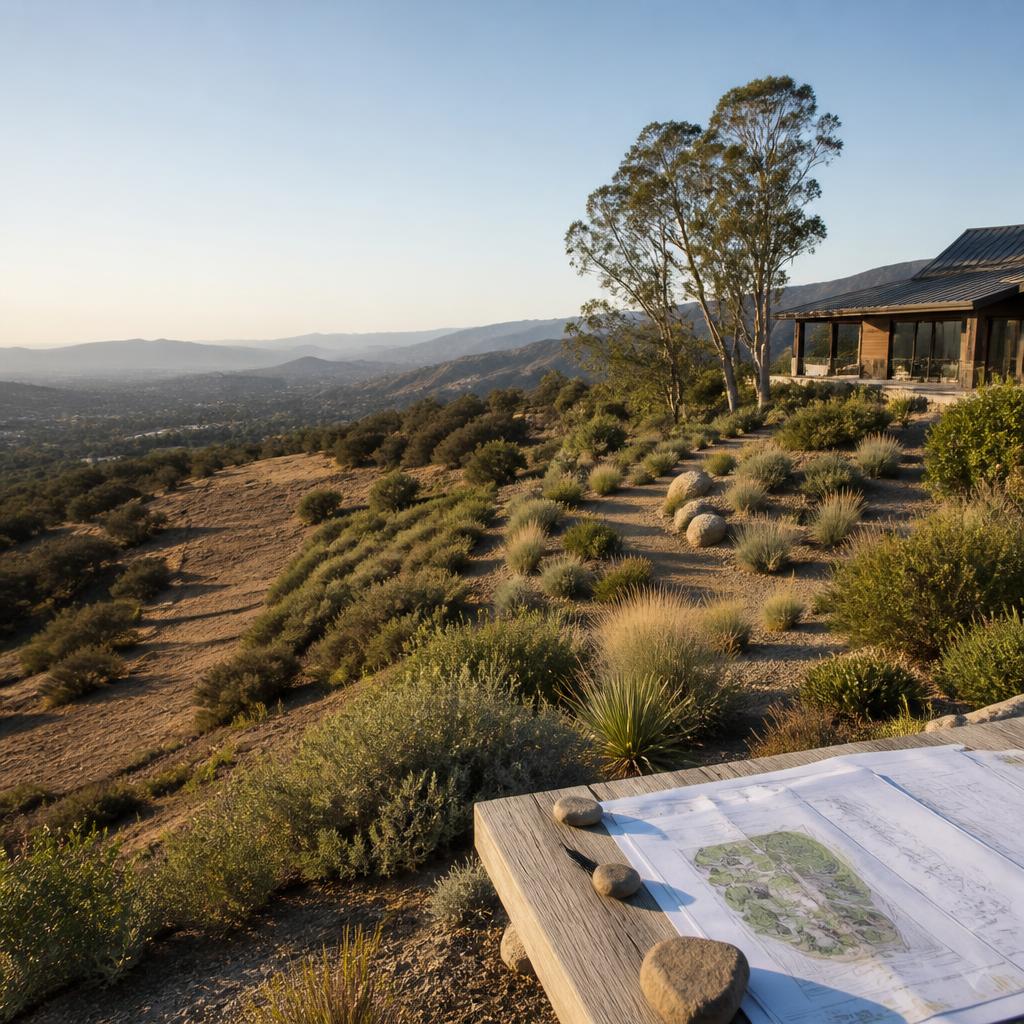
The Fuel Modification Plan is the document that translates a fire-safety objective into a site plan. It shows the proposed structure, the fuel-modification zones around it, existing vegetation to remain, proposed planting, irrigation, spacing, plant names, maintenance notes, and the relationship to the parcel boundary. For a qualifying new structure, it is not simply a homeowner’s voluntary landscaping preference. County Fire approval can be required before the applicable building permit or development approval moves forward.
This is different from the general brush-clearance and defensible-space obligations discussed in our separate brush-clearance guide. That article focuses on PRC §4291, routine maintenance, local inspection notices, and the distinction between maintenance and construction. This page focuses narrowly on the LA County Fire Forestry Division approval process for a new or substantially rebuilt structure, especially in unincorporated Altadena.
What Is a Fuel Modification Plan?
A Fuel Modification Plan is a fire-protection landscape plan for managing vegetation and other combustible fuels around a qualifying structure or development. The County Fire Department describes fuel modification as a way to create defensible space for effective fire protection in newly constructed or remodeled homes within Very High Fire Hazard Severity Zones. The plan is reviewed by the Forestry Division’s Fuel Modification Unit, not by the architect alone and not by the ordinary building plan checker alone.
The County’s qualifying conditions include a site within a State Responsibility Area Fire Hazard Severity Zone or a Local Responsibility Area Very High Fire Hazard Severity Zone, together with new construction or an addition equal to or greater than 50% of the existing square footage. County materials also identify certain accessory structures over 120 square feet, parcel splits, subdivisions, and developments as situations that can require Fuel Modification Plan approval. Because mapped zones, exemptions, and project facts vary, the property should be screened with the Forestry Division before the design team assumes no plan is needed.
The plan is not a private wildfire certification and it does not replace the building permit. It is one approval that feeds the building and site review. The approved plan may establish conditions that remain with the property: irrigation, planting, pruning, access, inspections, and restrictions on future landscaping. A later owner who replaces the approved plants with dense, dry, or ladder-forming vegetation may create a compliance problem even if the building permit was finalized years earlier.
LA County Fire Forestry Division vs. LAFD: Confirm the Jurisdiction First
The agency distinction is decisive. Unincorporated Altadena is served through Los Angeles County agencies, including the Los Angeles County Department of Building and Safety, Department of Regional Planning, and County Fire Department. The County Fire Department’s Forestry Division handles qualifying Fuel Modification Plan review in its service area. That is not the same process as submitting a landscape or brush-clearance question to the Los Angeles Fire Department.
LAFD serves the City of Los Angeles and has its own brush-clearance, fire-prevention, and construction-review programs. A City property in the Santa Monica Mountains, a County parcel in Altadena, and a home in an incorporated foothill city can sit in similar terrain but have different review agencies, forms, portals, and inspection sequences. “Los Angeles” in a project address is not enough to identify the authority.
Before a plan is drawn, confirm whether the property is inside the City of Los Angeles, an incorporated city, or unincorporated County territory; identify the building department; confirm the fire service area; and check the current Fire Hazard Severity Zone map. Our Altadena permit page explains why County Building & Safety and Regional Planning are different from LADBS. That same agency check determines whether County Forestry review belongs in the rebuild schedule.
The Three Fuel-Modification Zones
The County’s fire-rebuild FAQ describes three planning zones measured from the edge of the qualifying structure. The zones are not three generic landscaping bands that can be copied without looking at the site. They are a framework for showing different levels of fuel management as distance from the building increases. Slope, wind, vegetation, access, neighboring property, parcel boundaries, and the County’s review can change the treatment.
| Zone | Distance | Typical treatment | Maintenance responsibility |
|---|---|---|---|
| Zone 1 — irrigated zone | 0–30 feet from the edge of the qualifying structure | The most intensively managed area: irrigated, maintained landscaping; limited combustible material; plant placement and species selected to avoid direct ignition pathways, horizontal continuity, and fuel ladders. | Property owner or responsible landscape/maintenance contractor; ongoing upkeep and future planting must remain consistent with the approved plan. |
| Zone 2 — thinning zone | 30–100 feet from the edge of the qualifying structure | Reduced fuel continuity through selective thinning, separation, pruning, and managed planting. The County’s plant guidance addresses spacing, mature size, vertical separation, and avoiding ladder fuels rather than simply removing every plant. | Property owner, HOA, or other recorded maintenance entity identified by the approval; inspection access and recurring maintenance are part of the long-term condition. |
| Zone 3 — fuel-break / extended zone | From the edge of Zone 2 toward 200 feet, where site conditions require it | A broader transition or fuel-break area between the structure and surrounding open space or natural vegetation. Exact treatment depends on slope, fuels, parcel boundaries, access, neighboring conditions, and the approved site plan. | The plan must identify who maintains the area and how obligations are shared or recorded; Zone 3 may be limited by property lines and cannot be assumed to extend across another owner’s land. |
Zone distances and treatment are a planning summary based on current County Fire materials. The approved site plan controls. Zone 3 may be limited by the property boundary and site conditions; it should not be assumed to require work on a neighboring parcel.
What the Landscape Plan Must Show
The County Fire Forestry Fuel Modification page identifies the elements the reviewer needs to understand the proposed fire-safe landscape. The plan should be drawn to scale and should not leave the zones as an unstated concept. The building footprint, property lines, vegetation, irrigation, and plant palette need to work together so the reviewer can see both the intended treatment and the long-term maintenance obligation.
| Submittal element | What it should communicate | Where it usually appears |
|---|---|---|
| Site and property information | Property lines, north arrow, scale bar, access, existing structures, proposed structures, slopes, and relevant surrounding conditions. | Landscape plan / site plan |
| Fuel modification zones | Zones drawn from each qualifying structure to the property boundary, with dimensions or site-specific limits clearly shown. | Fuel Modification Plan |
| Existing vegetation | Vegetation proposed to remain, shown at approximately 75% maturity and coordinated with the arborist or landscape team. | Planting / tree plan |
| Proposed planting | Plant locations, mature size, scientific names, spacing, irrigation, mulch, and any limitations required by County guidance. | Planting schedule and notes |
| Fire and maintenance notes | Approved plan notes, irrigation and maintenance obligations, inspection access, and future-planting restrictions. | Plan notes / maintenance exhibit |
Plant labels matter. The County requests scientific names, not only common names, because common names can describe different species in different regions. Existing plants proposed to remain should be drawn at approximately 75% maturity so the plan reflects the future canopy and spacing rather than the appearance of a newly installed landscape. Plant-selection guidance also addresses where woody plants, shrubs, grasses, and trees should not create a direct fuel path to windows or walls.
The County Fuel Modification Plan is related to, but not automatically identical to, a City or County landscape plan. The planting should be coordinated so the building permit set, landscape set, and Fire Department plan do not promise different plants or different irrigation. A mismatch between those plans is a common and avoidable correction.
How the Plan Fits Into the Altadena Rebuild Permit
The January 2025 Eaton Fire made this sequencing especially important. An Altadena owner may be moving through debris clearance, County Building & Safety, Regional Planning, utility coordination, structural design, Chapter 7A details, grading, and fire-sprinkler review at the same time. A Fuel Modification Plan adds a site and landscape approval that can affect the building footprint and final inspection. It should be started alongside the architectural site plan, not after the house plans are already approved.
The first coordination question is whether the rebuild qualifies as new construction or another qualifying scope under the County’s conditions. A replacement home can be “like-for-like” for a particular emergency or land-use program while still being new construction for current fire, energy, and green-site review. Our like-for-like rebuild guide explains the procedural concept; it should not be read as a blanket exemption from County Fire requirements.
The Fuel Modification Plan can influence where the house, driveway, retaining walls, pool, accessory structures, and landscape are placed. If the Forestry reviewer requires a different zone treatment or an expanded plan area, the architect may need to revise grading, irrigation, planting, or access. Those revisions can affect cost and the schedule for County Building & Safety review. A coordinated site plan reduces the chance that a landscape correction arrives after structural plans have been submitted.
It also connects to final approval. County Fire plan notes commonly preserve the Department’s ability to inspect compliance with the approved plan at any time and require future planting to be consistent with County guidelines. A home can be framed and visually complete while missing irrigation, approved planting, zone maintenance, or inspection documentation. Build those items into the construction schedule rather than treating them as decorative work after the Certificate of Occupancy conversation begins.
Fuel Modification, Chapter 7A, and General Brush Clearance Are Different Layers
Wildfire permitting uses several overlapping terms. General defensible space under PRC §4291 is an ongoing property-maintenance responsibility. Chapter 7A is a building-construction standard for ignition-resistant roofs, walls, vents, windows, decks, and related assemblies. A Fuel Modification Plan is an agency-reviewed site strategy for zones, vegetation, irrigation, and maintenance. They support the same safety objective but answer different questions.
A property can be compliant with the approved building materials and still have a problem with unmanaged vegetation. It can also have a clean brush inspection and still need a County-approved Fuel Modification Plan for a new home. Similarly, an approved fuel landscape cannot make a roof, vent, or exterior wall comply with Chapter 7A. The permit package should list each layer and the agency responsible for it.
For the general maintenance and PRC §4291 distinction, read our brush-clearance and defensible-space article. For the building-material side, see our Chapter 7A construction guide. The Fuel Modification Plan is the bridge between the site, the landscape, and the County Fire approval record.
Typical Timeline and Common Causes of Delay
County Fire does not publish one guaranteed turnaround for every Fuel Modification Plan. A realistic schedule depends on the quality of the base survey, the building footprint, the slope and vegetation, the plant palette, irrigation, property boundaries, and whether the plan has to be coordinated with grading, trees, access, or a subdivision. A straightforward plan may move in weeks; a hillside fire rebuild with several correction rounds can take materially longer.
The most common delay is starting with an incomplete site plan. If the plan does not show the property line, proposed structure, zone dimensions, existing vegetation, mature planting, or a scale bar, the reviewer has to ask for basic information before evaluating the treatment. Another common problem is using a generic plant list without scientific names, mature size, spacing, irrigation, or an explanation of how the plantings avoid vertical and horizontal fuel continuity.
Plans also stall when the building and landscape drawings disagree. The architect may show one driveway, the civil plan another; the landscape plan may retain a tree that the fire plan removes; or the irrigation design may not reach the Zone 1 planting. A project can lose more time resolving these internal contradictions than responding to a clear County comment.
Finally, owners sometimes wait until final inspection to ask who maintains Zone 2 or Zone 3. Maintenance responsibility should be identified before approval, especially for HOAs, subdivisions, shared drives, parcels next to open space, and properties where the zone meets a boundary. Clarifying that responsibility early protects both the permit schedule and the long-term value of the approval.
Responding to Forestry Plan-Check Corrections
A Forestry correction should be treated as a design-coordination item, not as a separate landscape memo. Start by matching each comment to the current plan sheet and identifying every discipline affected. A request to move a plant, clarify a zone boundary, or add irrigation may appear limited to the Fuel Modification Plan, but it can also affect a retaining wall, drainage swale, utility trench, driveway sight line, tree-protection area, or architectural hardscape. The correction response should explain what changed and point to the revised sheet rather than simply state that the applicant agrees.
When the reviewer questions a plant, confirm the scientific name, mature height and width, spacing, form, water needs, and proposed location. A plant is not approved in the abstract; the same species can create a different risk when massed below a window, placed beneath a tree canopy, or allowed to form a continuous path from native vegetation to the structure. County plant-selection guidance is therefore best used as a design tool together with the site conditions, not as a shopping list that guarantees approval.
If a correction changes the zone layout, compare the revised linework against the architectural and civil base before resubmittal. Confirm the current building footprint, decks, eaves, accessory structures, property line, topography, and grading limits. Old base files are a common source of repeated comments during rebuilds because the landscape consultant may begin before the architect issues the latest site plan. A dated, shared base file and a short revision log make it easier to show the County exactly what changed.
Finally, keep the correction response and approved plan with the building-permit record. Contractors and inspectors need the final approved version, not the first version that was submitted. If a later substitution is necessary, route it through the responsible designer and County Fire contact before installation whenever possible. That prevents the field team from building a landscape that satisfies the contractor’s interpretation but not the approval that controls the property.
Inspections, Ongoing Maintenance, and Future Landscape Changes
Fuel modification is not complete when the reviewer stamps the plan. The installation must match the approved design closely enough for the County Fire inspector to confirm the zones, plant placement, irrigation, spacing, and treatment of existing vegetation. The contractor should have the approved plan available on site and should resolve discrepancies before requesting inspection. Photographs, plant tags, invoices, and irrigation records can help explain installations that are difficult to identify after labels are removed.
Inspection should be placed on the master rebuild schedule alongside building, grading, sprinkler, utility, and final occupancy milestones. Do not assume that passing a County Building & Safety inspection closes the Forestry requirement. Conversely, Fuel Modification Plan approval does not close structural, Chapter 7A, grading, or life-safety inspections. The project manager should maintain a clearance matrix showing the responsible agency, request date, correction status, and required completion event for each track.
After occupancy, the approved landscape remains a maintained fire-protection condition. Irrigation failures, dead plants, accumulated leaf litter, unpruned shrubs, new fences, stored materials, and replacement landscaping can change the risk the plan was designed to manage. Zone 1 usually needs the most frequent attention because it is closest to the structure, but Zone 2 and any approved Zone 3 treatment also need recurring inspection and upkeep. Maintenance frequency should respond to plant growth, drought, wind, slope, and seasonal fuel conditions rather than rely on one annual cleanup.
Future owners should receive the approved Fuel Modification Plan with the property records. Before redesigning the yard, installing a pool or accessory structure, adding a deck, changing irrigation, or planting a screening hedge, compare the proposal to the approved zones and ask whether County Fire review is required. A landscape change can look minor while introducing a new fuel ladder or blocking the maintenance access assumed by the original approval. Preserving the plan and its maintenance history makes future permit work easier and helps avoid re-creating the record from scratch.
A Practical Fuel Modification Plan Workflow
- 01
Confirm the authority
Verify City, County, or other fire jurisdiction; confirm whether the parcel is unincorporated Altadena and identify the building department.
- 02
Screen the trigger
Check the FHSZ map, new-construction or addition scope, accessory structures, parcel splits, subdivisions, and any applicable exemption.
- 03
Build one accurate base
Coordinate survey, property lines, structure footprints, slopes, access, trees, existing vegetation, grading, and utilities.
- 04
Draft the zone plan
Show Zone 1, Zone 2, and Zone 3 treatment to the property boundary, with planting at maturity, scientific names, irrigation, notes, and maintenance responsibility.
- 05
Submit with the permit strategy
Route County Fire Forestry review early enough that corrections can be coordinated with County Building & Safety, Regional Planning, and the architect.
- 06
Track construction and inspection
Preserve the approved plan, install the approved landscape, document substitutions and irrigation, and schedule the fire inspection before final occupancy milestones.
Frequently Asked Questions
1. What is a Fuel Modification Plan in Los Angeles County?
A Fuel Modification Plan is a site-specific landscape and fire-safety plan that shows how vegetation and other fuels will be managed around a qualifying structure or development in a mapped fire-hazard area. It identifies the building footprint, fuel-modification zones, existing vegetation to remain, proposed plants, spacing, irrigation, access, and maintenance conditions. It is reviewed by the Los Angeles County Fire Department Forestry Division’s Fuel Modification Unit when the property falls within the County’s qualifying conditions.
2. When does LA County Fire require a Fuel Modification Plan?
The County Fire Department identifies qualifying conditions that include a property within a State Responsibility Area Fire Hazard Severity Zone or a Local Responsibility Area Very High Fire Hazard Severity Zone, combined with new construction or an addition equal to or greater than 50% of the existing square footage. County materials also identify certain outbuildings or accessory structures over 120 square feet, parcel splits, subdivisions, and developments as situations that may require approval. The exact parcel and project scope should be confirmed with the Forestry Division before relying on an exemption.
3. Is a Fuel Modification Plan the same as general brush clearance under PRC §4291?
No. PRC §4291 defensible-space maintenance is an ongoing state-law responsibility around structures in applicable fire-hazard areas. A Fuel Modification Plan is a project-specific, agency-reviewed plan that establishes zones, plant treatment, irrigation, maintenance, and inspection conditions for qualifying construction or development. The two can overlap, but routine brush clearance does not replace an approval required by LA County Fire for a new structure. See our separate brush-clearance guide for the general maintenance and enforcement layer.
4. Does LA County Fire or LAFD review the Fuel Modification Plan?
The authority depends on the parcel’s jurisdiction. The LA County Fire Department Forestry Division reviews qualifying properties in the County Fire service area, including unincorporated Altadena. The Los Angeles Fire Department serves the City of Los Angeles and has its own brush-clearance, fire-prevention, and project-review processes. A City of Los Angeles property should not be sent through the County Forestry Division process without confirming the agency, and an Altadena property should not be treated as an LADBS/LAFD project.
5. How far do the LA County fuel-modification zones extend?
The County’s current fire-rebuild FAQ describes Zone 1 as extending from the structure to 30 feet, Zone 2 from the edge of Zone 1 to 100 feet, and Zone 3 from the edge of Zone 2 up to 200 feet from the structure based on site conditions. The actual plan is site-specific. Property lines, slope, vegetation, access, neighboring land, existing conditions, and the County’s review can change how the zones are drawn and treated. The distances should be shown on the submitted plan rather than assumed from a generic radius.
6. What must the landscape plan show?
The County’s Forestry Fuel Modification page identifies proposed structures, fuel-modification zones to the property boundary, existing and proposed planting drawn at 75% maturity, plants labeled by scientific name, plan notes, and a scale bar among the required plan elements. A complete submittal also needs enough site information for the reviewer to understand access, slopes, irrigation, mature spacing, and maintenance. The City landscape plan and the County Fuel Modification Plan are related but are not automatically the same document.
7. Do I need a licensed landscape architect for the plan?
The County’s 2026 fire-rebuild FAQ says a licensed landscape architect is not categorically required if the plan is drawn to scale and contains the correct fuel-modification zones. That does not mean every project is simple or that a licensed professional is never useful. Complex slopes, subdivisions, significant grading, protected trees, large developments, irrigation design, or conflicts with the architectural site plan may warrant a landscape architect, arborist, civil engineer, or other qualified professional.
8. Can the building permit be issued before the Fuel Modification Plan is approved?
For a qualifying project in the County Fire jurisdiction, Forestry Division approval is generally a prerequisite tied to approval of the building permit or other applicable entitlement. The exact routing and sequencing can depend on the County agency and the project’s rebuild or permit program. Treating the Fuel Modification Plan as a post-permit landscaping item is risky: a zone change or plant correction can force revisions to the site plan, driveway, grading, irrigation, or building location.
9. Will the Fuel Modification Plan affect final inspection or the certificate of occupancy?
It can. County Fire approval notes commonly state that inspection for compliance with an approved Fuel Modification Plan may occur at any time, and the project may need the approved landscape and fuel conditions in place before final sign-off or occupancy. A building can be structurally complete while the fire authority still identifies missing irrigation, incorrect plantings, unmanaged fuels, or incomplete zone work. Confirm the required inspection and occupancy sequence with the County plan reviewer and inspector.
10. How long does LA County Fuel Modification Plan approval take?
There is no single guaranteed timeline. A straightforward plan with a clear survey, accurate zone lines, compliant planting, and no major grading or tree conflicts can move in weeks. A hillside or fire-rebuild plan can take longer when the site needs an arborist, irrigation redesign, grading coordination, environmental review, multiple correction rounds, or a revised building footprint. Starting the Forestry review before the building package is frozen is the best way to avoid turning a landscape correction into a structural schedule delay.
11. Does Chapter 7A replace the need for fuel modification?
No. California Building Code Chapter 7A addresses ignition-resistant construction features such as roofing, vents, exterior walls, windows, decks, and other building components in applicable wildfire areas. Fuel modification manages vegetation and combustible fuels outside the structure. An Altadena rebuild can need both: Chapter 7A compliance in the building plans and a County Fire-approved Fuel Modification Plan for the site. One does not substitute for the other.