_1781464136662-DVw5IPjt.png)
City agencies
StreetsLA, BOE, LADOT
Permit validity
Up to 60 days (StreetsLA)
Specialty
Palisades and Altadena rebuilds
Updated
October 18, 2026
The short answer: your building permit stops at the property line
A building permit from LADBS covers work on private property. The moment a project needs the sidewalk, the curb lane, the parkway, or the street itself, a separate set of agencies takes over. In the City of Los Angeles that usually means StreetsLA, the Bureau of Engineering (BOE), and the Los Angeles Department of Transportation (LADOT). The building permit and the right-of-way permit are independent: having one does not grant the other.
Many owners first meet this issue on a fire rebuild, a demolition, or a new foundation pour, when a dumpster, a concrete pump, a delivery truck, or a protective fence needs space that belongs to the public. Getting the right permit before setting anything in the street avoids citations, removal orders, and stop-work conflicts that can cost far more than the permit itself.
This guide explains which City permit fits which situation, how a protected pedestrian route is planned, how Altadena and state highways differ, and what the review steps look like.
- Dumpsters and roll-off bins in the curb lane
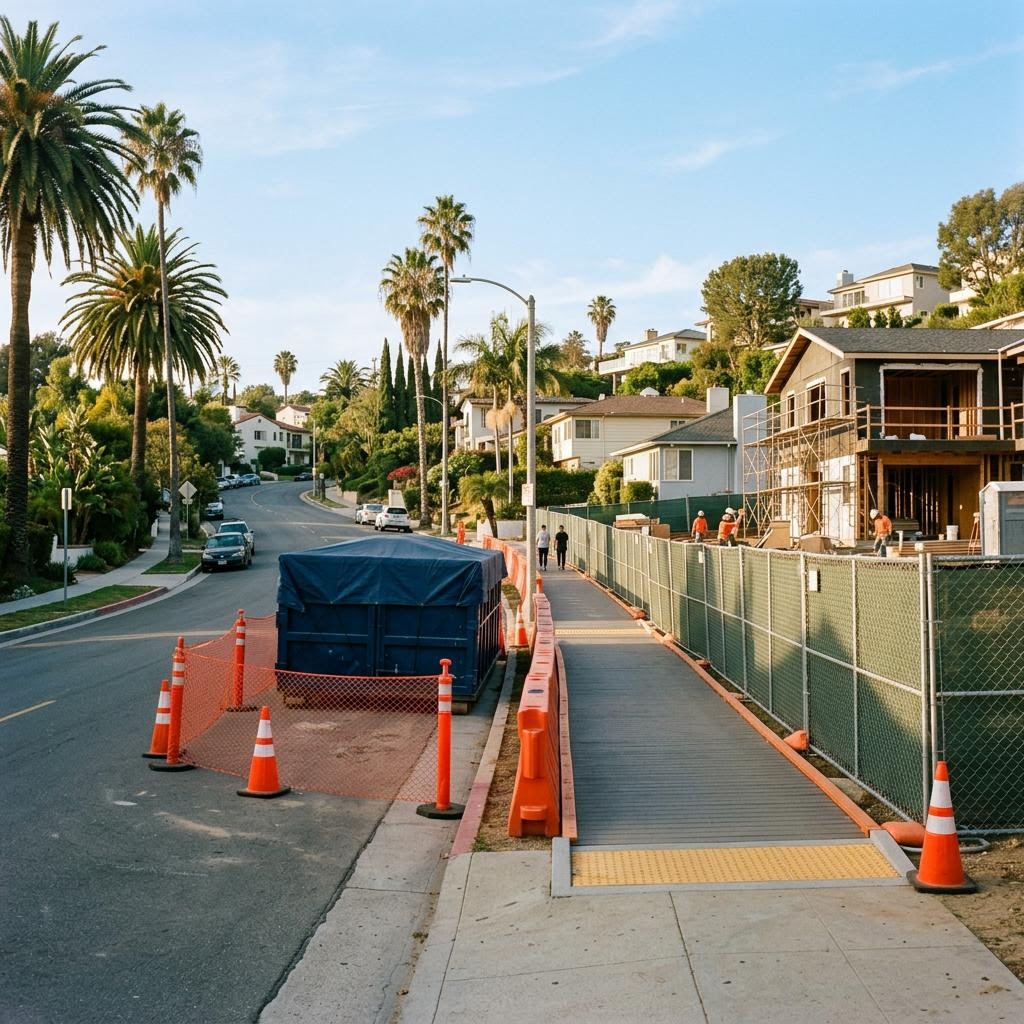
- Sidewalk canopies and protective fences
- Material storage in the public way
- Concrete pumps and crane lifts
- Curb, gutter and driveway repairs
- Lane or parking removal for staging
Private yard, curb lane, or sidewalk: where the equipment sits matters
Start with a simple map. A dumpster entirely inside your property, on your driveway or yard, is a private-property matter governed by your building permit, site conditions, and any hauling rules. The same dumpster set in the curb lane occupies the public street. A fence or canopy that extends over the sidewalk occupies the pedestrian right-of-way. Each step outward brings more review because more of the public is affected.
A parking reservation or temporary no-parking signage is not the same as a street closure permit. Reserving curb spaces for a delivery does not authorize closing a lane, and it does not authorize blocking the sidewalk. Lane removal, parking removal used for staging, and crane lifts over the public way need agency review and usually an approved traffic control plan.
Several common assumptions are also not approvals. Orange cones placed by the crew, a neighbor agreeing to share curb space, or a hauler confirming a bin delivery date do not authorize use of the right-of-way. The agency's written permit and its conditions do.
StreetsLA building materials permits
StreetsLA, through its Investigation and Enforcement Division, issues permits for placing building materials, equipment, and temporary protective structures in the public right-of-way. Typical uses include sidewalk canopies, protective construction fences, and materials or bins temporarily placed in public space. The current StreetsLA building materials permit page describes an application, a pre-inspection of the site, corrections where needed, coordination with BOE or LADOT when the proposal affects their areas, and then approval or denial.
StreetsLA states that the permit has a maximum validity of 60 days. That is how long the permit can remain in effect, not how long it takes to process. Longer occupancies need planning for renewal or a different arrangement. Applications are handled through the City's online building materials portal.
StreetsLA also states that there is no building materials permit charge when the project already holds an existing BOE A-Permit or B-Permit. That is a fee provision, not an automatic approval or a traffic exemption. Confirm that the existing A or B permit actually covers the project and location, and expect the occupancy, traffic, and pedestrian access to be reviewed on their own merits.
BOE A-Permits and B-Permits are for public improvements, not dumpsters
The Bureau of Engineering issues A-Permits under LAMC 62.106(a) for limited work on curbs, sidewalks, driveways, and gutters that match existing grades and do not need a survey or engineered plans. Replacing a damaged driveway approach or a section of sidewalk to the same grade is a typical example.
B-Permits under LAMC 62.106(b) cover more extensive public improvements, such as changes to street grade, sewer or storm drain work, street lights, and similar work requiring licensed engineering plans. B-Permits are often conditions of larger development.
Neither is a generic dumpster permit or a generic sidewalk closure permit. They authorize construction of public improvements. If you are rebuilding a driveway apron and also need a bin in the street, you may need both the BOE permit for the improvement and a StreetsLA permit for the occupancy, coordinated so the dates line up.
Excavation, shoring and permanent encroachments are separate paths
Digging in the public right-of-way, for a utility connection for example, may require a BOE excavation permit such as an E or U permit depending on the work. Shoring next to the public right-of-way during basement or foundation excavation involves LADBS structural review and BOE review of impacts to the public way.
Permanent private improvements that remain in the public right-of-way, such as certain walls, steps, or landscaping structures, are handled through a revocable permit (R-Permit) process. That is a long-term encroachment approval, not a temporary construction closure, and it has its own review and conditions.
Traffic control and accessible pedestrian detours
When construction affects travel lanes, parking, bike lanes, transit stops, or sidewalks, LADOT review and a temporary traffic control plan are typically involved. LADOT publishes a sample temporary traffic control plan that shows the level of detail reviewers expect: work area, signs, devices, tapers, and pedestrian routing.
Pedestrian access is not an afterthought. The City's obligations under ADA Title II and California accessibility law mean a sidewalk closure generally needs an approved, accessible, and protected detour: a continuous clear route, curb ramps where the route changes level, detectable barriers, adequate visibility at crossings, and advance signage. The plan should consider transit stops, bike facilities, school routes, and access for emergency vehicles and fire hydrants. We do not quote minimum detour widths or sign posting hours in a general guide; those come from the applicable standards and the permit conditions for your location.
Timing restrictions often attach to traffic plans. Peak-hour limits, school-hour limits, and event-related limits may narrow when a lane can be closed, independent of construction noise hours.
Altadena, other cities and state highways
Altadena is unincorporated Los Angeles County. City StreetsLA permits and BOE A or B permits do not apply there. Work in County roads is permitted through Los Angeles County Public Works under its own road permit process and conditions. Other cities, such as Pasadena or Santa Monica, issue their own encroachment permits.
If a project fronts a state highway, such as segments of Pacific Coast Highway, Caltrans encroachment permits apply to work in the state right-of-way. A City or County permit does not substitute for Caltrans approval where Caltrans has jurisdiction.
Fire debris clearance does not grant right-of-way permission either. Government-led or private debris programs operate under their own authority and conditions; once a lot transitions to private rebuilding, bins, fences, and staging in the public way need the normal permits for that jurisdiction.
The street use permit process, step by step
We follow a consistent sequence. Each step is confirmed with the reviewing agency, because forms and coordination requirements change.
Ocean Permits & Development is a women-owned Los Angeles permit expediting firm founded in 2021 by Katherine Amaya. We coordinate right-of-way permits alongside building, demolition, haul route, and noise approvals so the dates match, with fire rebuilding in Pacific Palisades and Altadena as a core specialty. We cannot guarantee approval or a processing time; we make sure the application is complete and sent to the correct agency. Call 213-277-8777 for a free consultation.
- Confirm jurisdiction: City, County, other city, or Caltrans
- Prepare a plot plan showing occupied area and duration
- Classify the work: StreetsLA occupancy, BOE A, B, E or U, or R-Permit
- Prepare an accessible traffic and pedestrian control plan
- Submit, coordinate hours with noise and haul approvals
- Receive written permit conditions before placing anything
- Install, pass inspection, and renew before expiration
- Remove devices and restore the right-of-way
Which right-of-way permit fits which situation
| Situation | Likely agency and path | Questions to confirm |
|---|---|---|
| Dumpster on private driveway | Private property; building permit conditions | Fully off the sidewalk and street? |
| Dumpster or materials in curb lane | StreetsLA building materials permit (City) | Duration up to 60-day validity, traffic review |
| Sidewalk canopy or protective fence | StreetsLA building materials permit; LADOT if routing affected | Accessible protected pedestrian route |
| Curb, sidewalk or driveway repair at existing grade | BOE A-Permit, LAMC 62.106(a) | No survey or engineered plans needed? |
| Street grade, sewer, drainage, street lights | BOE B-Permit, LAMC 62.106(b) | Licensed engineering plans |
| Lane closure for crane or concrete pump | StreetsLA or BOE with LADOT traffic control review | Hours, detours, transit, bike and emergency access |
| Altadena road work or occupancy | LA County Public Works road permit | County conditions, not City A or B |
| Work on a state highway | Caltrans encroachment permit | State jurisdiction boundaries |
Illustrative scenarios for planning only, not legal determinations or descriptions of client projects.
Fee and budget assessment basis
Budget permit and plan-review charges separately from any security deposit, engineering proposal and traffic-control contractor costs. Request a current agency assessment for the occupied area, duration and proposed work; an older fee sheet is not a reliable project quote.
| Cost item | Assessment basis | What moves it |
|---|---|---|
| Occupancy permit fee | Current StreetsLA or County assessment | Occupied area, duration, location |
| Existing BOE A or B permit holder | StreetsLA states no building materials permit charge | Confirm the existing permit covers the project |
| Plan review for public improvements | BOE assessment based on scope | Engineering plans, complexity, corrections |
| Traffic control devices and setup | Private contractor proposal | Lanes, signs, barriers, duration |
| Inspections and renewals | Agency assessment | Number of inspections and renewal periods |
| Deposits or bonds | Refundable or securing amounts, distinct from fees | Restoration risk and agency requirements |
Government charges, security deposits and private work are different cost categories. Confirm current charges and obtain project-specific contractor proposals.
Frequently Asked Questions
1. Does my LADBS building permit let me use the sidewalk or street?
No. The building permit covers private property. Using the sidewalk, curb lane or street needs a separate right-of-way permit, typically from StreetsLA, BOE, or LADOT review in the City of Los Angeles.
2. What is a StreetsLA building materials permit?
A permit from the StreetsLA Investigation and Enforcement Division for placing materials, bins, sidewalk canopies or protective fences in the public right-of-way. The process includes application, pre-inspection, corrections, coordination with BOE or LADOT where needed, and approval or denial.
3. How long is a building materials permit valid?
StreetsLA states a maximum validity of 60 days. That is how long the permit can remain in effect, not a processing time. Longer occupancies need renewal planning.
4. If I already have a BOE A or B permit, is the street use free?
StreetsLA states there is no building materials permit charge with an existing A or B permit. That does not mean automatic approval or exemption from traffic and pedestrian review. Confirm the existing permit covers the project.
5. What is the difference between an A-Permit and a B-Permit?
An A-Permit under LAMC 62.106(a) covers limited curb, sidewalk, driveway and gutter work matching existing grades without survey or engineered plans. A B-Permit under 62.106(b) covers extensive public improvements such as street grade, sewer, drainage or street lights with licensed engineering plans.
6. Is a parking reservation enough to close a lane?
No. Reserving curb parking is not a street closure permit. Lane or parking removal for staging, crane lifts and similar uses need agency review and usually an approved traffic control plan.
7. What does an accessible sidewalk detour require?
Generally an approved, protected pedestrian route with a continuous clear path, curb ramps where needed, detectable barriers, visibility and signage, consistent with ADA Title II and California accessibility requirements. Exact dimensions come from the applicable standards and permit conditions.
8. Are Altadena street permits the same as City permits?
No. Altadena is unincorporated County, so LA County Public Works issues road permits under its own process. City StreetsLA and BOE A or B permits do not apply. State highways need Caltrans encroachment permits.
9. Does fire debris clearance allow bins in the street?
No. Debris clearance programs do not grant general right-of-way permission for the rebuild. Bins, fences and staging in the public way during private rebuilding need the normal permits for that jurisdiction.
Ocean Permits & Development
Need a clear permit path?
We are a women-owned permit expediting firm founded in 2021 by Katherine Amaya. Our team helps property owners, architects, contractors, and operators move projects through the right jurisdiction and agency review. Consultations are free, and fire rebuild projects are a core specialty.