_1781464136662.png)
Women-owned, LA-based permit expediting firm. We help fire-rebuild clients in Pacific Palisades and Altadena coordinate debris hauling, grading, demolition, and building-permit schedules. Free consultation — call 213-277-8777.
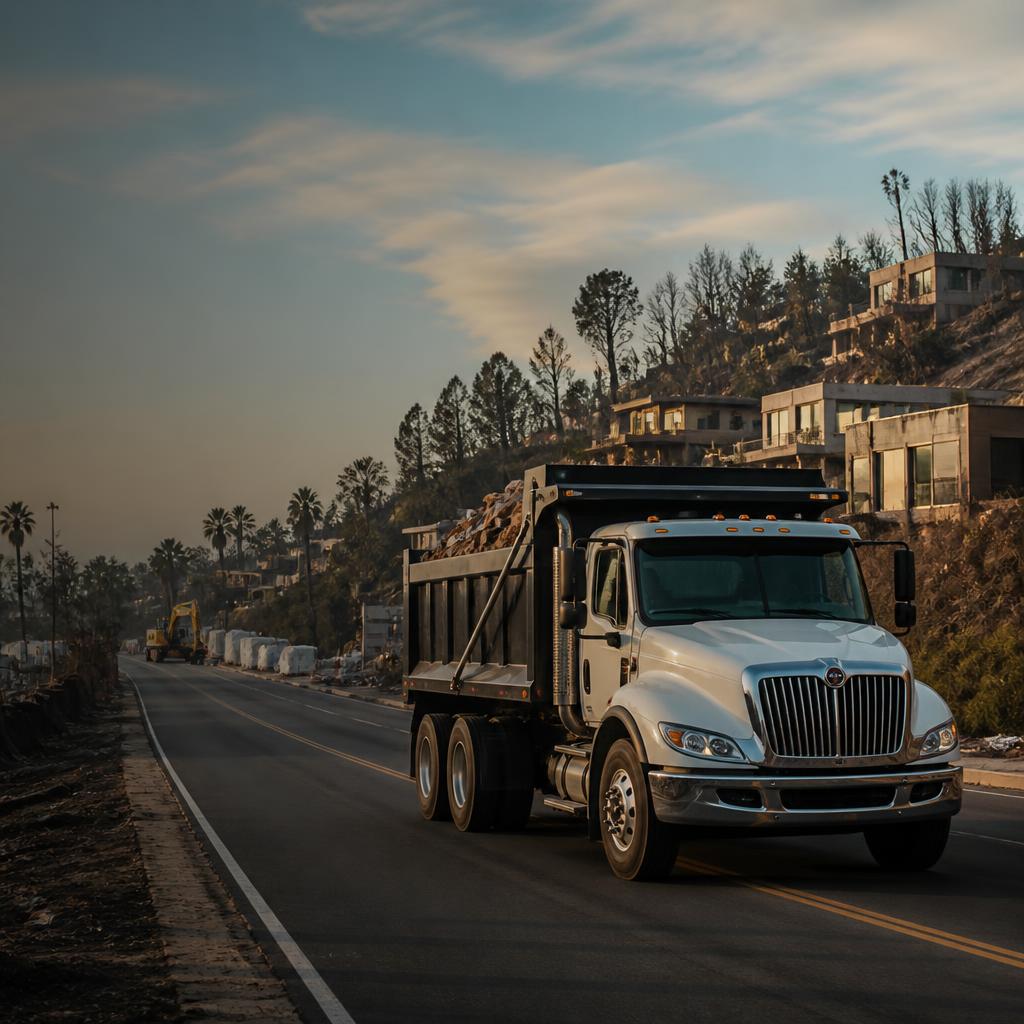
A fire rebuild creates a lot of movement before the new building is visible: demolition debris leaves the parcel, contaminated soil or ash may be removed, unsuitable material is exported, fill is imported, concrete trucks arrive, and heavy equipment has to reach a hillside or a constrained residential lot. When those trips use public streets, the route can become a permitting issue of its own.
In Los Angeles, “haul route permit” is often used as shorthand for several related approvals. A significant hillside grading project may need an LADBS haul-route application and Board of Building and Safety Commissioners hearing. A truck or trailer that exceeds ordinary legal dimensions may need an LADOT overload permit. Work that affects a sidewalk, curb, roadway, staging area, or public right-of-way can bring in the Bureau of Engineering or Street Services. Unincorporated Altadena follows a County path rather than the City of Los Angeles process.
This distinction matters because a demolition or grading permit does not automatically approve the truck route, and an overload permit does not approve the earthwork. The safest way to plan a rebuild is to map the complete trip early—project gate, staging location, borrow or disposal site, loaded direction, empty return route, and every agency-controlled road—and then coordinate the route with the fire debris-removal record, demolition permit, and grading plans.
What a Haul Route Review Actually Controls
A haul-route review is not just a request to let trucks pass. It gives the reviewing agency enough information to understand the effect of construction traffic on the public network and to impose workable protections. The City’s current LADBS bulletin asks for the origin and destination of material, every street in the route, truck staging areas, the maximum loaded gross weight, a route map, grading plans showing cut and fill, environmental documentation, and a 300-foot vicinity map identifying nearby lots and public facilities such as schools, hospitals, libraries, and parks.
The application should describe loaded and empty movements separately. A truck may use one route to a landfill or borrow site and a different return route because of turn restrictions, bridge limits, one-way streets, or roadway geometry. The package should also state the vehicle type, number of axles or wheels where requested, approximate trips per day, anticipated hours, project duration, and the proposed location for trucks to wait without blocking a travel lane or neighboring driveway.
The agency is looking at more than pavement. A route through a residential street can affect pedestrian safety, noise, dust, parked cars, school arrival and dismissal, emergency access, and the condition of curb returns. A route that looks efficient on a map can fail in the field if a loaded truck cannot make a turn, if the staging area is too small, or if the route crosses a bridge or freeway segment controlled by a different agency.
Common Triggers, Permit Tracks, and Planning Timelines
| Common Trigger | Likely Authority | Typical Track | Planning Window |
|---|---|---|---|
| Hillside earthwork with more than 1,000 cubic yards of import or export | City of Los Angeles / LADBS haul-route review | Haul-route application and, in the Special Grading Area, a Board of Building and Safety Commissioners hearing | Often several weeks or longer after a complete package; hearing and correction timing control |
| Large rebuild with recurring dump-truck trips on public streets | City of Los Angeles; LADBS plus City street agencies as applicable | Approved route, truck/staging information, grading quantities, neighborhood-vicinity materials, and street-protection conditions | Coordinate before grading or demolition mobilization; duration follows the approved hauling schedule |
| Truck, trailer, or equipment exceeds legal width, height, length, or weight | LADOT Overload Permit Unit for City routes | One-trip, 30-day, or annual overload permit with origin, destination, complete route, vehicle dimensions, and insurance | Application timing depends on the load and route; restricted streets or very heavy loads need extra review |
| Debris, fill, or equipment uses an unincorporated Altadena public route | Los Angeles County Public Works / Special Permits and Access | County oversize/overweight or special-route process, with County route limitations and any city-agreement issues checked | Allow additional coordination where a route crosses City, County, or State-controlled roads |
| Demolition or debris hauling from a fire-damaged parcel | Building department plus environmental, waste, and right-of-way agencies | Demolition/debris clearance, disposal documentation, traffic and staging plan, and any haul-route or overload permits | Run in parallel with debris-clearance and demolition planning; do not assume the rebuild permit covers hauling |
These are planning categories, not a promise that a specific project needs every listed approval. Exact review depends on the parcel, route, vehicle, road ownership, material quantity, and current agency requirements.
The City of Los Angeles: Hillside Import, Export, and the 1,000-Cubic-Yard Rule
For City of Los Angeles projects, the most important published threshold is not a general “all hauling” rule. The LADBS Information Bulletin P/BC 2026-134, revised June 9, 2026, says that a haul-route hearing before the Board of Building and Safety Commissioners is required for applications involving more than 1,000 cubic yards of soil import or export in a hillside area designated as a Special Grading Area. The bulletin points applicants to the Bureau of Engineering Basic Grid Map and ZIMAS for the applicable designation.
The quantity has to be tied to the actual grading design. Cut and fill, export, import, on-site balance, retaining-wall excavation, basement excavation, and replacement fill should be reconciled between the grading plan, soils or geology documents, haul-route questionnaire, and contractor estimate. A mismatch can result in a correction or a route package that no longer describes the construction the City is being asked to approve.
The threshold is important, but it is not the only trigger. A project under 1,000 cubic yards can still have route impacts, require a grading permit, need a temporary street-use approval, or involve an oversized vehicle. Conversely, an ordinary legal dump truck does not become an “oversize load” simply because it is carrying demolition debris. The material volume, vehicle envelope, route, and road impacts should be analyzed separately.
Starting the haul-route conversation during hillside design is much less expensive than discovering it after the grading permit is ready. The route may influence the disposal site, truck size, staging arrangement, construction hours, and even the sequencing of excavation. Coordinate it with the hillside grading and retaining-wall permit process rather than treating it as a trucking-company detail.
LADOT Overload Permits Are a Separate Track
A construction project can have an approved haul route and still need a separate overload permit. LADOT’s online overload process covers one-trip, 30-day, and annual permits and asks for the vehicle axle configuration and a complete route for one-trip and 30-day requests. The permit is for a vehicle or load that exceeds ordinary legal limits—such as a wide piece of equipment, excessive height, unusual length, or overweight movement—not merely for the fact that a truck is being used on a construction project.
The route must be checked for low clearances, narrow lanes, bridge or pavement limits, turning geometry, restricted streets, and road ownership. LADOT’s published process also calls for proof of automobile liability insurance and identifies the City as an additional insured under the stated requirements. Loads over a very high weight can require a Heavy Haul Record or additional attachments, and restricted or unusually large movements may need more coordination than a standard one-trip request.
Do not ask a hauling contractor to “just pull the permit” without giving the contractor the approved construction route and agency contacts. The contractor may know the truck, but the owner, architect, civil engineer, and expediter know the project assumptions. A change from a smaller dump truck to a larger trailer can change turning, axle, insurance, and route requirements even if the number of trips stays the same.
Altadena Uses the County Process, Not the City of LA Process
Unincorporated Altadena is an LA County jurisdiction. Its fire-rebuild building and grading permits are not submitted to LADBS, and an Altadena haul route should not be assumed to follow the City’s Board hearing or LADOT workflow. Los Angeles County Public Works maintains its own special-permit and access materials for oversize and overweight movement, including route limitations, permit conditions, and a list of roads or situations requiring additional approval.
County authority is also limited by the road itself. County route permits generally apply to County roads and certain incorporated-city agreements; they are not automatically valid on State highways or every city street. A route from an Altadena parcel to a disposal facility may cross County roads, City of Pasadena or Los Angeles roads, and Caltrans facilities in a single trip. Each segment needs to be assigned to the agency that controls it before the haul schedule is promised.
This is one reason the fire-rebuild volume in Altadena deserves its own logistics plan. Neighboring parcels may be in different stages of debris clearance, grading, utility work, and foundation construction, but all of them may depend on the same constrained roads. A route that is technically legal can still become operationally unworkable when multiple projects stage trucks at the same time. Build the route and delivery calendar with County review in mind, and keep the Altadena permit team informed when the project scope changes.
How Haul Routes Coordinate With Demolition, Debris Clearance, and Grading
A standard demolition permit authorizes removal of the structure, but demolition does not silently authorize every truck movement. The contractor still has to follow asbestos and air-quality requirements, utility-disconnect conditions, City construction-and-demolition recycling rules, waste-disposal requirements, and any public-right-of-way approvals. If a fire-damaged parcel is using the government debris-removal program, the federal or state-coordinated program may control the initial structural debris removal instead of a standard private demolition permit; that does not necessarily answer later grading or construction-hauling questions.
Grading is the other major coordination point. The grading plan establishes the cut-and-fill quantities, slopes, shoring, drainage, and export or import assumptions. The haul-route package converts those assumptions into a traffic plan: where the material is coming from or going, how many trips are expected, what vehicles are used, and which streets carry the load. If the grading design changes after route approval, the haul quantity, duration, route, or vehicle class may also need to be revisited.
Keep a single logistics schedule for debris removal, demolition, grading, concrete placement, and deliveries. It should show when trucks enter, where they queue, who controls the gate, what streets are swept, and how emergencies or school traffic are handled. The schedule is especially important for a Palisades or Altadena fire rebuild because multiple projects may be moving material through the same neighborhood at once.
The practical rule is simple: a building permit gets the project authorized on the parcel; a grading or demolition permit authorizes the site work; and haul-route, overload, street-use, waste, or County approvals authorize the movement and public-road impacts. Treating these as one permit is a common cause of late mobilization.
Hours, Schools, Residential Streets, and Route Conditions
Hauling hours are not something to fill in casually on a questionnaire. The proposed schedule should reflect local noise rules, the site’s construction-hour limits, school arrival and dismissal, commuter patterns, emergency access, and the time needed to load and secure a truck without spilling material. A route approval can impose conditions that are narrower than the contractor’s preferred shift, especially when the route uses neighborhood streets.
The City’s haul-route materials specifically require a 300-foot vicinity map that identifies nearby property owners and public facilities. That allows the review to see schools, hospitals, parks, libraries, and other sensitive uses near the project. It does not mean every nearby school receives the exact same condition or that a route is automatically prohibited; it means the reviewer has the information needed to evaluate timing, staging, pedestrian protection, and notification.
A good traffic plan also addresses what happens when a truck arrives early, when a load is rejected at the disposal site, when a street is blocked, or when a driver cannot safely make the approved turn. Identify a staging location off the travel lane, provide a contact who can release or hold trucks, keep loads covered, clean tracked mud or debris, and document route compliance. Those details protect neighbors and reduce the chance that a complaint stops the entire hauling operation.
Bonds, Deposits, Insurance, and Road Damage
Heavy construction traffic can damage pavement, curbs, sidewalks, signs, trees, and drainage structures. For that reason, a City haul-route package can involve Street Services permit fees and a Bureau of Engineering bond, while an overload permit can require insurance and additional documentation. County special-route permits can also carry conditions tied to the route and vehicle. The exact amount is project-specific and should be confirmed from the current agency estimate rather than copied from an old project.
Before the first truck moves, document the condition of the route with dated photographs and note existing cracks, damaged curb returns, utility covers, signs, and drainage features. Confirm who is responsible for sweeping, pothole response, temporary repairs, and final restoration. A bond or deposit does not authorize damage; it gives the agency a financial protection mechanism if the responsible party does not restore the right-of-way.
Insurance certificates should match the permit holder, the vehicle owner, and the agency’s additional-insured requirements. A hauling subcontractor’s general liability policy may not satisfy an overload permit’s automobile liability requirement. Resolve that distinction before the permit application is submitted, because correcting insurance after an approval deadline can delay the first trip.
Why Fire-Rebuild Hauling Needs Early Coordination
The Pacific Palisades and Altadena rebuilds are not ordinary single-site remodels. Fire debris removal, demolition, soil export, imported fill, foundation excavation, concrete deliveries, framing packages, and utility reconstruction can all create truck activity. The work is distributed across neighborhoods where streets were not designed for every parcel to operate a heavy-haul schedule at the same time.
A late route issue can therefore affect more than the trucking line item. If export cannot begin, the excavation schedule slips. If fill cannot arrive, foundations slip. If the route approval limits hours, the contractor’s production estimate changes. If a disposal site changes, the approved route, trip count, and environmental or waste documents may no longer match. Route planning belongs on the project critical path alongside debris clearance and building-plan review.
Ocean Permits & Development helps rebuild teams align the site plan, grading quantities, demolition scope, route map, truck information, street agency requirements, and permit schedule before mobilization. We coordinate with the architect, civil engineer, contractor, and hauling company so the route application reflects the actual project rather than a generic truck estimate. For City parcels, that can include LADBS, LADOT, and Bureau of Engineering coordination; for Altadena, we identify the County path and any additional road agencies.
Initial consultations are free. Call +1 (213) 277-8777 or submit a project inquiry online.
Official Authority and Current Reference Materials
Requirements and fees change, and the road owner controls the approval for its road. These official references are the right starting points for a current project:
- LADBS Information Bulletin P/BC 2026-134 — City haul-route applications over 1,000 cubic yards in Special Grading Areas, required maps, grading information, and vicinity materials.
- City of Los Angeles Overload Permits — one-trip, 30-day, and annual overload permits, route information, vehicle details, and insurance requirements.
- LADBS Haul Route Clearance Procedure — related City clearance and street-service/Bureau of Engineering coordination materials.
- LA City Planning Appendix A-4 Haul Route — proposed routes over public streets for qualifying earth import/export applications.
- Los Angeles County Public Works Special Permits and Access — County special-route and oversize/overweight materials for County-controlled roads and applicable agreements.
Frequently Asked Questions
What is a haul route permit in Los Angeles?
A haul route approval is the City or County review of how construction material, soil, debris, or heavy equipment will travel over public roads. In the City of Los Angeles, the term commonly refers to the LADBS haul-route application and related review for significant import or export, especially hillside earthwork. A separate LADOT overload permit may also be required when the vehicle or load exceeds ordinary legal size or weight limits. They are related approvals, but one does not automatically replace the other.
When does Los Angeles require a haul-route hearing for grading?
The current City of Los Angeles LADBS bulletin states that a haul-route hearing before the Board of Building and Safety Commissioners is required for applications involving more than 1,000 cubic yards of soil import or export in a hillside area designated as a Special Grading Area. That is a specific City threshold, not a universal rule that every Los Angeles County project over 1,000 cubic yards follows. A project below that threshold can still require grading, street, traffic, environmental, or overload review based on its location and truck impacts.
Does every debris-hauling truck from a fire rebuild need a haul-route permit?
No. Ordinary legal truck traffic is not automatically the same thing as a City haul-route hearing. The answer depends on the quantity and type of material, the grading or demolition scope, whether public streets or staging areas are affected, whether the vehicle is oversized or overweight, and which jurisdiction controls the route. Even when a formal haul-route hearing is not triggered, the project may still need a demolition or grading permit, waste-disposal records, traffic controls, and an LADOT or County special permit for an oversized vehicle.
Are Pacific Palisades haul routes handled by the City or Los Angeles County?
Pacific Palisades is within the City of Los Angeles, so City processes generally apply to building, grading, haul-route, and street approvals on City-controlled roads. LADBS handles the building and grading side, while LADOT and other City agencies may handle street or overload matters. A route can still touch Caltrans, County, or neighboring-city roads, so the route map must be checked road by road rather than assuming one City approval covers the entire trip.
What is different about haul routes for unincorporated Altadena?
Unincorporated Altadena is not inside the City of Los Angeles. Building and grading permits run through Los Angeles County departments, and special or oversize route matters generally run through Los Angeles County Public Works rather than LADBS or LADOT. County permits are limited to the roads and jurisdictions covered by the applicable County authority; a route that enters a City street or State highway can require additional approval from that road's agency. Confirm the parcel and every road segment before selecting a hauling contractor.
Does a demolition permit include debris hauling?
Not automatically. A demolition permit authorizes the permitted demolition scope; it does not by itself authorize an oversized vehicle, a temporary obstruction of a public street, a special staging area, a route over restricted roads, or the export of a large volume of soil from a hillside project. Demolition also has separate asbestos, utility, dust-control, recycling, and waste-documentation requirements. The hauling plan should be coordinated with the demolition permit rather than treated as an implied part of it.
Does a grading permit include the haul route?
A grading permit and a haul-route approval answer different questions. The grading permit reviews what happens on the parcel—cut, fill, excavation, drainage, slopes, shoring, and site stabilization. The haul-route review evaluates how trucks get to and from the site, where they stage, the borrow or disposal location, the number and type of vehicles, and the effects on public streets. Large hillside grading can require both tracks, and the route package should use the same cut-and-fill quantities as the grading plans.
Can the City restrict truck hours or routes near schools and homes?
Yes. A haul-route package identifies the proposed streets, truck staging, vehicle type, maximum gross weight, and anticipated schedule. The City can condition the approval to protect residential streets, schools, hospitals, parks, pedestrians, and traffic operations. The current LADBS materials call for a vicinity map identifying public facilities within 300 feet of the project boundary, while route-specific conditions can address hours, frequency, signage, flaggers, idling, street cleaning, and no-parking or staging limits. Do not promise a contractor a schedule before the approved conditions are known.
Will I have to post a bond or road-damage deposit for hauling?
Possibly. City haul-route materials distinguish street-service permit fees and Bureau of Engineering bond amounts, and an overload or special-route permit can carry insurance and road-protection requirements. The amount and form depend on the route, vehicle, work scope, and agency. A bond or deposit is intended to protect the public right-of-way from damage or unpaid restoration costs; it is not a substitute for repairing streets, maintaining a clean route, or complying with the permit conditions.
How long does a haul-route permit take in Los Angeles?
There is no single guaranteed timeline. A simple oversize one-trip application may move faster than a hillside haul-route case, while a route requiring a Board hearing, environmental documentation, multiple agencies, or a bond can take several weeks or longer. Start with the grading quantities, route map, disposal or borrow site, truck specifications, staging plan, insurance, and vicinity materials. Incomplete applications and a route that changes after submittal are common causes of delay.
How does a haul route affect a Pacific Palisades or Altadena fire rebuild?
Fire rebuilds can generate concentrated truck traffic from demolition, imported fill, grading, foundation excavation, concrete, and material delivery. In Pacific Palisades, the City route is also affected by hillsides, narrow residential streets, and the volume of concurrent rebuild work. In Altadena, the County jurisdiction and post-fire construction activity create a different agency path. Planning the route before mobilization helps keep debris removal, grading, and the building-permit schedule from colliding with a late street or overload review.