_1781464136662-DVw5IPjt.png)
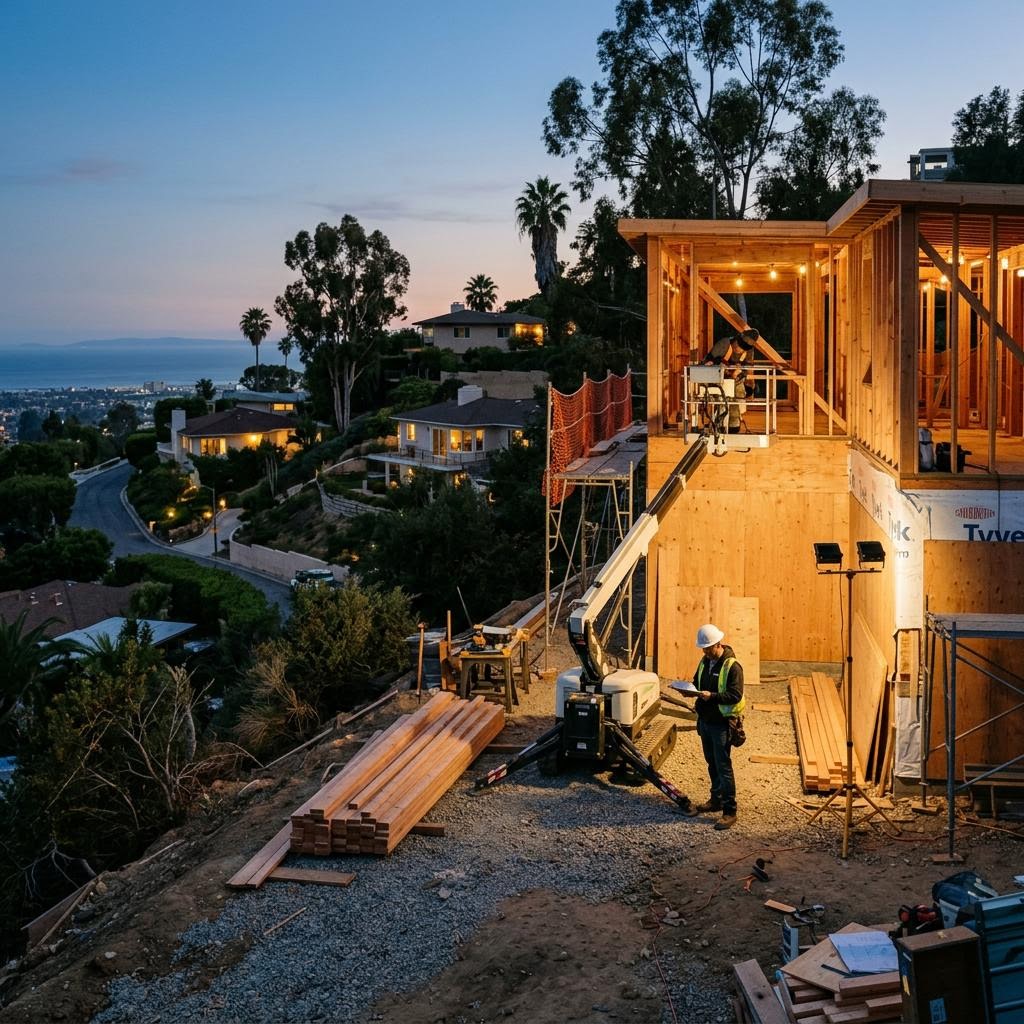
City authority
LAPD NET, LAMC 41.40
County authority
County DPH, Title 12
Specialty
Palisades and Altadena rebuilds
Updated
October 18, 2026
The short answer: a building permit does not set your work hours
Owners and contractors often assume that once LADBS issues a building permit, the crew can work whenever the schedule demands. That is not how Los Angeles works. A building permit approves the scope of construction. The hours when noisy construction may occur are controlled separately, by the noise provisions of the Los Angeles Municipal Code inside the City and by the County Code in unincorporated areas such as Altadena. Permit conditions can add their own, sometimes stricter, limits on top of both.
Inside the City of Los Angeles, the LAPD nuisance guidance states that construction noise is prohibited between 9:00 p.m. and 7:00 a.m., with exceptions handled under LAMC Section 41.40. City Planning environmental documents describe the ordinary City construction window as 7:00 a.m. to 9:00 p.m. on weekdays and 8:00 a.m. to 6:00 p.m. on Saturdays, with covered work on Sundays and national holidays generally prohibited unless an express exception or written authorization applies. The Saturday and Sunday restrictions in Section 41.40(b) relate to covered work within 500 feet of a residential zone, so whether they apply to a particular site depends on its location and the type of work. They are not a blanket rule for every project, and they are not a blanket permission either.
When a City project genuinely needs to work outside those hours, the route is a noise variance inquiry through the LAPD Noise Enforcement Team (NET) and, where applicable, the Board of Police Commissioners. It is not an LADBS counter item, and it is not a Planning zoning variance. Mixing those three up is the most common reason after-hours requests stall.
- Concrete pours that cannot be interrupted
- Crane picks and heavy deliveries timed around traffic
- Utility tie-ins scheduled by a utility
- Work in commercial corridors with daytime access limits
- Fire rebuild schedules under pressure
- Emergency stabilization of a damaged structure
Who decides: LAPD NET, not LADBS or City Planning
The LAPD nuisance page directs construction noise questions and exceptions under LAMC 41.40 to the Noise Enforcement Team, reachable at 213-996-1250. We use that number to confirm the procedure that currently applies, because forms, notice requirements, processing lead time, and the approving authority can change and are not always published in one place. Our standard practice is to ask NET directly for the current application form, any neighbor notice requirement, the expected processing time, and who will sign the approval.
Historical Board of Police Commissioners letters, such as the 2013 and 2015 items published on the Commission site, show that after-hours construction requests have been reviewed case by case, sometimes approved with conditions and sometimes denied. Those letters are useful as examples of how the review reasons. They are not a current fee schedule, current form, or evidence that any similar request will be approved today.
A Planning variance is a different instrument entirely. It addresses zoning standards such as height, yards, or use and is processed under the zoning code. Nothing about a zoning variance authorizes 6:00 a.m. concrete trucks. Likewise, LADBS plan check does not issue construction noise exceptions, although inspectors and permit conditions may reference allowed hours.
What a strong after-hours request includes
Agencies reviewing an after-hours request want to understand exactly what will happen, when, and why it cannot happen during ordinary hours. Vague requests for open-ended night work tend to fare poorly. A focused request ties each proposed time block to a specific task, a specific piece of equipment, and a specific reason.
We assemble the exact site address and permit numbers, the specific dates, task-specific start and end times, and the equipment involved. We document why daytime work is insufficient, for example a pour duration that exceeds the daytime window, a utility shutdown scheduled by the utility, or a traffic restriction on daytime lane use. We identify sensitive neighbors such as residences, schools, hospitals, or care facilities, describe noise mitigation such as equipment placement, temporary barriers, and quieter staging, and provide a responsible on-site contact who will answer the phone during the work.
If the reviewing authority requires neighbor notice, we prepare a notice plan that fits its instructions rather than inventing a radius or posting period. Most importantly, no after-hours work should begin until the approved scope is in writing. If dates, times, or equipment change, the approval should be amended before the changed work proceeds.
- Exact site address and permit numbers
- Dates and task-specific start and end times
- Equipment list for each time block
- Why daytime hours are insufficient
- Sensitive receptors and mitigation measures
- Named on-site contact and notice plan if required
What does not count as a variance
Several things feel like permission but are not. A building permit is not a noise variance. Signatures from neighbors saying they do not mind early work are not a variance, however friendly. Switching to quieter or electric equipment may be good practice and may support a request, but it does not by itself authorize work outside the allowed hours. A general contractor's schedule, a lender deadline, or an insurance timeline is a reason to ask, not a substitute for asking.
Emergency work deserves a careful distinction. Work needed to address an imminent danger to people or property, such as stabilizing a collapsing wall, is treated differently from work that is simply behind schedule. A deadline is not an emergency, and labeling routine production as emergency work can create enforcement problems and credibility problems for later requests.
Allowed hours are also not a free pass. Even during permitted hours, equipment remains subject to applicable noise standards in the municipal code and any project conditions. We do not quote decibel limits in general guides because the applicable standard depends on the equipment, distance, and code provision; confirm the specific standard for your site with the enforcing agency or your acoustical consultant.
Altadena and unincorporated County: the temporary rebuilding framework
Altadena is unincorporated Los Angeles County, so City LAMC hours do not govern it. County noise rules sit in Title 12 of the County Code, including Chapters 12.08 and 12.12, and are administered with the County Department of Public Health. In January 2026 the County Department of Public Health published updated noise information along with a builder handout for fire rebuilding.
That current temporary rebuilding guidance describes allowed construction hours of 7:00 a.m. to 8:00 p.m. Monday through Saturday, and 7:00 a.m. to 7:00 p.m. on Sundays and holidays. No construction is allowed between 8:00 p.m. and 7:00 a.m. on any day, and Sunday work must stop by 7:00 p.m. This is a temporary framework tied to wildfire recovery, not a permanent rewrite of the County code.
Before relying on it, confirm with County DPH that your project is eligible, that it falls within the covered area and type of work, that the framework is still in effect for your dates, and whether your permits carry stricter conditions. Temporary recovery measures can change; obtain current agency confirmation before committing to an extended-hours schedule.
Pacific Palisades is City work: do not borrow County hours
Pacific Palisades is inside the City of Los Angeles. The County's temporary rebuilding hours do not transfer to a Palisades lot simply because both communities are recovering from 2025 wildfires. City noise provisions, any applicable City recovery orders, and project permit conditions control there.
We also do not assume that every City fire rebuild is automatically approved for weekend or extended hours. Emergency orders have adjusted many City processes, but whether any order affects construction hours for your specific project is something to verify with NET at the time of scheduling. If extended hours are needed, plan to ask for them with the same specificity as any other request.
Haul trucks, deliveries, street work, and inspections have their own rules
Construction noise hours are only one schedule constraint. Haul routes approved through LADBS and the Board of Building and Safety Commissioners often carry their own allowed trucking hours, which can be narrower than general construction hours. Work or staging in the public right-of-way, such as a lane closure for a concrete pump or a crane, is reviewed by StreetsLA, BOE, or LADOT, and the traffic control plan may restrict hours further, especially near schools or on peak-hour corridors.
Inspections follow agency scheduling, not crew schedules, and debris removal programs may operate under their own operational windows. A noise approval does not override any of these. When we build an after-hours plan we line up all of them so that the noise approval, haul route, street use permit, and inspection request describe the same day.
How Ocean Permits manages an after-hours request
First, we confirm jurisdiction: City of Los Angeles, unincorporated County, or another city. Second, we compare the planned work to ordinary allowed hours and permit conditions to see whether an exception is actually needed, because sometimes resequencing solves the problem. Third, we contact LAPD NET or County DPH to confirm the current procedure, form, notice, and lead time. Fourth, we build the task-by-task request with your contractor. Fifth, we coordinate any related haul, right-of-way, and inspection approvals. Sixth, we keep the written approval on site and handle amendments if the schedule shifts.
Ocean Permits & Development is a women-owned Los Angeles permit expediting firm founded in 2021 by Katherine Amaya. We coordinate agencies for owners, builders, and design teams, with fire rebuilding in Pacific Palisades and Altadena as a core specialty. We cannot guarantee that any variance or extended-hours request will be approved; we can make sure it is complete, accurate, and sent to the right office. Call 213-277-8777 for a free consultation.
City versus County construction hour frameworks
| Topic | City of Los Angeles | Unincorporated County (e.g. Altadena) |
|---|---|---|
| Governing law | LAMC, including Section 41.40 | County Code Title 12, Ch. 12.08 and 12.12 |
| Night restriction | Construction noise prohibited 9 p.m. to 7 a.m. per LAPD guidance | Temporary rebuild guidance: no construction 8 p.m. to 7 a.m. |
| Ordinary daytime window | 7 a.m. to 9 p.m. weekdays; 8 a.m. to 6 p.m. Saturday for covered work near residential zones | Temporary rebuild guidance: 7 a.m. to 8 p.m. Monday to Saturday |
| Sundays and holidays | Covered work generally prohibited without express exception or written authorization | Temporary rebuild guidance: 7 a.m. to 7 p.m. |
| Who to ask about exceptions | LAPD Noise Enforcement Team, 213-996-1250; Police Commission where applicable | County Department of Public Health |
| Stricter limits | Permit conditions, haul routes, traffic plans may be narrower | Permit conditions and eligibility may be narrower |
Summary for planning only. Confirm current applicability, eligibility and effective period with the enforcing agency before scheduling work.
Cost and budget drivers for after-hours work
There is no universal all-in project price for an extended-hours request. Confirm any current filing or review charge with the responsible agency rather than relying on a fee from another jurisdiction. Separately budget contractor premiums, mitigation and related street approvals; the items below are assessment bases, not a government fee schedule or Ocean Permits service quote.
| Cost item | Basis | What moves it |
|---|---|---|
| Agency review or variance fee | Current agency assessment required | Request type, number of dates, reviewing body |
| Neighbor notice preparation | Only if required by the reviewing agency | Notice method and number of recipients |
| Night and weekend labor premiums | Contractor and union agreements | Crew size, overtime rules, number of shifts |
| Noise mitigation | Contractor or acoustical consultant proposal | Barriers, equipment substitution, monitoring |
| Related right-of-way or traffic control | Separate StreetsLA, BOE, LADOT or County assessment | Lanes affected, duration, devices and inspection |
| Schedule risk if denied | Project-specific | Resequencing, idle equipment, rebooked deliveries |
No approval is automatic. Obtain project-specific contractor proposals and current agency assessments.
Frequently Asked Questions
1. What hours can construction happen in the City of Los Angeles?
LAPD guidance says construction noise is prohibited from 9 p.m. to 7 a.m. City Planning documents describe ordinary construction as 7 a.m. to 9 p.m. on weekdays and 8 a.m. to 6 p.m. on Saturdays, with covered Sunday and national holiday work generally prohibited without an express exception or written authorization. Permit conditions can be stricter.
2. Who approves a construction noise variance in the City?
Exceptions under LAMC 41.40 are handled through the LAPD Noise Enforcement Team and, where applicable, the Board of Police Commissioners. Call NET at 213-996-1250 to confirm the current form, notice, lead time and approving authority.
3. Can LADBS or City Planning approve after-hours construction?
No. LADBS issues building permits and Planning handles zoning variances. Neither instrument is a construction noise variance, though permit conditions may reference work hours.
4. Do the weekend restrictions apply to every project?
Not automatically. The Saturday and Sunday restrictions in LAMC 41.40(b) relate to covered work within 500 feet of a residential zone. Confirm applicability for your site and work type rather than assuming either a restriction or a permission.
5. Is neighbor consent enough to start work early?
No. Neighbor signatures, quieter equipment and a building permit do not replace the written approval required for a noise variance. If relying on an express legal exception instead, confirm its applicability with the enforcing agency before scheduling the work.
6. What should an after-hours request include?
The site address and permit numbers, specific dates, task-specific times and equipment, why daytime work is insufficient, sensitive neighbors, mitigation measures, an on-site contact, and a notice plan if required. Get the approved scope in writing and amend it if anything changes.
7. What are the Altadena rebuilding construction hours?
County DPH temporary rebuilding guidance published in January 2026 lists 7 a.m. to 8 p.m. Monday through Saturday and 7 a.m. to 7 p.m. on Sundays and holidays, with no construction from 8 p.m. to 7 a.m. Confirm eligibility, coverage, effective period and any stricter permit conditions with County DPH.
8. Do the County rebuild hours apply in Pacific Palisades?
No. Pacific Palisades is in the City of Los Angeles, so City noise rules, any applicable City recovery orders and permit conditions govern. Verify current City orders with LAPD NET rather than assuming weekend approval.
9. Is behind-schedule work treated as emergency work?
No. Work responding to imminent danger is treated differently from work facing a deadline. Schedule pressure is a reason to request an exception, not an exemption from asking, and allowed-hours work remains subject to equipment noise standards.
Ocean Permits & Development
Need a clear permit path?
We are a women-owned permit expediting firm founded in 2021 by Katherine Amaya. Our team helps property owners, architects, contractors, and operators move projects through the right jurisdiction and agency review. Consultations are free, and fire rebuild projects are a core specialty.