_1781464136662-DVw5IPjt.png)
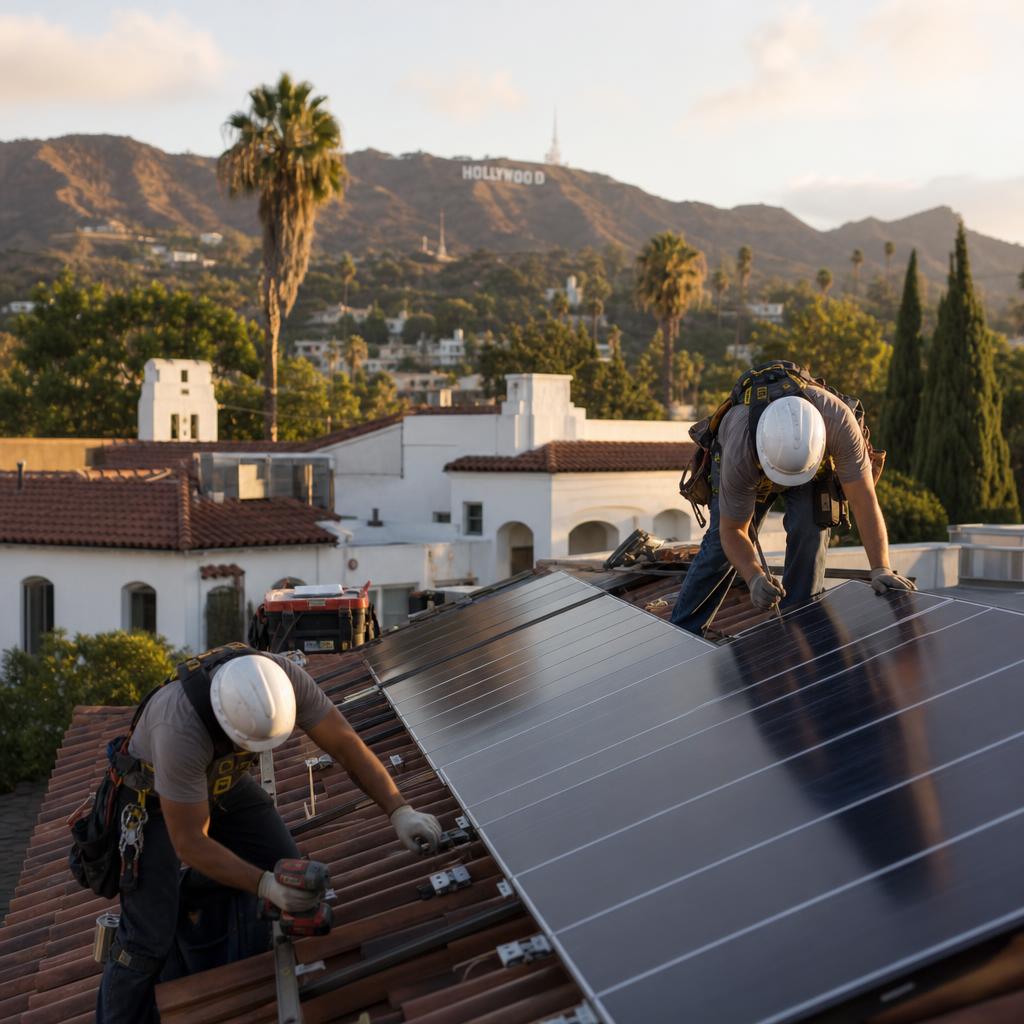
If you're installing solar panels or a battery storage system anywhere in the City of Los Angeles, you are not dealing with one permitting process — you're dealing with two, run by two completely separate government agencies with different rules, different forms, and different timelines. Homeowners and even some contractors routinely assume that once the Los Angeles Department of Building and Safety (LADBS) signs off on the physical installation, the job is done. It isn't. Your system cannot legally export power to the grid — and in most cases can't even be turned on — until the Los Angeles Department of Water and Power (LADWP) separately approves the interconnection and issues Permission to Operate. Understanding this two-agency structure, and the fact that LADWP runs its own net metering program instead of the statewide NEM 3.0 tariff, is the single most important thing to know before you start. This guide walks through both tracks in detail, with the fire-code and rooftop-access rules that apply to every install, and the specific considerations for homeowners rebuilding in Pacific Palisades and Altadena after the 2025 wildfires.
Why LA Solar Permitting Is a Two-Agency Process
Most Southern California cities served by an investor-owned utility (SCE, PG&E, SDG&E) only require coordination between the local building department and that utility. The City of Los Angeles is different because it is served by its own municipal utility, LADWP, which sits entirely outside of California Public Utilities Commission (CPUC) jurisdiction. That means the building permit and the utility interconnection are handled by two agencies that don't share a system, don't share a timeline, and require separate applications.
Track 1: LADBS — the building and electrical permit
LADBS is the City of Los Angeles building department. It reviews and permits the physical scope of work: the racking and roof attachment, the inverter and disconnects, the electrical wiring back to the service panel, structural adequacy of the roof, and — for battery storage — placement, fire clearances, and equipment listing. LADBS also handles the final building/electrical inspection once the system is installed. This is the track most people think of as "getting a solar permit," but on its own it does not authorize you to send power onto the grid.
Track 2: LADWP — interconnection and Net Energy Metering (and why it isn't NEM 3.0)
Separately, LADWP has to approve the electrical interconnection of your system to its distribution grid and enroll your account in its Net Energy Metering (NEM) program before the system can be energized. Because LADWP is a publicly-owned municipal utility rather than a CPUC-regulated investor-owned utility, it was never subject to the CPUC's December 2022 NEM 3.0 decision (the "Net Billing Tariff") that cut export compensation for SCE, PG&E, and SDG&E customers to wholesale-level rates. LADWP instead operates under its own Net Energy Metering Guidelines, crediting exported solar energy at close to the full retail rate, with unused credits rolling forward from bill to bill on LADWP's bi-monthly billing cycle. Homeowners just outside city limits should double check which utility actually serves their meter — some pockets near Santa Monica and the westside are on SCE, not LADWP.
Both approvals are mandatory. A system can pass LADBS final inspection and still be sitting dark because LADWP hasn't issued Permission to Operate.
Step-by-Step: The LADBS Permit Track
Step 1 — Determine your eligibility for SolarAPP+ instant permitting
Under California's SB 379 (the Solar Access Act), every California city with a population over 50,000 was required to stand up an automated, real-time online permitting platform for qualifying residential solar and paired battery storage systems by September 30, 2023. LADBS complies through SolarAPP+, developed with the National Renewable Energy Laboratory, which lets a licensed contractor submit a compliant residential system and receive an issued permit without a human plan checker in the loop — often within a day. Statewide, SB 379 sets the SolarAPP+ eligibility ceiling at 38.4 kW AC for a residential solar system and paired battery storage. In practice, LADBS's own guidelines (Information Bulletin P/GI 2023-027) are written around roof-mounted, single-family or duplex systems up to 10 kW AC combined inverter output, interconnecting to a single-phase 240V service panel with a busbar rating of 225A or less.
Step 2 — Standard plan check for everything else
Larger systems, ground-mounted arrays, three-phase services, structurally unusual roofs, and many battery storage configurations fall outside the automated criteria and route instead through LADBS's conventional plan check via ePlanLA. That review is done by a plan checker rather than an algorithm and takes materially longer, particularly for storage, because it triggers fire and life-safety review. Our permit expediting team routinely pre-screens submittals against LADBS's checklist before filing.
Step 3 — Inspection
Once work is complete, LADBS performs a final electrical/building inspection against the approved plan set. Passing LADBS inspection is a prerequisite to the LADWP interconnection process, not a substitute for it.
Step-by-Step: The LADWP Interconnection Track
Step 1 — File the NEM / interconnection application
Before or shortly after the physical install, your contractor submits an interconnection application through LADWP's NEM portal (ladwp.com/nem), which issues an Interconnection Work Request Number (WR#) that tracks the project through LADWP's system.
Step 2 — Type 1 fast-track vs. manual review for larger systems
LADWP offers a simplified Type 1 Interconnection Process for combined PV (NEM) and/or battery storage projects up to 30 kW aggregate system size — covering the overwhelming majority of single-family homes. Systems at or above 30 kW AC-CEC require a manual application, and for more complex projects, LADWP's Solar-Powered Customer Generation Interconnection Agreement (the "Long-Form IA"). No individual LADWP account can be enrolled in net metering for a system larger than 1 megawatt.
Step 3 — Meter set and Permission to Operate (PTO)
After LADBS final inspection, LADWP still has to inspect or verify the interconnection, install or verify bi-directional metering, and issue Permission to Operate — the formal authorization to energize the system. When paperwork is complete, LADWP's own review can move in roughly one to two weeks, but end-to-end, homeowners should plan for the full permit-to-PTO span to run several weeks to a few months. Attempting to energize a system before PTO is issued is a tariff violation, not just a paperwork technicality.
Standard Solar vs. Solar + Battery Storage
| Standard Rooftop Solar (PV only) | Solar + Battery Storage | |
|---|---|---|
| LADBS permit type | Express/SolarAPP+ instant permit for qualifying systems ≤10 kW AC, single/duplex, ≤225A 240V panel | Standard plan check in most cases; many battery installs route through conventional plan check due to fire/life-safety review |
| Agencies involved | LADBS (permit/inspection) + LADWP (NEM/interconnection) | LADBS (permit/inspection, plus LAFD fire-code review) + LADWP (NEM/interconnection, storage-inclusive) |
| Typical timeline | Same day–48 hours for SolarAPP+ eligible systems; 2–6+ weeks for standard plan check; LADWP interconnection adds 2–6+ weeks | Several weeks for plan check and fire review alone; total permit-to-PTO commonly runs 6–16 weeks |
| Key code requirements | Title 24, Part 6 solar mandate compliance (new construction); LAFD Requirement No. 96 roof access pathways; NEC rapid shutdown | All PV requirements above, plus UL 9540 system listing (2022 CRC §R328.2 / CA Fire Code §1207.3.1), UL 9540A-informed separation distances |
| Structural review | Required if roof-mounted array needs added structural calculations | Required for array; battery pad/wall-mount also reviewed for weight, seismic anchorage, clearance |
| Typical fee range* | Roughly $200–$450 for a SolarAPP+-issued residential PV permit | Roughly $350–$800 for storage alone, or $500–$1,100 for combined solar+storage |
*Fees scale with system valuation and scope; treat as planning-level estimates, confirm current figures before budgeting.
Fire Code and Rooftop Access Requirements (LAFD Requirement No. 96)
Every rooftop PV installation has to satisfy the Los Angeles Fire Department's rooftop solar placement standard, LAFD Requirement No. 96, implementing roof access/pathway provisions of the California Fire Code and CRC §R324.6:
Access pathways are mandatory: on a hip roof, at least one 3-foot-wide clear pathway per roof slope with panels; on a single-ridge roof, two 3-foot-wide pathways per slope. Panels can't be within 3 feet of the ridge.
Array size is capped at 150 by 150 feet, forcing larger roofs to be broken into multiple arrays.
DC combiner boxes must keep conduit runs out of pathways; systems must carry LAFD-compliant marking, labeling, and rapid-shutdown signage.
Overhead/trellis-mounted arrays need a minimum 7-foot clearance and the same labeling.
Battery storage carries additional fire-code layers: under 2022 CRC §R328.2 and CA Fire Code §1207.3.1, residential storage systems must be UL 9540 listed as a complete system. Placement is governed by UL 9540A test data: baseline required separation between battery units is 3 feet, reducible only if manufacturer UL 9540A data justifies it. Garage- or wall-mounted units also need setbacks from doors, windows, and egress paths.
Solar Permitting for Palisades and Altadena Fire Rebuilds
Under the 2022 Building Energy Efficiency Standards (California Energy Code, Title 24, Part 6, §150.1(c)14), effective January 1, 2023, every new single-family home and new low-rise multifamily building in California is required to include a photovoltaic system, and the 2023 update extended that mandate further while adding a "battery-ready" electrical infrastructure requirement. A full teardown-and-rebuild is normally treated as new construction, which would trigger this mandate in full.
For homes lost in the January 2025 Palisades and Eaton fires, that default has been modified by emergency state action. Governor Newsom's executive orders issued to accelerate fire recovery — beginning with EO N-4-25 in January 2025 and extended through subsequent orders including EO N-29-25 — suspended application of the 2025 California Building Standards Code, including the rooftop solar and battery storage installation mandate, for like-for-like rebuilds that do not exceed 110% of the original structure's footprint and height. Critically, the orders retained the underlying "solar-ready" requirement, meaning rebuilt homes still need the conduit, panel capacity, and roof provisioning to accept a solar system later, even where installing the panels themselves isn't currently mandatory.
Practically, that leaves Palisades and Altadena rebuild homeowners in one of three positions: (1) a true like-for-like rebuild under the streamlined exemption, where solar is currently optional but the home must be wired solar-ready; (2) exceeding the 110% threshold, where the standard Title 24, Part 6 solar mandate applies just as it would to any new home in California; or (3) choosing to install solar and battery storage anyway. Many homeowners rebuilding in fire-prone hillside terrain choose the third option: a paired battery system provides backup power for critical loads during Public Safety Power Shutoffs and grid outages, and because LADWP's own NEM program credits exported energy at close to full retail value rather than NEM 3.0's discounted export rate, the economics of adding solar during a full rebuild are considerably better in LA than for a comparable rebuild on SCE territory. See our rebuilding guide for Pacific Palisades and Altadena and our breakdown of like-for-like rebuild rules. If your home also needs structural upgrades, see our seismic retrofit permitting guide. For the citywide rebuild timeline, see how long permits are taking in Los Angeles, and our fire rebuild page.
Work With a Permit Expediter Who Knows Both Agencies
Ocean Permits is a women-owned permit expediting firm based in Los Angeles, built specifically around LA's building and utility departments, and we specialize in fire rebuild permitting for Pacific Palisades and Altadena alongside standard residential and light commercial solar and battery storage work. We track your LADBS submittal and your LADWP interconnection application in parallel. We offer a free consultation — call 213-277-8777, or learn more about our permit expediting services and consulting support. Reach us through our contact page.
Frequently Asked Questions
Do I need a permit to install solar panels in Los Angeles?
Yes. Any grid-tied residential or commercial solar installation requires an LADBS building/electrical permit and a separate interconnection approval from LADWP before the system can be legally energized.
What is SolarAPP+, and does the City of LA use it?
SolarAPP+ is a state-mandated automated online permitting platform (required under SB 379) that reviews qualifying residential solar applications in real time. LADBS uses it for eligible single-family and duplex systems, typically up to about 10 kW AC.
Does battery storage qualify for the same instant permit as solar panels?
Not reliably. Battery systems trigger additional fire and life-safety review, so most battery installs go through LADBS's standard plan check instead.
What is the difference between LADBS and LADWP in the solar process?
LADBS is the building department; it permits and inspects the physical installation. LADWP is the municipal electric utility; it separately approves the grid interconnection and issues Permission to Operate.
Is LADWP on NEM 3.0?
No. NEM 3.0 applies only to CPUC-regulated investor-owned utilities — SCE, PG&E, and SDG&E. LADWP is a municipal utility outside CPUC jurisdiction and runs its own Net Energy Metering Guidelines, generally crediting exported solar at close to full retail value.
How long does it take to get a solar permit approved in LA?
A SolarAPP+-eligible system can be issued in as little as a day. Systems requiring standard plan check, and any project including battery storage, typically take several weeks, with total project timelines commonly running six to sixteen weeks.
Can I turn my solar system on as soon as LADBS approves the inspection?
No. You cannot legally energize the system or export power to the grid until LADWP separately issues Permission to Operate.
What are the fire department's rooftop setback rules for solar panels?
Under LAFD Requirement No. 96, hip roofs need at least one 3-foot-wide access pathway per slope, single-ridge roofs need two 3-foot pathways per slope, and individual arrays are capped at 150 by 150 feet.
Does battery storage require special fire code review?
Yes. Residential batteries must be UL 9540 listed, and placement is governed by UL 9540A separation-distance data — generally a minimum 3-foot clearance between units unless manufacturer testing justifies less.
Am I required to install solar if I'm rebuilding my home in Pacific Palisades or Altadena?
Not automatically. Executive orders suspended the standard Title 24 solar mandate for like-for-like rebuilds within 110% of the original footprint, though homes must still be wired solar-ready.
Why would a fire rebuild homeowner add solar and battery storage even if it isn't required?
Many add a battery system for backup power during Public Safety Power Shutoffs, and because LADWP's retail-rate net metering makes the economics more favorable than NEM 3.0.
What size solar system can go through LADWP's simplified interconnection review?
LADWP's Type 1 Interconnection Process covers combined PV and/or battery storage projects up to 30 kW aggregate; no single account can exceed 1 megawatt.