_1781464136662.png)
Wireless Communication Facility
& Cell Tower Permits in Los Angeles
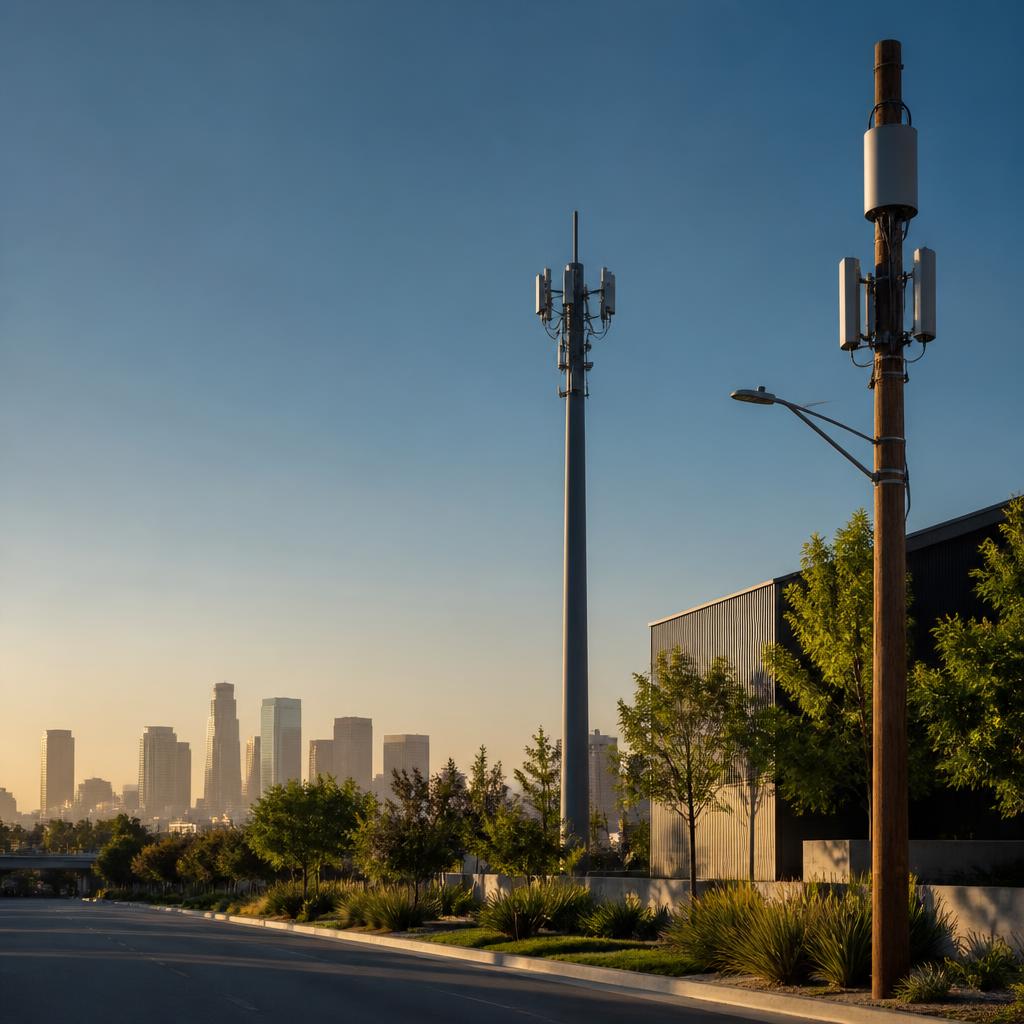
A cell tower and a small antenna on a streetlight are not the same permit problem. One is a discretionary land-use decision measured in months; the other is a federally time-limited, largely ministerial review measured in days. Confusing the two is the single most common cause of a stalled wireless deployment in Los Angeles.
Ocean Permits & Development coordinates permit administration for wireless communication facilities across Los Angeles and the surrounding region — macro cell towers, rooftop and building-mounted macro antennas, Small Wireless Facilities (SWFs) on streetlights and utility poles, distributed antenna system (DAS) nodes, and equipment upgrades or co-locations on existing structures. Carriers, tower companies, neutral-host operators, integrators, and property owners each face a different permit path depending on the facility type, the structure it sits on, and whether it occupies private property or the public right-of-way.
Los Angeles wireless review typically runs through LADBS for building and electrical permits, City Planning for a Conditional Use Permit (CUP) when zoning requires discretionary approval, Bureau of Engineering (BOE) or StreetsLA for right-of-way encroachment permits on public poles, and LADWP when the facility attaches to or is powered from utility infrastructure. A site in an adjacent city or in unincorporated Los Angeles County follows its own zoning code and right-of-way process, but the underlying federal framework — the Telecommunications Act, the FCC's Small Cell Order, and Section 6409(a) co-location rules — still applies.
Our role is permit administration and agency coordination, not radio-frequency engineering, structural design, or antenna design. We help carriers, tower owners, contractors, and property owners assemble a complete application, track the applicable federal shot clock, and keep the CUP, building, electrical, and encroachment tracks moving on one schedule.
Macro cell towers and monopoles: the discretionary path
A new freestanding monopole, lattice tower, or a large macro installation on a commercial rooftop is generally the most permit-intensive wireless facility type. Los Angeles zoning typically requires a Conditional Use Permit for a new macro tower, which means a public hearing, a staff report, findings on compatibility with the surrounding neighborhood, and often a Mitigated Negative Declaration or other CEQA review before City Planning acts. The CUP process runs on a City Planning calendar, not a fixed federal shot clock, and can take several months from a complete application to a final, appeal-period-expired decision.
Once land-use approval is final, the project still needs an LADBS building permit for the foundation and structure, an electrical permit for the equipment shelter and power feed, and often a separate structural analysis demonstrating the tower or rooftop can support the proposed loading, including planned future co-location. A macro tower on private property may also need a lease or easement, a Federal Aviation Administration (FAA) obstruction evaluation if it exceeds certain height thresholds near flight paths, and Federal Communications Commission (FCC) antenna structure registration in some cases. None of the federal RF-safety or shot-clock rules discussed below remove the CUP or CEQA requirement for a genuinely new macro structure.
- New monopoles, lattice towers, and large rooftop macro installations
- Conditional Use Permit, public hearing, and CEQA review through City Planning
- LADBS building, electrical, and structural permits for the tower and equipment
- FAA obstruction evaluation and FCC antenna structure registration where applicable
- Lease, easement, and neighboring-property notice requirements
Small Wireless Facilities and the FCC's 2018 Small Cell Order
Small Wireless Facilities are the compact antenna and equipment installations mounted on streetlights, traffic signals, and utility poles, typically serving 4G densification and 5G coverage. In 2018 the FCC adopted Declaratory Ruling and Third Report and Order, WC Docket No. 17-84 and WT Docket No. 17-79 (commonly called the Small Cell Order), which defines an eligible Small Wireless Facility by size and finds that state and local review of a compliant SWF is subject to a 60-day shot clock for collocations on existing structures and a 90-day shot clock for new structures, measured from a complete application. The order also caps application and recurring right-of-way fees at a reasonable approximation of the locality's actual cost.
California layers its own streamlining on top of the federal order. Public Utilities Code Section 7901 gives telephone corporations a right to construct lines, poles, and related infrastructure along and across public roads in a manner that does not incommode public use, and California courts and the Public Utilities Commission have read that authority as limiting a city's ability to deny a compliant SWF outright, even though the city retains reasonable time, place, and manner control through its encroachment permit process. The combined effect is that a compliant SWF application in the right-of-way is reviewed on a compressed, largely ministerial timeline rather than the discretionary CUP process that applies to a new macro tower.
A locality can still adopt an SWF ordinance or master permit process that sets design standards, application requirements, and fees, as Los Angeles has done through its Bureau of Engineering wireless facility rules. Meeting those local design and application standards is what keeps the review inside the streamlined shot clock; an application that is missing required elements can be deemed incomplete, which pauses the clock until it is cured.
- FCC Small Cell Order: 60-day shot clock for collocation, 90-day for new SWF structures
- Size thresholds define what qualifies as a Small Wireless Facility under the order
- California Public Utilities Code §7901 authorizes right-of-way use for telephone corporations
- City design standards and application completeness control what stays inside the shot clock
- Application and recurring fees are capped at a reasonable approximation of actual cost
Right-of-way encroachment permits and pole attachment approvals
An SWF mounted on a City-owned streetlight or traffic signal pole needs an encroachment permit from the Bureau of Engineering or StreetsLA authorizing work in the public right-of-way, separate from any building or electrical permit for the equipment itself. The encroachment application typically documents the exact pole location, pole ownership, proposed attachment height and configuration, traffic control during installation, and compliance with the City's SWF design standards for antenna shrouds, equipment cabinets, and cable routing.
If the facility attaches to an LADWP-owned pole rather than a City streetlight, LADWP's own pole attachment or joint-use process applies, which can run on a different timeline than the BOE encroachment permit and may require its own structural loading review of the pole. A site on a Southern California Edison or private utility pole follows that utility's pole attachment tariff process instead of a City right-of-way permit. Confirming pole ownership before submittal is one of the most consequential early steps in a wireless project, because it determines which agency's process and timeline actually controls.
- Bureau of Engineering / StreetsLA encroachment permit for City right-of-way poles
- Pole ownership determines whether BOE, LADWP, or a private utility process applies
- Traffic control and public safety plans for installation in active streets and sidewalks
- Design standards for antenna shrouds, cabinets, cable routing, and ground equipment
- Coordination between the encroachment permit and any required electrical connection
Federal preemption of RF-emissions review under the Telecommunications Act
Section 332(c)(7)(B)(iv) of the Telecommunications Act of 1996 provides that no state or local government may regulate the placement, construction, or modification of personal wireless service facilities on the basis of the environmental effects of radio frequency emissions, to the extent those facilities comply with FCC RF-exposure limits. In practice, this means a City Planning commission, city council, or hearing officer cannot deny or condition a wireless permit because of neighborhood concerns about RF radiation or health effects, provided the applicant demonstrates compliance with the FCC's exposure limits.
This preemption does not eliminate local review altogether. A locality retains authority over land use, aesthetics, structural safety, traffic, and other conventional zoning and building considerations; it simply cannot use RF-emissions concerns as the basis for a decision. Applicants should still expect community meetings and public comment on a CUP-level macro tower application, and comments raising RF-safety concerns; the legal question is whether the ultimate decision relies on those concerns, not whether they are raised.
Concealment standards, aesthetics, and co-location design
Los Angeles and most surrounding jurisdictions apply concealment or "stealth" design standards to wireless facilities, particularly in residential zones, scenic corridors, and hillside areas. A macro installation may need to be integrated into an architectural feature, disguised as a flagpole or faux chimney, or screened with materials matching the host structure. An SWF on a streetlight typically must match the pole's existing style and color, keep equipment cabinets within specified size limits, and route cabling internally or through approved conduit rather than exposed lashing.
Co-location — adding new antennas or equipment to an existing tower, rooftop, or pole rather than building a new structure — is favored by both federal and local policy because it reduces the number of new structures in the right-of-way and the visual impact of wireless infrastructure. Section 6409(a) of the Spectrum Act (part of the Middle Class Tax Relief and Job Creation Act of 2012) requires localities to approve, without discretionary land-use review, an eligible facilities request that does not substantially change the physical dimensions of an existing wireless tower or base station, subject to a 60-day shot clock. A substantial-change determination — based on height increase, width increase, additional equipment cabinets, or excavation beyond the existing site — is the threshold question that decides whether a co-location gets the fast Section 6409(a) path or falls back into full discretionary review.
- Concealment and stealth design requirements by zone and neighborhood context
- Pole-matching, cabinet size limits, and internal cable routing for streetlight SWFs
- Section 6409(a) eligible facilities requests: ministerial review, 60-day shot clock
- Substantial-change thresholds for height, width, equipment, and ground disturbance
- Structural loading analysis confirming the existing tower or pole can support new equipment
DAS networks, in-building systems, and neutral-host deployments
Distributed Antenna Systems and in-building wireless deployments extend coverage inside stadiums, hospitals, hotels, office towers, and parking structures using a network of low-power antenna nodes connected to a shared fiber or coaxial backbone. These systems are generally treated as tenant-improvement electrical and low-voltage work under LADBS rather than as land-use wireless facilities, unless the project also includes new exterior antennas or rooftop equipment that trigger the macro or SWF review paths described above.
A neutral-host DAS or small-cell network serving multiple carriers adds a coordination layer: the host property owner, the neutral-host operator, and each carrier's equipment may all need separate approvals or license agreements, and the fire department may require the DAS to also support first-responder radio coverage under applicable fire and building code provisions for emergency responder communication systems.
Wireless permit process and typical sequence
A macro tower project typically begins with a zoning and site feasibility review, a pre-application meeting with City Planning, environmental and RF-compliance documentation, and a CUP application supported by a radio-frequency engineer's exhibits and a structural engineer's loading analysis. After the CUP is approved and any appeal period expires, the building, electrical, and (if applicable) FAA/FCC filings proceed, followed by construction and final inspection.
An SWF or co-location project runs on a shorter, more procedural track: confirm pole ownership and applicable design standards, assemble a complete application package (site plan, structural loading letter, RF-compliance exhibit, photo simulations, and any required insurance or bonding), submit for the encroachment permit and any building/electrical permit in parallel, and track the federal shot clock from the date the application is deemed complete. If the reviewing agency issues a request for additional information, the clock is generally tolled until the applicant responds, so a fast, complete resubmittal matters more on this track than on a discretionary CUP timeline.
- Macro tower: pre-application meeting, CUP hearing, CEQA, then building/electrical permits
- SWF/co-location: pole ownership confirmation, complete application, shot-clock tracking
- RF-compliance exhibits and structural loading letters supporting every facility type
- Photo simulations and concealment detail for aesthetic and design review
- Final inspection, as-built documentation, and closeout for each permit track
How Ocean Permits helps wireless deployments move
Ocean Permits & Development is a women-owned, Los Angeles-based permit expediting firm founded in 2021 by Katherine Amaya. We coordinate permit administration for complex infrastructure projects, including data centers and mission-critical facilities, warehouse and industrial conversions, and wireless communication installations. We do not perform RF engineering, structural design, or antenna design; our role is to assemble a complete, agency-ready application, confirm which review track and shot clock actually applies, and keep City Planning, LADBS, Bureau of Engineering, LADWP, and pole owners working from the same site plan and schedule.
A wireless project that also involves a data center, colocation facility, or other critical-infrastructure build-out benefits from coordinating both permit tracks together; see our data center and server colocation facility permit guide for the electrical, cooling, and fire-protection process that often runs alongside a carrier's network buildout. Call 213-277-8777 or request a free consultation with the site address or pole location, facility type (macro, SWF, DAS, or co-location), pole or structure ownership, carrier or operator information, and target activation date.
Wireless facility types and planning ranges
These are planning ranges from a complete, agency-ready application, not agency guarantees. Incomplete submittals, contested CUP hearings, and pole-ownership disputes can extend any of these timelines.
| Facility type | Review framework | Planning range | Primary agency |
|---|---|---|---|
| New macro tower / monopole | Discretionary CUP + CEQA + LADBS | 6–14+ months | City Planning, LADBS |
| Rooftop macro installation | CUP (varies by zone) + LADBS structural/electrical | 4–10 months | City Planning, LADBS |
| Small Wireless Facility (new pole) | FCC Small Cell Order, 90-day shot clock | 3–5 months incl. cure periods | Bureau of Engineering / StreetsLA |
| Small Wireless Facility (collocation) | FCC Small Cell Order, 60-day shot clock | 2–4 months incl. cure periods | Bureau of Engineering / StreetsLA |
| Eligible facilities co-location (§6409(a)) | Ministerial, 60-day shot clock | 6–10 weeks | LADBS / City Planning intake |
| Indoor DAS / in-building system | LADBS electrical & low-voltage TI | 6–12 weeks | LADBS |
Shot-clock timelines run from a complete application and are commonly tolled while the agency awaits additional information. Pole ownership (City, LADWP, or private utility) should be confirmed before the clock is assumed to be running.
Frequently Asked Questions
Does a new cell tower need a Conditional Use Permit in Los Angeles?
In most zones, yes. A new freestanding monopole, lattice tower, or large rooftop macro installation is a discretionary land use requiring a CUP, a public hearing, and CEQA review, in addition to LADBS building and electrical permits.
What is a Small Wireless Facility under the FCC's 2018 order?
The FCC's 2018 Declaratory Ruling and Third Report and Order (the Small Cell Order) defines eligible Small Wireless Facilities by antenna and equipment size limits and subjects compliant applications to a 60-day shot clock for collocations and a 90-day shot clock for new structures.
Can Los Angeles deny a compliant small cell application outright?
Generally no. California Public Utilities Code §7901 and the FCC's Small Cell Order limit a locality's ability to categorically deny a compliant SWF in the right-of-way, though the City retains reasonable time, place, and manner control through design standards and the encroachment permit process.
Can a city deny a wireless permit based on RF-emission health concerns?
No. Section 332(c)(7)(B)(iv) of the Telecommunications Act preempts state and local regulation of wireless facilities based on RF-emissions health effects when the facility complies with FCC exposure limits. The locality still retains authority over land use, structural safety, and aesthetics.
What is Section 6409(a) and how is it different from the Small Cell Order?
Section 6409(a) of the Spectrum Act requires ministerial approval, without discretionary review, of an eligible facilities request that does not substantially change an existing tower or base station, on a 60-day shot clock. It applies to co-locations on existing macro structures, while the Small Cell Order specifically addresses new and collocated Small Wireless Facilities.
Do I need a separate encroachment permit for a pole-mounted small cell?
Yes, if the facility attaches to a City-owned streetlight or traffic signal pole, a Bureau of Engineering or StreetsLA encroachment permit is required in addition to any electrical permit. A pole owned by LADWP or a private utility follows that owner's separate attachment process instead.
What counts as a 'substantial change' that removes co-location from the fast track?
Federal rules define substantial change by specific thresholds for height increase, width increase, the number of new equipment cabinets, and ground disturbance beyond the existing site. Exceeding those thresholds moves the project out of the Section 6409(a) ministerial path and into full discretionary review.
Does an indoor DAS need a wireless land-use permit?
Usually not. An indoor Distributed Antenna System is typically reviewed as electrical and low-voltage tenant-improvement work under LADBS unless the project also adds exterior antennas or rooftop equipment that trigger macro or SWF review.
How long does a small cell permit take in Los Angeles?
A complete collocation application can move through the 60-day federal shot clock, while a new small-cell structure runs on a 90-day shot clock. In practice, incomplete applications, design-standard corrections, and pole-ownership confirmation commonly add several weeks beyond the clock itself.
Can Ocean Permits design or engineer my wireless facility?
No. Licensed RF, structural, and civil engineers must design and certify the facility. Ocean Permits coordinates the CUP, building, electrical, and encroachment applications, confirms which shot clock applies, and manages the agency correction and resubmittal process.
What should I provide for a wireless facility permit consultation?
Provide the site address or pole location, facility type (macro, SWF, DAS, or co-location), pole or structure ownership, carrier or neutral-host operator information, RF-compliance and structural documentation if available, and the target activation date.
Relevant Ocean Permits Resources
Deploying a Cell Tower or Small Wireless Facility?
We coordinate CUP, LADBS, Bureau of Engineering encroachment, and LADWP pole-attachment tracks around the federal shot clock that actually applies to your facility. Free initial consultation for carriers, tower owners, and property owners.
Free Initial ConsultationCall 213-277-8777