_1781464136662-DVw5IPjt.png)
Quick Answer
A temporary power pole (T-pole) needs its own electrical permit and AHJ inspection—LADBS, LA County, or the local city's building department, depending on the parcel—before LADWP, Southern California Edison, or another utility will energize it. The pole must be built to the serving utility's current specification and to NEC Article 590's rules for temporary wiring, and it is meant to come down once permanent service is approved.
Before a single framing inspection happens, most Los Angeles construction sites need power for tools, lighting, security, and a job trailer. That power almost never comes from a permanent electrical service on day one—it comes from a temporary power pole, permitted and inspected as its own piece of electrical work. Skipping or mishandling this step is a common, avoidable cause of early-schedule delays, especially on fire-rebuild lots where the prior electrical service was removed along with the rest of the structure.
This guide walks through how temporary power pole permitting actually works across Los Angeles-area jurisdictions, why LADWP and Southern California Edison territory are not interchangeable, what NEC Article 590 requires, and how the T-pole permit fits into the broader construction and fire-rebuild timeline. As always, utility specifications and AHJ practices can be updated, so confirm current requirements directly with the utility and building department for the specific parcel before finalizing plans.
Why a Temporary Power Pole Is Its Own Permit, Not an Afterthought
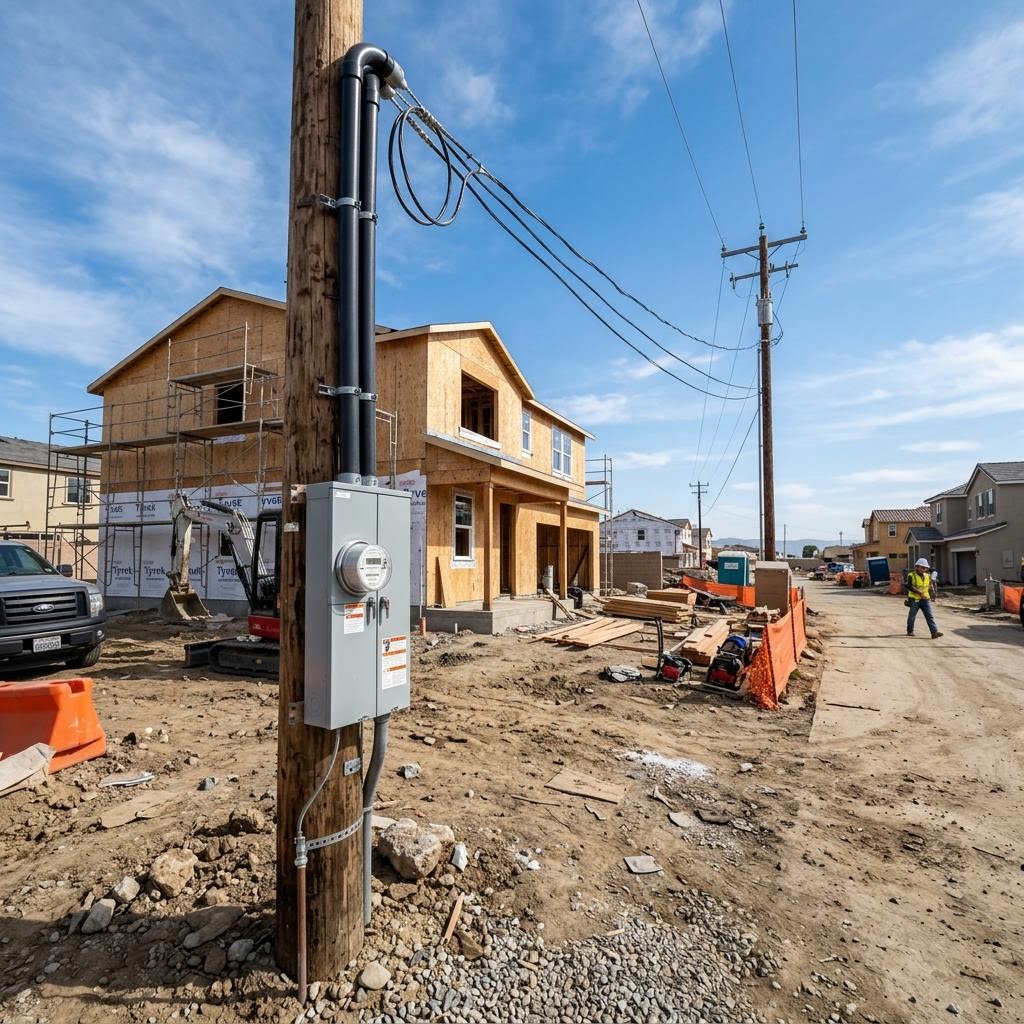
A temporary power pole is a functioning piece of electrical infrastructure—complete with a meter socket, main panel, breakers, grounding electrode system, and a disconnecting means—even though it is meant to be temporary. Because it carries utility-supplied power to a job site, it is reviewed and inspected under the same basic electrical-safety framework as any other service equipment, not treated as a simple extension cord arrangement. That means it needs its own permit application, its own set of installation specifications from the serving utility, and its own inspection before the utility will connect power.
Treating the T-pole as an afterthought—ordering materials without confirming the utility's current specification, or assuming a licensed electrician's general experience is enough without checking the local AHJ's process—is one of the most common causes of a failed first inspection. Building the T-pole permit into the very first phase of project planning, alongside demolition and grading, keeps a crew from showing up to a site with no legal way to power tools or lighting.
NEC Article 590: The Code Framework for Temporary Wiring
National Electrical Code Article 590, adopted into California's electrical code with any state or local amendments, governs temporary electrical installations used during construction, remodeling, maintenance, repair, or demolition. It addresses feeder and branch-circuit conductor protection, overcurrent protection sizing, grounding and bonding, GFCI protection for 125-volt, single-phase, 15-, 20-, and 30-ampere receptacles used by personnel, guarding of energized parts from accidental contact, and support and protection of cable and conductors from damage. It also makes clear that temporary wiring is meant to be removed immediately upon completion of the purpose for which it was installed.
In practice, this means an inspector reviewing a T-pole is not just confirming that a pole is standing and a meter socket is mounted. The inspector is checking that the panel is properly grounded and bonded, that the disconnect is accessible and clearly marked, that conductors are properly protected and supported, and that receptacles serving hand tools or trailers have GFCI protection consistent with Article 590's personnel-protection requirements. A pole assembled without attention to these details is a common reason for a rejected inspection and a delayed utility connection.
Utilities layer their own construction-power specifications on top of the base NEC framework—pole height and setting depth, service entrance conductor sizing, meter socket type, and clearance from structures, driveways, and overhead lines are all typically dictated by the specific utility serving the parcel. A T-pole built to a generic or outdated specification, rather than the current published requirements of the actual serving utility, is unlikely to pass inspection on the first attempt.
LADWP vs. Southern California Edison: Confirm the Serving Utility First
Los Angeles-area construction sites are not all served by the same electric utility, and the difference matters directly for T-pole permitting. Much of the City of Los Angeles, including Pacific Palisades, is served by the Los Angeles Department of Water and Power. Altadena and many surrounding unincorporated county areas and independent cities are served instead by Southern California Edison. Each utility maintains its own temporary-service application process, its own construction-power specification sheet, and its own scheduling practices for meter sets and disconnections, and the two processes are not interchangeable.
The authority that inspects the T-pole before energization also depends on the parcel's location. Inside the City of Los Angeles, LADBS electrical inspectors typically approve the installation before LADWP will connect it. In unincorporated Los Angeles County or in an independent city with its own building department, that inspection role generally falls to the county's or the local city's building and safety division instead, even though the physical utility serving the site might still be Southern California Edison or another provider. Confirming both the correct utility and the correct inspecting AHJ—for the specific parcel, not a neighboring one—should be the very first call made once a construction schedule starts to take shape.
This distinction comes up constantly in our Pacific Palisades and Altadena fire-rebuild work: a Palisades lot and an Altadena lot just a few miles apart, both rebuilding after the same fire event, can be routed through entirely different utility applications and inspecting agencies. Treating the two as identical processes is a fast way to lose weeks waiting on the wrong utility's queue.
Temporary Power by Jurisdiction
The table below is a general orientation, not a substitute for confirming the exact utility and AHJ for a specific parcel, since service territory boundaries and local practices can be granular and can change.
| Area | Serving utility | Inspecting AHJ | Notes |
|---|---|---|---|
| City of Los Angeles, LADWP-served (e.g., Pacific Palisades) | LADWP | LADBS electrical inspection before LADWP will energize | Temporary service application and LADWP-approved pole/panel configuration required. |
| Unincorporated LA County and cities served by SCE (e.g., Altadena) | Southern California Edison | LA County Building & Safety or the local city's building department | SCE's own temporary service and construction-power requirements apply; county inspection precedes energization. |
| Independent cities with their own building departments | SCE or the local municipal utility, depending on the city | Local city building and safety division | Confirm the specific city's temporary-service process; it will differ from LADBS or county practice. |
| State highway or CalTrans right-of-way encroachment | Varies | Encroachment permit plus standard AHJ electrical inspection | Rare for typical residential rebuilds, but relevant for some larger sites. |
General orientation only, not a legal determination of service territory or jurisdiction. Confirm the serving utility and inspecting agency directly for the specific parcel before ordering materials or scheduling an electrician.
Typical Timeline by Scenario
Actual timelines depend on current AHJ and utility workload, but the ranges below reflect the general pattern we see across LADWP and SCE territory.
| Scenario | Permit issuance | Inspection scheduling | Notes |
|---|---|---|---|
| Standard residential T-pole, LADWP territory | Often a few business days for LADBS electrical permit issuance once a complete application is submitted | Typically scheduled within about a week of the pole being built and ready | Timelines vary by current LADBS workload; confirm current scheduling directly. |
| Standard residential T-pole, SCE territory | Similar range through county or local city building and safety, often a few business days | Scheduling depends on the local AHJ's current inspection queue | SCE's own meter-set scheduling is a separate step after AHJ approval. |
| Fire-rebuild lot with no prior service equipment | Comparable permit-issuance timeline, but often prioritized alongside demolition and grading | Coordinating inspection timing with debris removal and grading inspections can shorten the overall gap without power | We track this sequencing specifically for Palisades and Altadena rebuild clients. |
| Larger commercial or multi-trade site | Can take longer if the panel size or service configuration needs additional utility engineering review | May require more than one inspection if the scope includes multiple disconnects or sub-panels | Confirm utility engineering lead time early for larger temporary services. |
General orientation only, not a quoted timeline. We confirm current AHJ and utility scheduling for your specific address during a free consultation.
Sequencing the T-Pole With Demolition, Grading, and the Building Permit
On a typical rebuild, the practical sequence runs roughly as follows: confirm the serving utility and inspecting AHJ for the parcel, retain a licensed electrician to build the T-pole to the utility's current specification, submit the electrical permit application to the AHJ, schedule and pass the AHJ's inspection, and then schedule the utility's meter set and energization. Only after that sequence is complete does the site typically have legal power for trailers, lighting, and tools.
This sequence should run in parallel with—not after—demolition and grading permitting, since a site with an approved demolition or grading permit but no power plan often ends up improvising with generators or delaying mobilization. For fire-rebuild lots specifically, where the prior meter and service equipment were typically removed along with the burned structure, the T-pole is frequently the very first electrical permit pulled on the project, well before framing or rough electrical for the new home begins.
Coordinating this timeline is exactly the kind of scheduling work we do alongside our broader fire debris removal and post-fire utility reconnection guidance, since power, water, and gas reconnection questions on a rebuild lot are closely related and often need to be sequenced together rather than solved one at a time.
Common Mistakes That Delay Energization
The most frequent mistake is building the T-pole to an outdated or generic specification rather than the serving utility's current construction-power standard, which forces a rebuild or rework after a failed inspection. A close second is confusing the serving utility—assuming LADWP because a neighboring property is inside city limits, when the actual parcel is served by Southern California Edison, or vice versa. Both mistakes are avoidable with a single confirming call before materials are ordered.
Another common issue is treating the AHJ inspection as optional or assuming a utility will energize a pole once it is physically built, without waiting for the inspection card or approval. Most utilities will not schedule a meter set until they receive confirmation that the AHJ inspection has passed, so skipping ahead in the sequence typically just adds a delay rather than saving time. Finally, projects sometimes forget that a temporary power permit is not indefinite; failing to track its status alongside the main building permit can create a gap between when temporary power is due for removal and when permanent service is actually ready.
LADBS's electrical inspections trace back to the Los Angeles Electrical Code adopted under LAMC Article 1, Chapter IX, which in turn adopts the California Electrical Code and, through it, the National Electrical Code with state amendments—so an inspector citing an Article 590 deficiency is applying a code that reaches the job site through that full adoption chain, not an informal preference. Once permanent service is ready, that same code framework governs any solar or home battery storage and generator installation planned for the finished home, which is reviewed separately from the temporary construction power.
Ocean Permits & Development coordinates T-pole applications alongside demolition, grading, and the main building permit so a site is never left waiting on the wrong queue. Ocean Permits is a women-owned Los Angeles permit-expediting firm with particular depth in Pacific Palisades and Altadena fire-rebuild sequencing. For a free consultation, call 213-277-8777 before your site sits idle waiting on power.
Common Questions About Temporary Power Pole Permits
What is a temporary power pole and why does a construction site need one?
A temporary power pole, often called a T-pole, is a job-built wood or metal pole with a meter socket, panel, and disconnect that gives a construction site electricity before permanent building power is available. It typically feeds job trailers, tool power, lighting, and small equipment. For a home rebuild, a T-pole is frequently the first electrical infrastructure installed on the lot, well before the new structure's permanent service is ready to be energized.
Do I need a permit to install a temporary power pole in Los Angeles?
Generally, yes. Temporary construction power is treated as electrical work and needs a permit and inspection from the authority having jurisdiction over the parcel—LADBS inside the City of Los Angeles, or the applicable county or city building department elsewhere—before the utility will connect service. The permit and inspection confirm the pole, panel, grounding, and disconnect meet code, not just that power is physically available at the site.
Who actually installs the temporary power pole?
A licensed electrical contractor typically fabricates and installs the T-pole to the utility's published construction-power specifications, since LADWP, SCE, and other utilities each publish their own pole height, panel rating, meter socket, and grounding requirements. Using an unlicensed installer or a pole that does not match the utility's current specification is one of the most common causes of a failed inspection or a delayed utility connection.
What does NEC Article 590 require?
National Electrical Code Article 590 governs temporary wiring installations, including temporary power poles used during construction, remodeling, or demolition. It covers feeder and branch-circuit protection, grounding, GFCI protection for receptacles used by personnel, guarding of energized parts, and removal of temporary wiring once its purpose ends. The AHJ's electrical inspector checks the T-pole against these requirements before signing off, and against any local amendments layered on top of the base NEC provisions adopted into the California Electrical Code.
What is the difference between an LADWP area and an SCE area for temporary power?
Pacific Palisades and most of the City of Los Angeles are served by LADWP, while Altadena and many surrounding unincorporated and independent-city areas are served by Southern California Edison. Each utility maintains its own temporary-service application, meter and panel specifications, and connection scheduling process, and the two are not interchangeable. Confirming which utility actually serves a specific parcel—rather than assuming based on a neighboring property—is the first step before ordering pole materials or scheduling an electrician.
Does LADBS or the county inspect the pole before the utility connects it?
Yes, in almost every case. The standard sequence is: the electrician installs the T-pole to the utility's specification, the AHJ's electrical inspector reviews and approves it (sometimes referred to informally as a green tag), and only then does the utility schedule the meter set and energize the service. Skipping the AHJ inspection and asking the utility to connect power directly is not a shortcut that most utilities or jurisdictions will accommodate.
How long is a temporary power permit valid?
Temporary power permits and installations are generally intended to be time-limited and tied to active construction, not treated as a permanent utility arrangement. The applicable AHJ and utility should be asked directly about renewal, extension, and removal requirements for a specific project, since practices and durations vary by jurisdiction and by how long the underlying building permit remains active.
Can I use a generator instead of a temporary power pole?
A portable generator can sometimes cover very limited early-stage power needs, such as hand tools on a small scope, but it is not a substitute for a T-pole once a project needs sustained power for trailers, lighting, larger equipment, or multiple trades working simultaneously. Fuel logistics, noise, and capacity limits make generators impractical for most multi-month construction schedules, and some jurisdictions or HOAs restrict generator use on active job sites.
Is a temporary power pole common for Palisades and Altadena fire rebuilds?
Yes. Many fire-rebuild lots have no functioning electrical service left standing after demolition and debris removal, so a T-pole is frequently the first permit pulled once site work begins—well ahead of the new home's permanent electrical service. Coordinating the T-pole permit alongside demolition, grading, and the main building permit helps avoid a gap where a contractor is on-site with no power for tools, security lighting, or a job trailer.
What happens to the temporary power pole once construction finishes?
Once the new or rebuilt home's permanent electrical service is inspected, approved, and energized, the temporary pole is generally required to be disconnected and removed, consistent with NEC Article 590's treatment of temporary wiring as a construction-phase installation rather than a permanent one. The AHJ and utility should confirm the exact sequence and any final inspection needed to close out the temporary service before the project's electrical permit is finaled.
Does Ocean Permits pull the temporary power permit for me?
Ocean Permits & Development coordinates the permit application, tracks the AHJ inspection and utility scheduling, and keeps the T-pole timeline aligned with demolition, grading, and the main building permit. We do not perform the electrical installation itself; a licensed electrician handles the physical work. Ocean Permits is a women-owned Los Angeles permit-expediting firm, and consultations are free at 213-277-8777.
What does a temporary power pole permit typically cost in Los Angeles?
Permit and plan-check fees for a temporary electrical service are generally modest compared to a building permit, but the larger cost is usually the licensed electrician's fabrication and installation of the pole itself, which varies with panel size, pole height, and site conditions. Utilities may also charge their own service-connection or meter-set fee separate from the AHJ's permit fee. We provide a project-specific estimate rather than a generic figure, since utility and AHJ fee schedules both factor in.
Does LADBS's electrical code reference NEC Article 590 directly?
Yes. The Los Angeles Electrical Code, adopted under LAMC Article 1, Chapter IX, incorporates the California Electrical Code, which in turn adopts the National Electrical Code with state amendments—so NEC Article 590's temporary-wiring provisions apply to LADBS-inspected T-poles through that adoption chain, not as a separate standalone rule. Confirm current amendments with LADBS, since local code cycles are updated periodically.
Can a solar or battery storage installation share a temporary power setup?
Not typically. A temporary power pole is meant strictly for construction-phase power and is removed once permanent service is live; a planned solar or battery storage installation is reviewed and permitted separately as part of the permanent electrical service. See our guides on solar permits and home battery storage and generator permits for how those installations are handled once the home's permanent power is in place.