_1781464136662-DVw5IPjt.png)
Women-owned, LA-based permit expediting firm. We coordinate septic and OWTS review alongside your building permit for fire rebuilds in Altadena, Topanga, and Malibu. Free consultation — call 213-277-8777.
A large share of homes in upper Altadena, Topanga Canyon, and rural Malibu were never connected to public sewer — they run on cesspools or septic systems, a fact that has almost nothing to do with your building permit and everything to do with a second agency most homeowners have never dealt with before: LA County Department of Public Health, Environmental Health Division.
If your fire-rebuilt home sits on one of these systems, your building permit alone won't get you to final sign-off. You also need clearance from the County's Onsite Wastewater Treatment Program (OWTS Program) — a completely separate application, fee, and review timeline that runs in parallel with, not as part of, your LA County Public Works or LADBS building permit.
This guide covers what qualifies as a like-for-like rebuild for septic purposes, when your existing cesspool can stay in service, when a new system or sewer connection becomes mandatory, what percolation testing and system design actually involve, realistic costs and timelines, and how we coordinate this process so it doesn't quietly become the bottleneck in your rebuild.
What Is an OWTS and Why It Matters for Your Rebuild
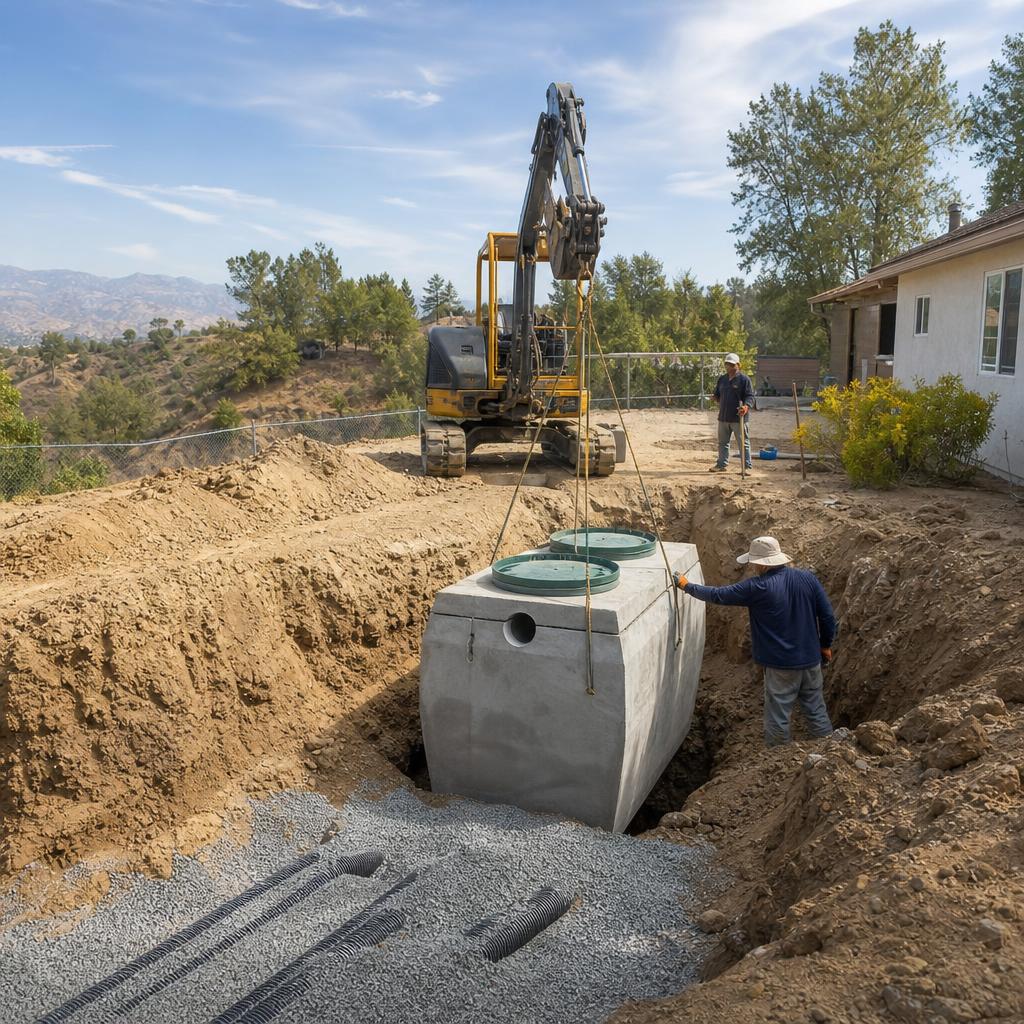
An Onsite Wastewater Treatment System (OWTS) is the general regulatory term for any system that treats and disposes of household wastewater on the property itself rather than sending it to a public sewer main — this includes conventional septic tanks with leach fields, seepage pits, and older cesspools (sometimes called "black holes" or "dry wells") common on properties built before sewer service extended into hillside and canyon communities.
In upper Altadena, much of the housing stock predates any sewer connection in that part of the community entirely, which is a major factor in Eaton Fire rebuilds. Similarly, large stretches of Topanga Canyon and rural Malibu remain unincorporated or low-density areas without public sewer infrastructure, meaning septic and cesspool systems aren't an edge case there — they're the norm.
Who Regulates This — And Why It's Not Building & Safety
Your building permit is reviewed by LA County Public Works, Building and Safety Division for unincorporated parcels like upper Altadena — see our unincorporated LA County permitting guide for how that agency works — or by LADBS inside City of Los Angeles limits. Your septic or cesspool system, by contrast, is reviewed entirely separately by LA County Department of Public Health, Environmental Health Division, through its Onsite Wastewater Treatment Program. This is a distinct agency with its own application, its own fee schedule, and its own review queue, governed by California's statewide OWTS policy and, where applicable, the County's Local Agency Management Program (LAMP) for more complex systems. Both approvals are typically required before final building permit sign-off on a property without sewer service.
Post-Fire Rules: When You Can Keep Your Existing System
LA County Public Health's post-fire OWTS guidelines allow a like-for-like rebuild to continue using an existing cesspool or septic system, provided two conditions hold: the system is still functional (typically confirmed through an inspection and dye test), and the rebuild does not add wastewater load beyond what the original structure generated.
"Added load" specifically means: additional bedrooms or bedroom-equivalent rooms, a new pool or spa, a new accessory dwelling unit (ADU) or junior ADU, or a meaningful increase in bathroom fixture count. A rebuild that matches the original bedroom and fixture count — even if finishes or layout change — generally qualifies to keep the existing system with a functional evaluation rather than a full new design and permit. For Eaton Fire rebuilds specifically, the County has stated many upper Altadena properties can proceed on this like-for-like basis without immediate full re-testing, provided there are no signs of system failure — a meaningful accommodation given how many properties in that community predate sewer connection entirely.
When a New System Is Required
If your rebuild adds bedrooms, a pool or spa, an ADU, or otherwise increases wastewater flow, the County typically requires a new or expanded system design rather than simply continuing to use the existing cesspool or septic tank. That process includes a percolation (perc) test to measure how quickly the soil absorbs water — necessary to size a new leach field or seepage pit correctly — and an engineered system design prepared by a registered professional, submitted to Public Health for plan review. The County also generally requires the site plan to reserve a designated area for future system expansion, even if that expansion isn't built immediately, so a later addition doesn't get permanently boxed out by the current design.
The 200-Foot Public Sewer Rule
If a public sewer line runs within 200 linear feet of your property and your rebuild adds wastewater load, County guidelines generally require connecting to that public sewer rather than repairing, replacing, or expanding an onsite system. If no sewer main exists within that 200-foot distance, or your rebuild doesn't add load, the onsite system path typically remains available. One practical limitation worth knowing: a sewer connection generally cannot run across a neighboring property line, so a sewer main that's technically close by distance may still not be a viable connection option depending on your parcel's access and easements — something we verify with the County directly rather than assuming based on a map distance alone.
Costs and Timelines
| Item | Typical Cost | Typical Timeline |
|---|---|---|
| OWTS review application fee (LA County Public Health) | Approximately $522 for initial system evaluation | Application processed on submittal; review typically begins within a few weeks |
| Existing cesspool/septic functional evaluation | Varies by contractor; typically several hundred dollars for inspection and dye test | 1–2 weeks to schedule and complete |
| Percolation (perc) test for a new system | Typically $1,500–$4,000+ depending on site access and number of test holes | 2–6 weeks including scheduling, testing, and County review of results |
| New septic system design (registered engineer or geologist) | Typically $3,000–$8,000+ depending on system type and site constraints | 2–4 weeks for design, plus County plan review |
| OWTS permit issuance after complete submittal | Included in review fee above | Several weeks to a few months depending on backlog and whether corrections are needed |
| New system installation (if required) | Highly variable — typically $15,000–$40,000+ depending on system type, soil conditions, and site access | 1–3 weeks for installation once permitted |
These figures are typical ranges, not quotes — actual costs depend on your specific system, soil conditions, and site access. We provide a project-specific estimate once we know your rebuild scope and existing system condition.
Contacting LA County Environmental Health Directly
LA County Department of Public Health, Environmental Health Division, Onsite Wastewater Treatment Program can be reached directly at (626) 430-5380 or by email at dlanduse@ph.lacounty.gov. This is the County agency's own direct line — separate from Ocean Permits — and you're always welcome to contact them yourself with system-specific questions. In practice, we handle this coordination on our clients' behalf as part of our permit expediting service, since the OWTS application requires close coordination with the building permit design.
How We Coordinate This With Your Building Permit
The single biggest risk with septic and OWTS review isn't the process itself — it's timing. Because building permit final sign-off on a non-sewered property typically depends on OWTS clearance, an OWTS application that sits unsubmitted while the building permit moves forward quietly becomes the bottleneck for the entire rebuild, often discovered only at final inspection. We submit the OWTS application in parallel with your building permit package from day one, determine early whether your existing system qualifies for like-for-like continuation or needs a new design, and track both agencies' review status simultaneously — so a slow week at one agency doesn't turn into a stalled rebuild at the other.
Related Guides
For the broader unincorporated LA County permitting picture, see our unincorporated LA County permit guide. For the full rebuild picture across both fire footprints, see our Pacific Palisades and Altadena rebuild guide. For like-for-like rebuild mechanics generally, see our like-for-like rebuild guide. And for our full-service approach to fire rebuilds, see our fire rebuild services page.
Frequently Asked Questions
Can I keep using my cesspool after rebuilding my house?
In many cases, yes. LA County Department of Public Health's post-fire OWTS guidelines allow a like-for-like rebuild to continue using an existing cesspool or septic system if that system is still functional and the rebuild does not add wastewater flow — meaning no additional bedrooms or bedroom-equivalent spaces, no new pool or spa, no new ADU, and no other feature that increases sewage flow beyond what the original structure generated. If your rebuild is truly like-for-like in bedroom count and fixture count, your existing system generally does not need to be replaced, though Public Health typically still requires a functional evaluation to confirm the system is in working condition.
What counts as 'additional wastewater load' that triggers a new septic requirement?
The most common triggers we see are adding bedrooms or bedroom-equivalent rooms (a den, office, or bonus room that could function as a bedroom), adding a pool or spa, adding an accessory dwelling unit (ADU) or junior ADU, or increasing the number of full bathrooms beyond the original design in a way that meaningfully increases fixture units. Public Health evaluates this based on the specific plan, not just square footage — a larger home with the same bedroom and fixture count can sometimes still qualify as no additional load, while a smaller addition that adds a bedroom can trigger full re-evaluation.
Who actually regulates septic and cesspool permits — is it the same department as my building permit?
No, and this is one of the most common points of confusion in a fire rebuild. Your building permit is reviewed by LA County Public Works, Building and Safety Division (for unincorporated territory like upper Altadena) or LADBS (in City of LA jurisdiction). Your septic or cesspool system is reviewed entirely separately by LA County Department of Public Health, Environmental Health Division, through its Onsite Wastewater Treatment Program (OWTS Program). These are two different agencies with two different applications, two different fee schedules, and two different review timelines that both have to clear before your rebuild is fully permitted.
How much does an OWTS permit cost in LA County?
The initial OWTS review application fee for evaluating an existing system is approximately $522, covering the County's review of your existing system's condition and adequacy for the proposed rebuild. If a new system design is required, you'll separately pay for a percolation test (typically $1,500–$4,000+ depending on site conditions and access) and an engineered system design (typically $3,000–$8,000+), on top of the County's plan review fee for the new system. We give clients a project-specific cost estimate once we know whether the existing system can be retained or a new one is required.
Do I need a percolation test?
A percolation (perc) test — which measures how quickly water absorbs into the soil — is required when you're installing a new septic system or expanding an existing one, since the County needs the perc rate to size the leach field or seepage pits correctly. If your rebuild qualifies to keep the existing system as-is with no added wastewater load, a full new perc test generally isn't required, though the County may still want documentation confirming the existing system's design and condition.
What if there's a public sewer line near my property — do I have to connect instead of using septic?
LA County's rebuilding guidelines generally require connection to public sewer, rather than repairing or replacing an onsite system, when a public sewer line runs within 200 linear feet of the property and the rebuild adds wastewater load (additional bedrooms, an ADU, etc.). If no public sewer exists within that distance, or the rebuild doesn't add load, the onsite system path typically remains available. Sewer connection also cannot run across a neighboring property line, which sometimes rules out an otherwise-nearby sewer main depending on the parcel's access and easements.
My property is in upper Altadena — does the Eaton Fire rebuild get any special septic accommodation?
LA County Department of Public Health issued specific post-fire guidance allowing many Eaton Fire rebuilds in upper Altadena to proceed on a like-for-like basis without immediate full septic re-testing, provided the rebuild doesn't add wastewater load and the existing system shows no signs of failure. This is a meaningful accommodation for a community where a large share of properties predate connection to any sewer system entirely. We confirm your specific parcel's status and system history with the County directly before finalizing your rebuild plans, since guidance has been updated as the recovery has progressed.
How does the septic/OWTS permit timeline interact with my building permit timeline?
They run in parallel, not in sequence, when handled correctly — but if nobody is actively coordinating both applications, the slower of the two agencies quietly becomes the bottleneck for your entire rebuild, since final building permit sign-off typically requires OWTS clearance for any property not on public sewer. We submit the OWTS application at the same time as the building permit package, track both independently, and flag as early as possible whether the existing system qualifies to stay in place or needs a new design — because that determination affects both timelines.
What agency do I contact directly for septic/OWTS questions?
LA County Department of Public Health, Environmental Health Division, Onsite Wastewater Treatment Program handles all septic and cesspool review. Their direct line is (626) 430-5380, and their intake email is dlanduse@ph.lacounty.gov. That's the County's own contact information, separate from Ocean Permits — we coordinate directly with this office on your behalf as part of our permit expediting service, but you're always welcome to reach them directly with system-specific questions.
I want to add an ADU and I have a septic system — is that possible?
It's possible, but an ADU almost always counts as added wastewater load, which means your existing system generally needs County re-evaluation and, in many cases, expansion or replacement to handle the additional flow — including a designated area reserved for future system expansion, which the County requires on the site plan even if not built out immediately. This doesn't make an ADU impossible on a septic lot, but it does add a design and permitting step that a sewer-connected property wouldn't face, and it's worth budgeting for early rather than discovering it mid-permit.
What is the Local Agency Management Program (LAMP) and does it apply to me?
The Local Agency Management Program is the framework under California's statewide OWTS policy that allows LA County Department of Public Health to administer onsite wastewater system permitting locally, including for more complex or higher-risk systems, rather than defaulting to the state's more generic tiered standards. In practice, most straightforward residential rebuild cases are handled through the County's standard OWTS review process; LAMP-level review typically comes into play for larger systems, environmentally sensitive sites, or properties near water bodies where additional design standards apply.
What documents do I need to submit for my OWTS application?
Typically: a completed OWTS Review Application, a site plan showing the existing or proposed system location relative to the structure, property lines, wells, and water bodies, documentation of the existing system's history if you're seeking like-for-like approval, and — if a new system is required — percolation test results and an engineered system design. We assemble this package alongside your building permit submittal so both applications move forward together rather than one waiting on the other.