_1781464136662-DVw5IPjt.png)
Women-owned, LA-based permit expediting firm. Many clients rebuilding in Pacific Palisades and building in Malibu are adding or restoring a pool as part of a hillside project — we coordinate the building, electrical, plumbing, and grading review as one timeline. Free consultation — call 213-277-8777.
A backyard pool feels like a single project, but permit-wise it's several projects running in parallel: a building permit for the shell, an electrical permit for pumps and lighting, a plumbing permit for gas-fed heaters, and — on many lots — a grading permit for the excavation and earthwork. Add California's pool safety law, hillside geotechnical review, and equipment efficiency standards, and a "simple" pool permit has more moving parts than most homeowners expect.
None of this is designed to be an obstacle course — it reflects real safety and engineering considerations specific to a large, water-filled excavated structure. A pool's structural loads, its electrical systems near standing water, its water disposal, and (on a slope) its interaction with hillside soil are all legitimately different from a typical room addition, and the permit process is built around those differences.
This guide covers exactly which permits a new in-ground pool needs, what California's Swimming Pool Safety Act actually requires, how fencing and barrier rules interact with LA's general fence-height limits (see our companion deck and fence permit guide for the zoning side of that), hillside geotechnical requirements, Title 24 equipment rules, and LASAN's backwash discharge requirements.
Which Permits a New Pool Actually Requires
A new in-ground pool in Los Angeles requires a building permit from LADBS covering the pool shell and structure — the excavated, engineered vessel itself, whether built from gunite, shotcrete, or another approved method. This is reviewed for structural adequacy, including how the shell interacts with the surrounding soil and any adjacent structures or slopes.
On top of the building permit, an electrical permit is required for the pump, filtration, lighting, and any heater circuits — pool electrical work sits near standing water and is held to a stricter code standard (including bonding and grounding requirements) than typical residential electrical work. A plumbing permit covers gas line work feeding a pool or spa heater. If the project involves substantial earthwork — significant cut, fill, or soil export beyond what's incidental to a standard flatland excavation — a grading permit may also apply, and on hillside lots this shifts from "may apply" to "will apply," discussed further below.
These permits are typically submitted and tracked together as one project, but they're separate disciplines with separate plan checkers and separate inspections — a common source of confusion for owners who assume "the pool permit" is a single document rather than a coordinated package. See our LADBS permit process guide for how multi-discipline review generally works.
Pool Project Types & Typical Timelines
| Project Type | When It Applies | Permit Process | Typical Timeline |
|---|---|---|---|
| Standard in-ground pool (flatland) | New pool shell on a standard flatland residential lot | LADBS building permit for the shell, plus electrical and plumbing permits for equipment | 4–10 weeks |
| Pool + spa combo | New pool built together with an attached or adjacent spa | Combined building permit application; electrical permit for additional spa equipment and heater circuit | 6–12 weeks |
| Hillside pool with geotechnical review | Pool sited on a hillside lot subject to the Baseline Hillside Ordinance | Building permit + LADBS Grading Division review + soils/geotechnical report; retaining wall permit if applicable | 10–20+ weeks |
| Pool resurfacing / equipment-only permit | Replacing plaster, tile, or swapping pump/heater/filter equipment without shell changes | Simpler electrical/plumbing permit; no grading review | 1–4 weeks |
| Pool removal / demolition permit | Filling in and removing an existing pool shell | Demolition permit through LADBS; compaction/backfill inspection required | 2–6 weeks |
Timelines are estimates consistent with our broader guide on how long LA permits take, adapted for pool-specific scopes. Actual timelines depend on plan completeness, inspection scheduling, and — for hillside lots — geotechnical review.
California's Pool Safety Law: Health & Safety Code §115922
Since January 1, 2018, California's Swimming Pool Safety Act — codified at Health & Safety Code §115922 — has required new or substantially remodeled residential pools and spas to include at least one drowning-prevention safety feature from a statutorily defined list. This isn't a vague best-practice suggestion; it's a real, enforceable state law requirement checked as part of the permit process.
The qualifying options include: an enclosure that isolates the pool from the home; removable mesh fencing meeting ASTM F2286 standards; an approved safety pool cover; exit alarms on doors with direct access to the pool area; self-closing, self-latching devices on doors and gates that provide pool access; or a pool alarm that detects unauthorized entry into the water. A property owner or designer chooses which of these options fits the project, but at least one is legally required — it is not optional, and LADBS checks for compliance as part of plan review for qualifying pools.
In practice, most residential projects satisfy this requirement with a physical enclosure — fencing with a self-closing, self-latching gate — because it's the most straightforward option to design around and verify at inspection. But if a property's layout makes fencing impractical, the other statutory options remain legitimate compliance paths, and we help clients choose the option that fits their site and design goals rather than defaulting to fencing without considering the alternatives.
Pool Barriers vs. LA's General Fence-Height Rules
A compliant pool enclosure has to satisfy two separate rule sets that don't always overlap cleanly. The first is the pool-specific barrier standard under the California Building Code and Health & Safety Code §115922 — covering minimum barrier height, maximum gap spacing that would let a small child squeeze through, and self-closing, self-latching hardware on any gate providing pool access. The second is the Los Angeles Municipal Code's general zoning fence-height limits, which vary depending on where the fence sits on the lot (a distinction we cover in depth in our deck and fence permit guide).
In most backyard pool layouts, these two rule sets don't conflict — a rear-yard fence tall enough to satisfy the pool barrier standard is usually well within the zoning code's rear-yard fence-height allowance. The friction shows up more often on tight or irregularly shaped lots, where a pool sits close to a side yard or where the layout forces a barrier fence into a more restrictive zoning setback area. We check both standards together during design, rather than treating pool safety compliance and zoning fence compliance as two disconnected checklists.
Hillside Pools: Geotechnical Review Under the Baseline Hillside Ordinance
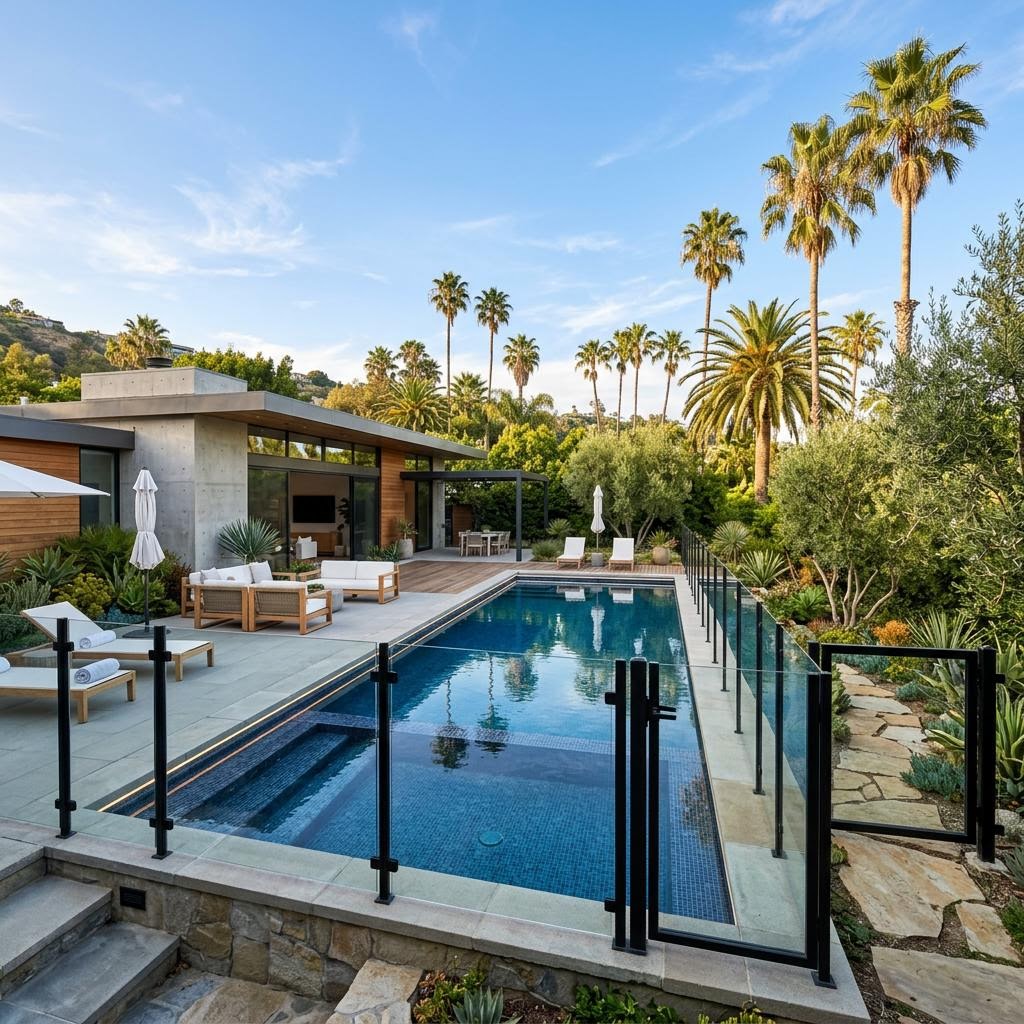
A pool on a hillside lot subject to the Baseline Hillside Ordinance is a meaningfully different engineering proposition than a flatland pool. A large excavated, water-filled structure introduces significant loading and drainage considerations on sloped terrain, and LADBS requires a geotechnical or soils report addressing slope stability, drainage management, and how the pool structure interacts with the surrounding hillside soil before it will approve the building permit.
LADBS's Grading Division reviews this report alongside the standard building permit review, and where the pool requires a retaining wall — either to support the excavation itself or to stabilize an adjacent slope — that retaining wall typically needs its own coordinated permit and structural review. This combination of geotechnical review, grading permit, and possible retaining wall permit is why hillside pool projects in areas like Calabasas or Malibu routinely take significantly longer than a comparable flatland pool.
We recommend commissioning the geotechnical report early in hillside pool projects — before final pool design is locked in — since soils findings can materially affect where a pool can be sited on the lot and what retaining structure it will need.
Title 24 & Title 20: Energy Code Requirements for Pool Equipment
California's Title 24 Energy Code, together with related equipment efficiency standards under Title 20, governs the pumps and heaters used on new and replacement residential pool systems. The most significant requirement for most projects is that pool circulation pumps must be variable-speed rather than the older single-speed pumps still common in older installations — variable-speed pumps can run at lower speeds for routine filtration, cutting energy use substantially compared to a single-speed pump that only runs at full power.
Pool and spa heaters are also subject to efficiency standards under this framework. These requirements apply not just to new pool construction but to most equipment replacement projects as well — meaning an owner replacing an old single-speed pump on an existing pool can't simply install another single-speed unit and expect it to pass inspection. We confirm equipment specifications against current Title 24/Title 20 standards before a client purchases equipment, since finding out at inspection that a purchased unit doesn't qualify is an avoidable, costly delay.
Pool Water Disposal: LA Sanitation (LASAN) Discharge Rules
Draining or backwashing a pool isn't as simple as letting the water run into the street or storm drain. LA Sanitation (LASAN) regulates discharge of pool water because chlorinated pool water is harmful to the waterways that storm drains ultimately feed into. Water discharged to the storm drain system generally must be dechlorinated first — typically by letting residual chlorine dissipate naturally over time or through a neutralizing treatment — before discharge is permitted.
Alternatively, pool drainage can in some cases be routed to the sanitary sewer system with appropriate approval, which avoids the storm drain question entirely but requires coordination with LASAN's sewer discharge requirements. We confirm the applicable discharge pathway and any documentation LASAN requires as part of scoping a pool project, since improper storm drain discharge of chlorinated water is a real code violation with its own enforcement exposure — not a minor technicality.
Equipment Noise & Property-Line Setbacks
Pool pumps, heaters, and filtration equipment run for hours at a time and generate real, ongoing operational noise — not a brief, incidental sound. The Los Angeles Municipal Code's noise regulations and standard mechanical equipment setback requirements from property lines both bear on where this equipment can be sited. Placing a pump too close to a neighbor's bedroom window is one of the most common sources of post-construction neighbor complaints and code enforcement calls, even on a project where the underlying permit was properly obtained. We review equipment placement during design, factoring in both the applicable setback rules and basic good-neighbor siting, rather than leaving equipment location as an afterthought decided on-site during construction.
Why Work With Ocean Permits on a Pool Permit
Ocean Permits & Development is a women-owned permit expediting firm based in Los Angeles. Pool projects touch more review disciplines than most residential permits — building, electrical, plumbing, and often grading — and on hillside lots in places like Calabasas and Malibu, geotechnical review adds another layer entirely. We coordinate all of these as one project timeline rather than a series of disconnected applications.
For fire-rebuild clients in Pacific Palisades restoring or adding a pool as part of a hillside rebuild, we fold pool permitting into the broader rebuild coordination alongside ADU and other site work. We offer a free consultation — call 213-277-8777 or reach out through our contact page.
Frequently Asked Questions
What permits does a new in-ground pool actually require in Los Angeles?
A new in-ground pool is not a single permit — it's a package. You need a building permit from LADBS for the pool shell and structure itself (the excavated, engineered concrete or gunite vessel), a separate electrical permit for the pump, lighting, and heater circuits, and a plumbing permit for any gas lines feeding a pool or spa heater. If the site needs significant earthwork to prepare the pool excavation or manage soil export, a grading permit may also apply. Treating these as one bundled "pool permit" is a common misconception — LADBS reviews and inspects each discipline separately, even though they're usually submitted and tracked together.
What is California's pool safety law, and does it actually require a fence around my pool?
California's Swimming Pool Safety Act, codified at Health & Safety Code §115922, has required — since January 1, 2018 — that any new or substantially remodeled residential pool or spa include at least one of a statutorily defined list of drowning-prevention safety features, not specifically a fence in every case. The qualifying options include an enclosure (fencing) that isolates the pool from the home and meets pool safety standards, removable mesh fencing meeting ASTM F2286 standards, an approved safety pool cover, exit alarms on doors with direct access to the pool area, self-closing and self-latching devices on doors and gates providing pool access, or a pool alarm that detects unauthorized entry into the water. In practice, a physical enclosure with a self-closing, self-latching gate is the most common way projects satisfy this requirement, but the statute is written to allow the listed alternatives — the key point is that at least one compliant feature is legally required, not optional, for qualifying new or remodeled pools.
How tall does my pool fence or barrier need to be, and how does that interact with LA's general fence-height rules?
Pool barrier standards under the California Building Code and Health & Safety Code §115922 set specific requirements for enclosure height, gap spacing, and self-closing/self-latching gate hardware distinct from LA's general zoning fence-height rules. A pool-enclosure fence has to meet the pool-specific barrier requirements (including minimum height and gate self-closing/self-latching mechanisms) regardless of where it sits on the property, while its placement — front yard versus side or rear yard — still has to respect the Los Angeles Municipal Code's general zoning fence-height limits described in our deck and fence permit guide. In effect, a compliant pool fence has to clear two separate rule sets at once: the safety-code barrier standard and the zoning fence-height limit for its location on the lot.
Does a hillside pool need a geotechnical or soils report?
Yes, in most cases. Pools sited on hillside lots subject to the Baseline Hillside Ordinance require a geotechnical or soils report addressing slope stability, drainage, and the pool's structural interaction with the surrounding hillside soil — because a large excavated, water-filled structure on a slope introduces loading and drainage considerations that a flatland pool doesn't have. LADBS's Grading Division reviews this report alongside the building permit, and any retaining wall needed to support the pool excavation or adjacent slope typically requires its own coordinated permit. We flag this hillside review requirement at the very start of a project, since it adds meaningfully to both timeline and design constraints compared to a flatland pool.
What does Title 24 require for pool and spa equipment?
California's Title 24 Energy Code (with related equipment standards under Title 20) sets efficiency requirements for pool and spa equipment, most notably requiring variable-speed pumps rather than older single-speed pumps for most new or replacement pool circulation systems, and setting efficiency standards for pool and spa heaters. These requirements are checked as part of the electrical and plumbing permit review, and equipment that doesn't meet current Title 24/Title 20 standards can be rejected at plan check or inspection — so equipment selection should account for current code, not just what a supplier has in stock.
What happens to the water when I drain or backwash my pool — do I need a separate permit for that?
Pool backwash and drainage water is regulated by LA Sanitation (LASAN), not treated as an incidental byproduct you can dispose of however is convenient. Water discharged to the storm drain system generally must be dechlorinated first, since chlorinated water is harmful to the receiving waterway, and LASAN has specific requirements around this. Alternatively, some pool drainage can be routed to the sanitary sewer system with appropriate approval. This isn't always a separate standalone permit, but it is a compliance requirement tied to the pool project that we confirm with LASAN's requirements as part of project scoping, since discharging chlorinated water improperly into a storm drain is a code violation with its own enforcement exposure.
Do I need to worry about pool equipment noise or setbacks from my neighbor's property?
Yes. Pool pumps, heaters, and filtration equipment generate ongoing operational noise, and the Los Angeles Municipal Code's noise regulations, along with standard mechanical equipment setback requirements from property lines, apply to where this equipment can be placed. Poor equipment placement — too close to a neighboring bedroom window, for instance — is one of the more common sources of neighbor complaints and code enforcement calls after a pool is built, even when the underlying permit was properly issued. We consider equipment placement during design review, not as an afterthought once the pad is poured.
How long does a standard flatland pool permit take in Los Angeles?
A standard in-ground pool on a flatland lot, without hillside grading or complex site conditions, typically moves through LADBS's building, electrical, and plumbing plan check in roughly 4 to 10 weeks, consistent with our broader Los Angeles permit timeline guide. A pool combined with a spa adds some review complexity for the additional equipment; a hillside pool requiring geotechnical review and Grading Division sign-off takes considerably longer — often 10 to 20-plus weeks.
Is a pool resurfacing or equipment replacement project a simpler permit?
Generally, yes. Resurfacing an existing pool shell (replastering, retiling) or replacing equipment like a pump, heater, or filter without changing the pool's shape or structure is a narrower-scope project than new construction — it typically only needs the applicable electrical or plumbing permit for the equipment involved, without triggering full building plan check or grading review. That said, equipment swaps still have to meet current Title 24/Title 20 efficiency standards even when replacing like-for-like older equipment, which occasionally surprises owners expecting a purely cosmetic update.
What's involved in permitting a pool removal or demolition?
Filling in and removing an existing pool requires a demolition permit through LADBS, and the process isn't as simple as just filling the hole with dirt — the shell typically needs to be broken up (or at minimum have drainage holes created) so groundwater doesn't collect beneath the fill, and the backfill has to be properly compacted in engineered lifts to prevent future settling that could affect a structure built over the former pool location. LADBS requires compaction inspection as part of this permit, and skipping it can create serious foundation problems for any future construction on that footprint.
Do fire-rebuild projects in Pacific Palisades or Malibu need to re-permit an existing pool?
It depends on the pool's condition and the rebuild scope. A pool that survived a fire largely intact may not need a new building permit for the shell itself, but any damaged or replaced equipment — pumps, heaters, electrical connections — will need its own permit, and if the rebuild qualifies as new construction rather than a like-for-like reconstruction, the current Health & Safety Code §115922 safety-feature requirement and Title 24 equipment standards apply to the pool system as part of the overall project, even if the shell itself is being reused. We evaluate existing pool infrastructure as part of the broader rebuild permit strategy for clients in Pacific Palisades and Malibu.
How much does Ocean Permits charge to manage a pool permit?
Cost depends on project type: a standard flatland pool building/electrical/plumbing package is priced differently than a hillside pool requiring geotechnical review and Grading Division coordination, or a pool+spa combo with additional equipment permits. We provide a firm, project-specific quote after a free consultation reviewing your property, lot conditions, and project scope.