_1781464136662-DVw5IPjt.png)
Residential & Commercial Permits · September 10, 2026
Sewer Lateral Permits & Certificate of Compliance
Private plumbing permits, BOE sewer connections, CCTV conditions and jurisdiction-specific documentation.
A Los Angeles sewer lateral project can involve LADBS plumbing approval, a Bureau of Engineering Sewer S-Permit and public-way inspection. Start with the actual connection, repair method and jurisdiction; do not assume a property sale automatically requires a universal LASAN Certificate of Compliance. This guide explains the application sequence, CCTV requirements, private-property versus public-way work and the separate septic/OWTS pathway. Call Ocean Permits at 213-277-8777.
What Is a Sewer Lateral, and Who's Responsible for It?
A sewer lateral is the private pipe that connects a building's plumbing system to the public sewer main running under the street. In Los Angeles, the property owner is responsible for the lateral's condition and maintenance along its entire length, from the building to the point of connection with the public main — including the portion that runs under public right-of-way. This ownership structure is one of the more commonly misunderstood parts of LA's sewer system, since most owners assume the City takes responsibility for anything beneath the street.
Because laterals are buried and largely invisible during normal use, problems — root intrusion, cracked clay or cast-iron pipe, offset joints from ground settlement, or bellies that trap standing wastewater — often go unnoticed until a specific event forces an inspection: a property sale, a major remodel, or a change of use to something like a restaurant.
Verify the Jurisdiction and the Exact Document Requested
Do not assume a universal LASAN Certificate of Compliance is required for every City of Los Angeles property sale. A private buyer inspection, an escrow condition, a municipal certification program elsewhere and an approved City sewer connection are different requirements. Identify which one applies before paying for an application.
- Property transactions — obtain the written request and identify the required issuing authority; a private CCTV report is not automatically a municipal certificate.
- Major remodels or additions — a project that adds significant plumbing fixture count, bedrooms, or building footprint can trigger a lateral capacity and condition review, since added fixtures increase wastewater flow through the existing line.
- Change of use to restaurant or food service — grease-laden wastewater and higher discharge volumes make lateral condition especially important for food-service conversions, often paired with a grease interceptor requirement.
City of Los Angeles sewer work uses BOE Sewer S-Permit procedures under LAMC 64.12 where applicable, together with LADBS plumbing review for the private-property scope. Altadena and independent cities have different authorities. Confirm ownership of the main, the existing connection record and any sewer capacity or facility-charge requirements before choosing the application path.
How Lateral Testing Works
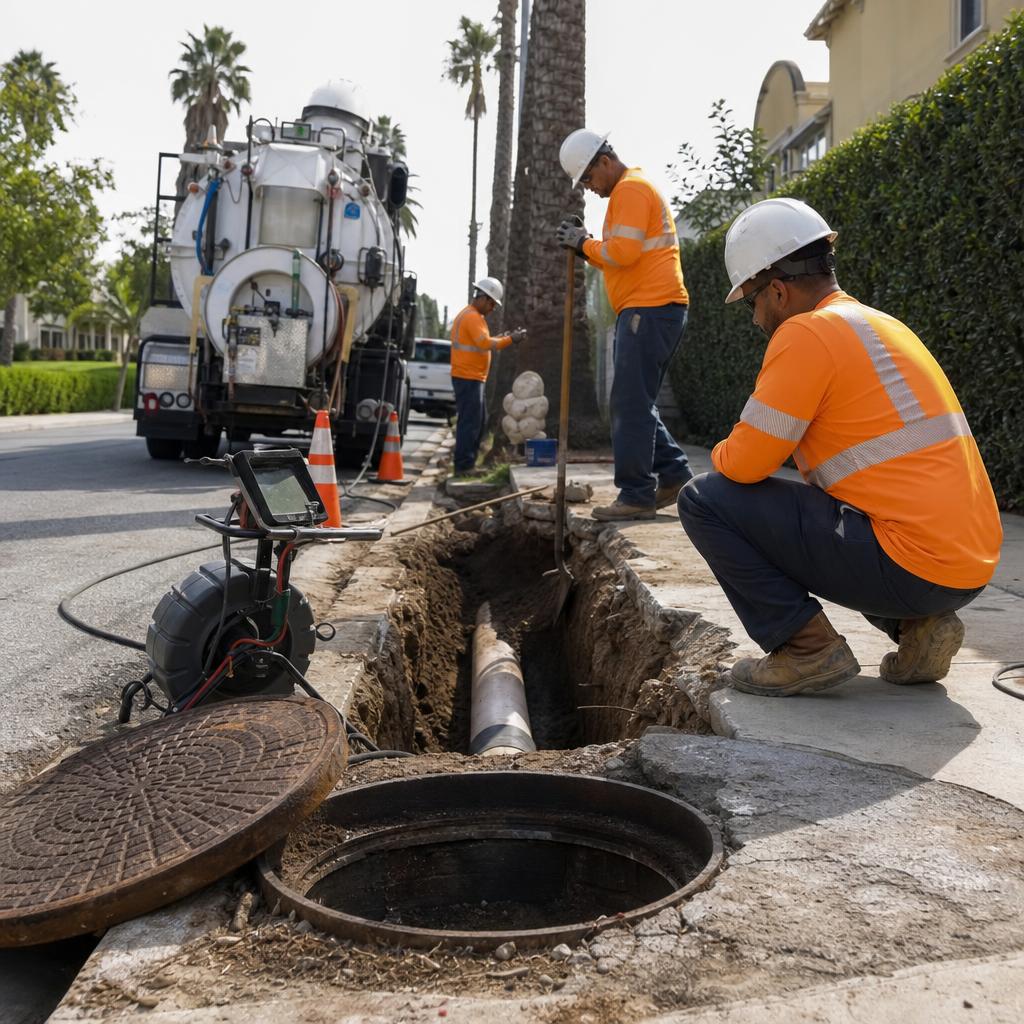
A licensed plumbing contractor performs a video (CCTV) inspection, feeding a camera through the lateral to document its interior condition end to end, sometimes paired with a dye test or air test to check for leaks at specific points. The resulting video and written report identify exactly where along the line any defects are located — root intrusion, cracked or offset sections, bellies, or scale buildup — which then determines whether the appropriate fix is a targeted spot repair or a full replacement of the line.
Typical Costs & Timelines
| Item | Typical Cost | Typical Timeline |
|---|---|---|
| Sewer lateral video inspection / dye test | Typically several hundred dollars depending on line length and access | Usually scheduled and completed within 1-2 weeks |
| Bureau of Engineering Sewer S-Permit | Current permit and applicable connection/facility charges; confirm the actual scope with BOE | Depends on connection records, capacity review and required inspection |
| LADBS plumbing permit for applicable private-property work | Current plumbing permit fee for the approved scope, separate from contractor costs | Some sewer alteration, repair or replacement scopes are listed in the Express bulletin; confirm eligibility |
| Spot repair (localized root intrusion, cracked section, or offset joint) | Typically a few thousand dollars depending on depth, access, and street cut requirements | 1-2 weeks including permit, excavation, and street restoration |
| Full lateral replacement (property line to main, or property line to structure) | Highly variable — commonly several thousand to over ten thousand dollars depending on length, depth, trenchless vs. open-trench method, and street cut/restoration requirements | 2-4 weeks including permit, excavation or pipe bursting/lining, and final inspection |
| Street cut permit (LA Bureau of Engineering / BOE) if the lateral extends under a public street | Separate permit fee plus a street restoration bond or deposit | Adds 1-3 weeks to overall timeline for coordination and inspection |
Costs and timelines vary by property, lateral length, depth, access, and current LASAN/LADBS fee schedules. We confirm current figures for your specific property during a free consultation.
Spot Repair vs. Full Replacement, and Trenchless Options
A spot repair addresses one localized defect without replacing the entire line and is generally faster and less expensive, while a full replacement is typically recommended when a video inspection shows multiple defects, when the pipe material (often old clay or cast iron) is near the end of its service life, or when a single severe failure makes a targeted fix impractical.
Trenchless methods — pipe bursting and cured-in-place pipe lining — can often address lateral defects without a full open trench, which matters when the line runs under a driveway, mature landscaping, or the public street. If the affected section of lateral runs under a public street or parkway, the work also requires a separate street cut permit from the LA Bureau of Engineering along with a street restoration bond, adding a coordination step beyond the core plumbing permit.
Sewer Lateral vs. Septic (OWTS): Two Different Systems
Sewer lateral permitting applies to a property connected to a sewer main. Properties using an Onsite Wastewater Treatment System (OWTS) instead follow an onsite wastewater pathway; in unincorporated Los Angeles County, County health and building authorities are involved. Confirm the actual connection for the parcel rather than assuming every property in a hillside neighborhood has the same system.
These are genuinely separate regulatory pathways with different agencies, forms, and inspection criteria, and confusing the two can send an owner down the wrong process entirely. If your property relies on an onsite system rather than public sewer — which is especially relevant for fire rebuild projects in these same hillside communities — see our septic system (OWTS) permit guide for how LA County's process works, including when a rebuild can keep an existing cesspool.
LADBS and BOE: The Actual Application Sequence
BOE's Sewer S-Permit processing procedures distinguish a new connection, reconnection and repair. The application also distinguishes Public Works inspection from Building & Safety residential or commercial inspection. Choose the work and inspection scope based on the location of the pipe and the agency instructions, not simply whether the owner calls the project a sewer repair.
- Collect the address, parcel information, existing permit record and contractor's proposed scope. Establish whether the main is City-owned, privately owned or controlled by another jurisdiction.
- Have the qualified contractor document the line location, defect, repair method and private-property versus public-way work. Identify any access easement before choosing an excavation route.
- Coordinate the BOE S-Permit for applicable house connection work under LAMC 64.12. BOE checks connection records and whether a Sewer Capacity Availability Request or sewerage facility charges are required.
- Coordinate the applicable LADBS plumbing permit. The current Express bulletin lists sewer alteration, repair or replacement, and a sewer connection application must identify the Public Works/BOE permit number where required.
- Meet the assigned CCTV and inspection conditions. Work in the public right-of-way can require a bonded sewer contractor, insurance and public-way restoration requirements.
- Schedule the inspections before work is concealed and retain the final approval records. An inspection video, a permit issued and a permit finaled are three different milestones.
| Sewer scope | BOE's published CCTV distinction | Coordination issue |
|---|---|---|
| Reconnection at property line | Generally required for an existing lateral under the processing table; verify the B-permit exception | Existing lateral records and correct inspection assignment |
| Extend an existing house connection | Required to evaluate existing condition | A damaged lateral can require an additional repair/replacement permit |
| Rehabilitate or install a liner | Before-and-after CCTV | BCA inspector determines rehabilitation feasibility |
| New lateral or full conventional replacement | Not the same blanket CCTV requirement as an existing reconnection; trenchless work changes conditions | Confirm the method and permit inspection requirements before construction |
BOE's general conditions specify a minimum four-foot depth at the property line and a two-percent minimum slope for house connections. These published criteria do not replace the approved connection design, existing utility information or the inspector's instructions. Pipe bursting requires a bonded sewer contractor and CCTV before and after construction. Shared connections across multiple lots are restricted by LAMC 64.11.1 and can require recorded agreements; adding an ADU on one lot is not the same as creating a separate lot.
Official sources reviewed October 9, 2026: BOE S-Permit processing and CCTV table, BOE house connection and pipe bursting conditions, and LADBS Express plumbing permit qualifications.
Coordinate added fixtures with our ADU permit service and review separate-lot proposals with the SB9 lot split guide. A food-service conversion can also need grease interceptor and commercial kitchen review. Deep trenches or nearby foundations may require engineered excavation and shoring permitting, while a fire-damaged connection should be coordinated with the post-fire utility reconnection sequence.
Related Reading
Converting a space to restaurant use? See our restaurant permits guide for how lateral review and grease interceptor requirements fit into the broader food-service permitting process. Rebuilding after the Palisades or Eaton fires on a property with an existing onsite system? See our septic/OWTS rebuild guide and our fire rebuild services page. For general questions about our process, visit our FAQ page.
Frequently Asked Questions
What is a sewer lateral, and who is responsible for maintaining it?
A sewer lateral is the pipe that carries wastewater from a building to the public sewer main, typically running under the property and, for many properties, under a portion of the public street or parkway as well. In Los Angeles, the property owner is generally responsible for maintaining and repairing the lateral from the building all the way to its connection with the public sewer main, even for the portion of the line that runs under public right-of-way, which surprises many homeowners who assume the City is responsible for anything under the street.
Is a sewer Certificate of Compliance a universal Los Angeles requirement?
Do not assume so. An escrow condition, another municipality's lateral certification program, a contractor's CCTV report and a City sewer permit are different things. Ask the requesting party to identify the exact document, issuing authority and legal or permit condition for the property's jurisdiction. The City of Los Angeles BOE S-Permit procedures govern connection, reconnection and repair work, not a universal certificate for every property sale.
Do I need a Certificate of Compliance every time I sell a house in Los Angeles?
Do not treat every Los Angeles sale as requiring a LASAN sewer lateral certificate. Confirm any transaction-specific condition with the requesting party and the responsible agency. A buyer can request a private CCTV inspection without that request itself creating a City certification program or a repair permit.
How does the lateral testing process work?
A licensed plumbing contractor typically performs a video (CCTV) inspection of the lateral, running a camera through the line to visually document its condition, and may also perform a dye test or air test to check for leaks. If the inspection reveals root intrusion, cracks, bellies (sags that trap standing water), offset joints, or other defects, the report identifies exactly where along the lateral's length the problems are located, which then determines whether a spot repair or a full replacement is the appropriate scope.
What's the difference between a spot repair and a full lateral replacement?
A spot repair addresses an isolated defect; a full replacement addresses the line as a whole. A qualified contractor evaluates the CCTV findings, pipe alignment, material and access, with the responsible inspector reviewing the permitted work. Multiple defects or a collapse may justify replacement, but the repair method must be selected for the actual line rather than a generic certification assumption.
Can a sewer lateral be repaired without digging up my yard or the street?
Often, yes. Trenchless methods — including pipe bursting (which fractures the old pipe outward while pulling a new pipe through) and cured-in-place pipe lining (which installs a resin-saturated liner inside the existing pipe) — can address many lateral defects without a full open trench, which is faster and less disruptive, particularly when the lateral runs under a driveway, mature landscaping, or the public street. Not every defect is a good candidate for trenchless repair; a plumbing contractor's video inspection findings determine which method fits the specific damage.
Do I need a separate permit if my lateral repair extends under the public street?
Yes. If the portion of the lateral needing repair or replacement runs under a public street or parkway, the work generally requires a separate street cut permit from the LA Bureau of Engineering (or the applicable public works agency) in addition to the LADBS plumbing permit for the lateral itself, along with a street restoration bond or deposit to ensure the pavement is properly repaired afterward. This adds a coordination step and typically a few weeks to the overall project timeline that a property-line-only repair wouldn't need.
What triggers a sewer lateral review for a restaurant or food-service change of use?
Converting a space to restaurant or food-service use — or any use generating grease-laden wastewater — typically triggers LA Sanitation review of the existing lateral's condition and capacity, since grease buildup, higher wastewater volume, and food-service discharge requirements place additional demand on an aging line. This review is often paired with a grease interceptor requirement as part of the broader restaurant permitting process; see our restaurant permits guide for how these pieces fit together.
How is this different from a septic system (OWTS) permit?
A sewer lateral connects a property to a sewer main; an OWTS treats wastewater onsite. City sewer connection work can involve BOE, LADBS and Public Works inspection, while unincorporated County onsite systems follow County health and building requirements. Confirm the parcel's actual service rather than inferring it from the neighborhood.
My property is near the edge of a public sewer service area — how do I know which process applies to me?
Some properties, particularly at the boundary between incorporated Los Angeles and unincorporated county areas, may not immediately be clear on whether they're served by public sewer or a private onsite system. Checking your water and sewer service connection, or a recent utility bill, is a starting point, but we recommend confirming directly with LA Sanitation & Environment or LA County Public Health for the specific parcel before assuming which process applies, since the requirements, permitting agency, and cost profile are substantially different between the two.
What documents should I retain after permitted sewer lateral work?
Keep the applicable finaled plumbing and sewer permit records, required inspection results, CCTV reports where applicable, contractor scope and any recorded easement or shared-connection agreement. If an escrow party requested a separate document, confirm acceptance with that party; do not label a contractor report a City-issued certificate.
Why use Ocean Permits & Development for a sewer lateral permit or Certificate of Compliance?
Ocean Permits coordinates the applicable LADBS plumbing application, BOE S-Permit, outside clearances and inspection dependencies. The qualified contractor performs testing and repair. We identify any transaction-specific certification request separately rather than promising a universal LASAN certificate. Call 213-277-8777 for an initial consultation.
When does BOE require CCTV for a house connection lateral?
BOE's published processing procedures distinguish reconnections, extensions, new laterals, full replacements and rehabilitation. Reconnection and extension of an existing lateral generally require CCTV under the published table; rehabilitation or lining requires before-and-after CCTV. A new lateral or full conventional replacement is not assigned the same blanket CCTV requirement, but trenchless work changes the conditions. Confirm the project's permit and inspection instructions.
Can one sewer connection serve two lots after a lot split?
LAMC 64.11.1 generally requires separate lot connections, with limited exceptions described in BOE's S-Permit guidance. A permitted shared connection may require City Engineer approval and recorded maintenance agreements. An ADU on one lot and a subdivision into separate lots are not the same sewer-connection question.
Need a Sewer Lateral Certified?
We coordinate video inspection, LASAN certification, and any repair permit as one process.