
Permit authority
LADBS for City parcels; County Building and Safety in unincorporated areas
Seismic reference
LAPC 507.2; LADBS bulletin P/PC 2026-003
County fee example
$65.82 in two published base items, before other applicable charges
Critical distinction
Equivalent replacement ≠ relocation ≠ fuel conversion
The short answer: a replacement usually still needs plumbing approval
Replacing a water heater is not automatically permit-exempt because the new appliance fits the same space. The City of Los Angeles Department of Building and Safety publishes a direct answer: a plumbing permit is required to replace a gas water heater in a single-family dwelling, unless the work falls within its stated Certified Licensed Contractor exception. That narrow exception requires a valid LADBS Certificate of Registration and equivalent capacity in gallons, BTU rating and vent capacity. An ordinary contractor license alone does not establish this registration.
Do not extend that City exception to unincorporated LA County, a relocation, a larger input rating, a tank-to-tankless conversion or a gas-to-electric redesign without agency confirmation. Altadena's serving building agency is County Public Works Building and Safety, while City Pacific Palisades parcels ordinarily use LADBS. Confirm the address, APN, fuel type and proposed work before using a permit portal or telling a homeowner that a like-for-like job needs no permit.
Tank replacement, relocation and a tankless conversion are different scopes
A conventional tank replacement can be relatively limited when the location, fuel, capacity, piping and venting remain suitable. It still requires checking current installation requirements, equipment listing, seismic restraints, relief discharge and any conditions identified by the serving inspector. A deteriorated connector, unsuitable vent or missing restraint does not become acceptable because it was part of the old installation.
Moving the heater into an attic, closet, exterior enclosure or another garage wall changes the review. Show the proposed location, service access, support, nearby openings, combustion-air route if applicable, vent path, drainage and any new electrical or gas work. A tankless model can substantially change the gas demand and vent specification even when it serves the same bathrooms. The contractor should establish utility and branch-piping capacity rather than assume the old tank's connection is adequate.
Describe all work on the application. A plumbing approval is not permission to alter a structural wall, install an unapproved roof penetration or increase the electrical service without the corresponding scope. For work bundled with cabinets, new fixtures or walls, coordinate the heater with the larger kitchen or bathroom permit package instead of creating contradictory trade drawings.
Seismic strapping: use the current LADBS bulletin, not an improvised strap
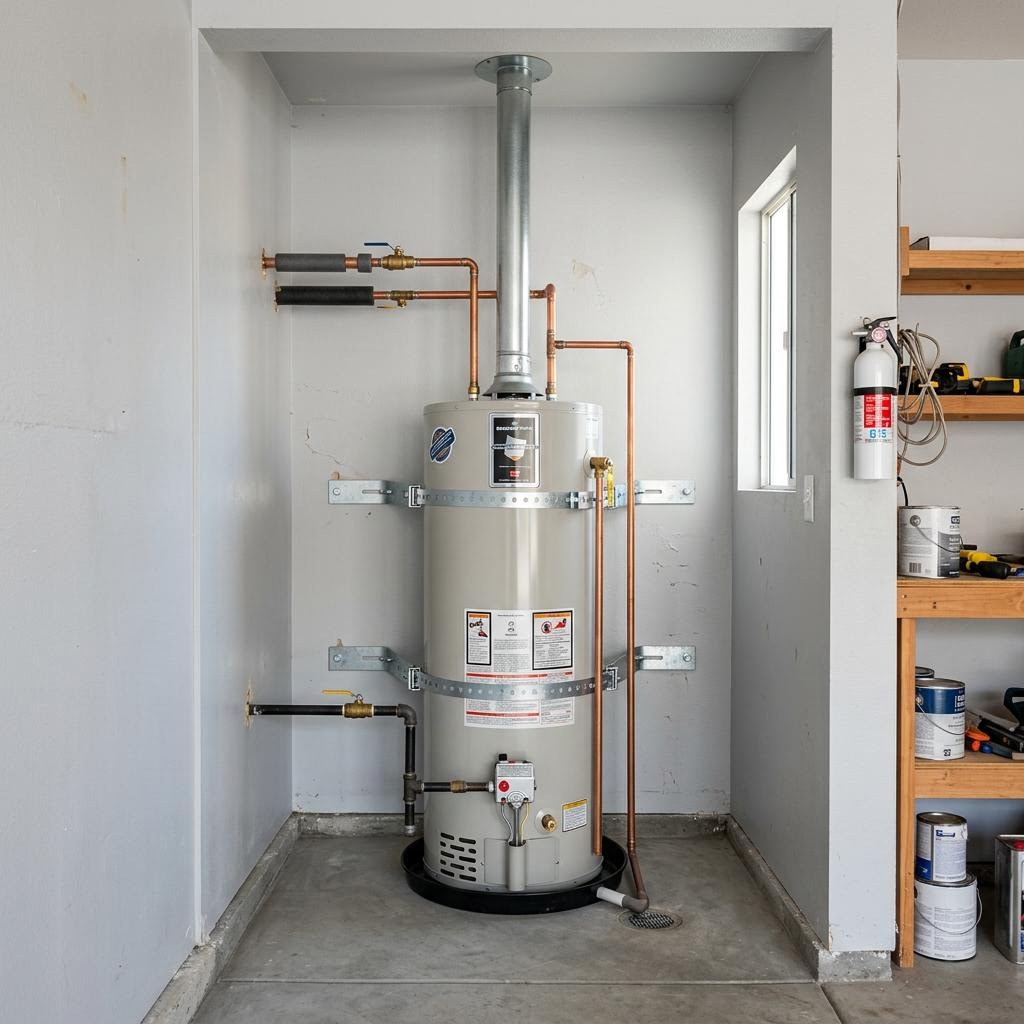
LADBS bulletin P/PC 2026-003, revised March 16, 2026, references Los Angeles Plumbing Code Section 507.2. It calls for restraint at the upper one-third and lower one-third of the water heater, with the lower strap at least four inches above the control unit. Its published details address anchorage to framing, washers, restraint material and manufacturer clearances. Decorative banding attached only to drywall is not an equivalent engineered restraint.
The same bulletin says perforated plumber's tape is not acceptable strapping for water heaters over 40 gallons. Have the installer use an approved system suitable for the actual equipment and support conditions, following the applicable detail and listing. This is a permitting overview, not a substitute for an installation design. A wall-mounted tankless unit has different support and anchorage details from a standing storage tank; do not copy a tank's wrap-around restraint detail onto an unrelated appliance.
Garage installations also need consideration of vehicle impact, ignition-source requirements where applicable and safe servicing space. Applicable exceptions and equipment listings matter, so a generic statement that every heater needs the same platform or enclosure is unreliable. Keep the model documentation with the permit record for the inspector.
Gas combustion air, B-vent and tankless exhaust must match the appliance
An atmospheric gas heater needs adequate combustion air and an approved venting system sized and installed for the appliance and configuration. A listed Type B gas vent may be appropriate for an appliance designed to use it; it is not the default exhaust for every gas water heater. Verify the connector, common vent if present, routing, clearances, termination and manufacturer instructions under the current plumbing and mechanical requirements.
Many high-efficiency or condensing tankless units use a different listed vent system and may need condensate collection and approved disposal. Do not reuse the old B-vent or choose generic plastic pipe simply because it fits. A direct-vent or sealed-combustion installation also has specific inlet and outlet requirements. The licensed installer and reviewing agency must confirm the arrangement, including clearances to openings and other equipment.
Removing a furnace from a shared gas vent can leave the remaining water heater connected to an unsuitable vent. Converting one appliance to electric therefore deserves a review of the appliances that remain, not just the new circuit. Gas-line alterations and pressure testing can introduce additional permit scope. Confirm any meter or service work with the serving utility; passing a building inspection does not itself authorize utility reconnection.
Electric and heat-pump heaters: circuit, service capacity and condensate
For electric resistance or heat-pump equipment, provide the model's voltage, nameplate load, connection method and listing to the electrical designer or licensed contractor. Some products use 240-volt circuits, while listed 120-volt options also exist. Do not assume all heat-pump water heaters use the same breaker, wire size or receptacle arrangement. California Electrical Code Section 110.3(B) requires listed or labeled equipment to be installed and used according to its instructions.
A new branch circuit or service change may need an electrical permit in addition to the plumbing scope. Evaluate panel capacity and the relevant load calculation rather than treating an unused breaker position as proof of adequate service. Our electrical-panel and service-upgrade guide explains that utility coordination, meter work and a larger service can become separate schedule dependencies.
Heat-pump units also need the manufacturer's required air volume or ducting, clearances, acoustic consideration and condensate routing. Locate the unit so it can operate and be maintained without compromising a required accessible route or creating moisture damage. Do not combine condensate and temperature/pressure relief discharge into an improvised drain arrangement. The relief protection and discharge requirements remain a distinct plumbing review item.
New installations and fire rebuilds need coordinated energy and utility plans
A destroyed water heater replaced during a Pacific Palisades or Altadena rebuild is part of a new coordinated building system, not necessarily an isolated same-location appliance swap. Show the equipment, location, water distribution, fuel or electrical demand, venting and drainage in the approved rebuild package. Ask whether the trade scope is carried under the larger permit or needs a separate trade permit; do not automatically order a duplicate standalone permit.
City and County reviewers may apply different rebuild procedures and accepted code editions. The project's approved energy-compliance design is especially important for a new home: a replacement exemption or older appliance choice does not automatically determine the permitted water-heating system in a rebuilt residence. Confirm the applicable California Energy Code path and any eligible rebuild provisions with the design team and agency.
For Altadena, resolve County clearance requirements and the actual local water and energy providers. For City Palisades, coordinate the applicable LADBS and utility process. A like-for-like zoning determination is not permission to bypass plumbing inspection, seismic anchorage or utility safety procedures. Keep the equipment schedule consistent with the service-load documents and final inspection records.
Step-by-step permit and inspection coordination
1. Confirm jurisdiction and scope. Collect the address, existing permit information, tank or tankless model, capacity, energy source, installation location and proposed changes. Ask the serving agency whether a standard trade-permit route is available and document any claimed City CLC exception.
2. Resolve the installation design. Have the appropriate licensed professionals confirm restraints, venting or air supply, water piping, relief discharge, drain/pan requirements, gas demand or electrical circuit and service capacity. Identify any supporting building, mechanical or electrical scope before applying.
3. Apply through the serving agency's current channel and pay the calculated fees. Straightforward eligible trade work and a complex relocation can use different review paths. A material change in the submitted scope should be reflected in the permit and plans, not handled as an undocumented field change.
4. Arrange the required inspection at the appropriate stage and make the approved documents and equipment instructions available. Keep relevant connections and other required items accessible for inspection. Correct deficiencies and obtain final approval; do not equate an application receipt with a completed inspection.
5. Retain the closed permit record. If service was disconnected or the work belongs to a rebuild, separately confirm any utility release and broader building final requirements. A water-heater final alone is not a certificate of occupancy for an entire reconstructed home.
Fees: a current County example, not an old City price sheet
The unincorporated County plumbing schedule effective July 1, 2026 lists a $41.35 permit-issuance fee and $24.47 for each water heater and/or vent. Those two listed items total $65.82 for one heater/vent entry before any other applicable charges. This is a transparent line-item example, not a promise that every County invoice is $65.82, and it is not a LADBS fee quote.
The same County schedule lists separate charges for gas-piping alterations and other work, and a plan-check calculation where plan review is required. Do not automatically add complex-system plan-check fees to every simple replacement, or omit them from a scope that needs them. County rebuild fee-relief eligibility must be confirmed separately; the fee schedule alone does not establish whether a particular owner receives a waiver.
For City work, obtain the current LADBS application calculation. An older plumbing fee PDF remaining online is not sufficient evidence of a current 2026 total. Private equipment, installation, design, permit coordination and utility charges are separate from government fees. Ocean Permits provides a project-specific coordination proposal rather than advertising the County's fee as its own service price.
How long should an owner allow?
For budgeting a straightforward eligible replacement, allow several business days for permit and inspection coordination rather than assuming the inspector can attend whenever the installer arrives. An online eligible permit may be issued quickly, but inspection availability, application accuracy and corrections determine the actual closeout. The illustrative allowances in the table are not agency turnaround commitments.
Relocations, new vent routes, panel work, utility changes and rebuild packages can take several weeks or longer to coordinate. Order equipment only after resolving the major compatibility questions. A ready-to-deliver tankless unit does not shorten a necessary gas-service upgrade, and an emergency loss of hot water does not make unapproved work automatically exempt. Ask the agency and licensed contractor how any emergency procedure applies.
Related systems and common mistakes to avoid
Keep the water heater separate from unrelated approvals while coordinating shared loads and plumbing. Rooftop photovoltaic equipment does not itself permit a new water heater, and solar water heating is not the same system as solar PV. A battery backup plan must identify its actual supported electrical loads; do not assume an existing home battery can run any new resistance or heat-pump unit.
Likewise, a greywater design does not authorize arbitrary discharge from a water heater. Hot relief discharge, condensate and an approved greywater collection system have different functions and rules. The licensed designer should keep those systems distinct and show any specifically approved connections.
Common correction causes include omitted permits, incomplete model specifications, inadequate seismic anchorage, incompatible reused venting, unreviewed gas or electrical capacity, hidden connections before inspection and permit records left open after installation. Accurate scope and a coordinated inspection plan prevent more rework than simply choosing the fastest application option.
Water heater fees and coordination allowances — reviewed October 25, 2026
| Scope / jurisdiction | Government fee basis | Illustrative coordination allowance |
|---|---|---|
| One County heater/vent entry | $41.35 issuance + $24.47 heater/vent = $65.82 in listed base items; other charges may apply | Several business days for a straightforward eligible permit/inspection package; appointment dependent |
| County gas-piping alteration, if required | Schedule lists $24.47 for a low-pressure system of five outlets or fewer, in addition to applicable permit items | Additional test/inspection and utility coordination as required |
| City LADBS replacement | Current application quote; confirm the narrowly defined registered CLC exception rather than assuming exemption | Eligible online trade route or assigned review, plus the inspection appointment |
| Relocation, tankless conversion or heat-pump service changes | Scope-calculated plumbing and any required electrical, mechanical or building charges | Allow several weeks or more when design, service upgrades or corrections are involved |
| Destroyed equipment within a rebuild | Approved trade scope and any confirmed owner fee relief; no automatic separate duplicate permit | Follows the coordinated rebuild, inspections and utility releases |
Frequently Asked Questions
1. Do I need a permit for a like-for-like gas water heater replacement in Los Angeles?
Usually yes. LADBS publishes a narrow exception for a contractor holding its valid Certified Licensed Contractor registration, limited to equivalent gallon capacity, BTU rating and vent capacity in the stated single-family gas replacement scenario. An ordinary contractor license is not that registration. Confirm eligibility with LADBS; do not apply the City exception to County work or to a changed installation.
2. Does converting a tank heater to tankless require more than a simple swap?
It can. The new unit may change gas demand, venting, condensate routing, electrical needs and service access. Show the actual model and proposed work, and have the qualified installer and agency determine the plumbing and other required permits. Reusing the old gas connector or B-vent is not automatically acceptable.
3. What does LADBS require for earthquake straps?
Its current P/PC 2026-003 bulletin references LAPC Section 507.2 and specifies restraints at the upper and lower thirds, with the lower strap at least four inches above the control unit. It includes anchorage details and says perforated plumber's tape is not acceptable for heaters over 40 gallons. Use the applicable approved restraint system and equipment instructions.
4. Can I reuse B-vent for a new high-efficiency tankless heater?
Only if the specific appliance's listing and approved installation permit that vent system. Many condensing or direct-vent models require different listed materials and configurations. Have the installer verify the manufacturer's instructions, sizing, clearances, termination and condensate requirements; neither B-vent nor generic plastic is universally suitable.
5. Does a heat-pump water heater require an electrical permit?
New circuit, wiring or service work can require electrical approval in addition to the plumbing scope. The model's voltage, nameplate load and listing determine the design; both 120-volt and 240-volt products exist. Confirm panel/service capacity, connection and any required protective devices rather than assuming a spare breaker position proves capacity.
6. How much is a County water heater permit in 2026?
The unincorporated County schedule effective July 1, 2026 lists $41.35 for issuance and $24.47 for a water heater and/or vent, totaling $65.82 in those two base items. Other scope items and applicable charges can increase the invoice. These are not LADBS fees or Ocean Permits prices, and any fire-rebuild fee waiver requires separate eligibility confirmation.
7. How soon can I get a water heater inspected?
Ask the serving agency for the available appointment after the permit and installation are ready. Eligible simple trade permits may be processed quickly, but appointment availability and corrections control closeout. Several business days for basic coordination and several weeks for design or service changes are planning allowances, not guaranteed City or County service times.
8. Do Palisades and Altadena rebuilds need a separate water heater permit?
The required plumbing work must be covered, but it may be carried in the coordinated rebuild's approved trade scope or require a separate permit as directed by the agency. City Palisades and unincorporated Altadena use different building departments. Confirm the accepted code and energy design, seismic and venting details, inspections and utility releases; zoning relief is not a plumbing exemption.
Ocean Permits & Development
Need a clear permit path?
We are a women-owned permit expediting firm founded in 2021 by Katherine Amaya. Our team helps property owners, architects, contractors, and operators move projects through the right jurisdiction and agency review. Consultations are free, and fire rebuild projects are a core specialty.