_1781464136662-DVw5IPjt.png)
Women-owned, LA-based permit expediting firm. We coordinate temporary housing permits alongside fire rebuild permits in Pacific Palisades and Altadena. Free consultation — call 213-277-8777.
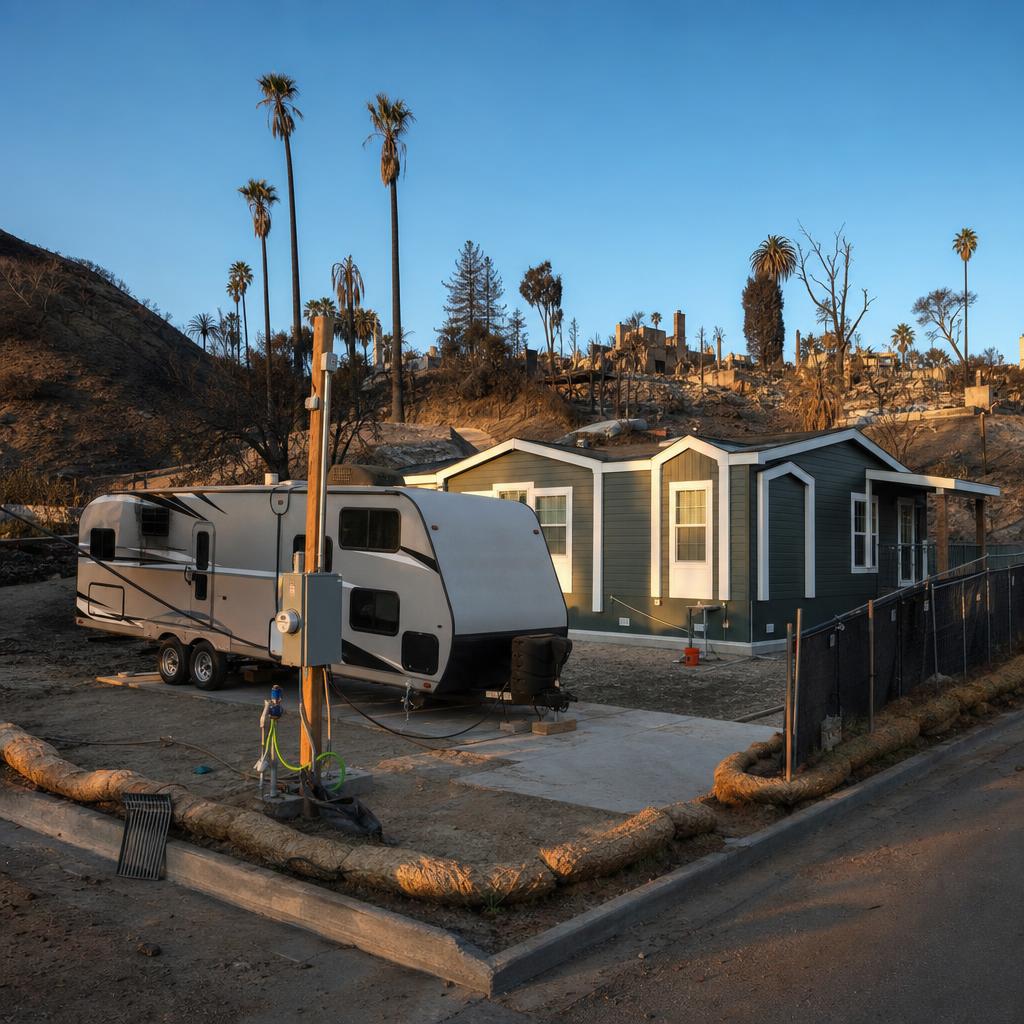
Most fire-rebuild guides cover debris removal, the FEMA 50% rule, fuel modification, water tanks, fire sprinklers, and fast-track permitting under Executive Order N-4-25 — but skip a question nearly every rebuilding family asks early: can we live on our own lot in an RV or manufactured home while the house is rebuilt, and what does that actually require?
The short answer is yes, in most cases, but it is its own permit process — separate from, and running in parallel with, the rebuild permit itself. Agencies treat an RV, travel trailer, or manufactured home used as a dwelling during construction as a temporary use that needs its own approval, its own utility hookups, and its own time limits tied to the active rebuild permit.
This guide covers the temporary-use permit itself, temporary power, water, and septic or sewer hookups, renewal rules if your rebuild runs long, insurance Additional Living Expenses (ALE) documentation, and how the temporary housing timeline coordinates with a fast-track rebuild under Executive Order N-4-25.
Why Temporary Housing Needs Its Own Permit
A rebuild permit authorizes construction of the permanent structure. It does not, by itself, authorize a family to live on the lot in an RV, trailer, or manufactured home while that construction happens. Using a vehicle or manufactured structure as a dwelling — even temporarily, even on your own property — is a separate land-use question, reviewed for setbacks from property lines, distance from active construction, and whether the utility hookups supporting it are safe and properly connected.
For City of Los Angeles parcels, LADBS reviews the temporary-use request; for unincorporated County territory such as Altadena, LA County Public Works and the Department of Regional Planning handle it — the same jurisdictional split covered in our unincorporated LA County permit guide for the underlying rebuild permit itself.
Temporary Housing Options, Compared
| Option | Permit Needed | Typical Time Limit | Notes |
|---|---|---|---|
| RV / travel trailer on the fire-damaged lot | Temporary-use permit for a recreational vehicle as a dwelling on the property during construction | Typically tied to the life of the active building permit, with periodic renewal | Most common option; requires temporary utility hookups and often a temporary septic or holding-tank arrangement |
| Manufactured / mobile home placed on the lot | Temporary-use permit plus HCD (Housing and Community Development) placement requirements for a manufactured home used as temporary housing | Generally matches the rebuild permit's active status, subject to renewal | Needs a compliant foundation or support system even for temporary placement, and its own utility connections |
| Modular temporary structure / container unit | Temporary-use permit; may require additional life-safety review depending on size and configuration | Tied to active rebuild permit status | Less common; egress, fire separation, and anchoring need specific review |
| Off-site rental (apartment, hotel, short-term rental) | No temporary on-site permit needed | Governed by lease or rental terms, not the rebuild permit | Simplest path administratively, but does not put anyone on-site to monitor the rebuild |
These are planning-level descriptions, not fee quotes or guaranteed approvals. We confirm current forms, fees, and requirements for your specific address during a free consultation.
Temporary Power, Water & Septic Hookups
Temporary electrical service typically comes through a temporary power pole permit — the same approval used to power the construction site — often serving both the job site and the occupant's RV or manufactured home with the utility's sign-off. Temporary water usually connects to the existing service lateral if it survived the fire, or through a temporary meter arrangement.
Sewer and septic are the more site-specific piece. If the lot's original sewer lateral or on-site septic system survived and can be certified as functional, the temporary housing unit may connect to it after an inspection confirms it can handle the added load. If the system was damaged or destroyed, expect either septic repair or replacement permitting before connecting, or a temporary holding tank with scheduled pump-outs in the meantime — see our septic system (OWTS) permit guide for the underlying process this depends on.
Time Limits, Renewal & Insurance ALE Coordination
A temporary-use permit is generally tied to the life of the active rebuild permit rather than a fixed calendar date, so it stays valid as long as the rebuild is genuinely progressing — but it still needs to be renewed before it lapses if the project runs longer than expected. We track this against the rebuild timeline rather than leaving it to the homeowner to remember a renewal date buried in a permit file.
On the insurance side, most homeowners policies' Additional Living Expenses (ALE) coverage is written broadly enough to include the cost of an on-site RV or manufactured home, but insurers vary on documentation requirements and reimbursement caps. Keep the temporary-use permit, hookup invoices, and any rental or purchase agreement on file, since these are the documents an adjuster is likely to request before reimbursing.
Coordinating With a Fast-Track Rebuild Under EO N-4-25
If your rebuild qualifies for Executive Order N-4-25 fast-track processing, the underlying rebuild permit can move faster than a typical temporary-use application. We file the temporary housing request alongside the rebuild permit application from the start, rather than waiting for the rebuild permit to issue first, so the temporary housing approval doesn't become the bottleneck holding up your ability to be on-site during a fast-track project.
Our Process for Temporary Housing During Your Rebuild
- 01
Confirm jurisdiction and rebuild permit status
We confirm whether LADBS or LA County Public Works has jurisdiction over the parcel, and whether the rebuild permit application is filed or already underway, since the temporary-use application typically references it.
- 02
Check the sewer/septic and utility condition of the lot
We verify whether the original sewer lateral or septic system survived the fire and can be certified, and whether the existing electrical service or a temporary power pole will serve the temporary housing unit.
- 03
File the temporary-use permit alongside the rebuild permit
We submit the temporary-use application for the RV, trailer, or manufactured home in parallel with the rebuild permit rather than waiting for one to finish before starting the other.
- 04
Coordinate temporary utility hookups
We coordinate the temporary power pole, water connection, and sewer/septic or holding-tank arrangement so the unit is legally habitable once it's placed on the lot.
- 05
Track renewal against the active rebuild permit
We monitor the temporary-use permit's status against the rebuild permit's timeline and file for renewal before the approval lapses if construction runs longer than expected.
- 06
Coordinate removal at rebuild closeout
We plan removal of the temporary housing unit and disconnection of temporary utilities around the rebuild's final inspection and certificate of occupancy.
Related Guides
For the fast-track rebuild process this temporary housing timeline coordinates with, see our Executive Order N-4-25 fast-track guide. For whether your rebuild counts as a substantial improvement under FEMA rules, see our FEMA 50% rule guide. For the temporary power hookup that often serves both the job site and temporary housing, see our temporary power pole permit guide. If your property is in Pacific Palisades or Altadena, see our Pacific Palisades and Altadena location guides, and our fire rebuild services page for our full-service approach.
Frequently Asked Questions
Can I legally park an RV or travel trailer on my fire-damaged lot while I rebuild?
Yes, in most cases, but it requires its own temporary-use permit from the same agency handling your rebuild — LADBS for City of Los Angeles parcels, LA County Department of Regional Planning and Public Works for unincorporated territory like Altadena. The RV cannot simply be parked and connected to utilities without approval; the temporary-use permit confirms setbacks, utility hookups, and habitability conditions specific to using a recreational vehicle as a dwelling during construction, and it is a separate approval from the building permit for the rebuild itself.
Do I need a separate permit for a manufactured or mobile home used as temporary housing?
Yes. A manufactured or mobile home placed on a lot for temporary occupancy during a rebuild needs a temporary-use permit from the local building department and generally needs to meet placement and support requirements — even for temporary use, the unit needs a compliant foundation, support, or tie-down system, along with its own electrical, water, and sewer or septic connections reviewed separately from the RV process.
How long is a temporary housing permit valid, and can it be renewed?
A temporary-use permit for an RV, trailer, or manufactured home is typically tied to the life of the active rebuild permit rather than to a fixed calendar date, meaning it generally stays valid as long as the rebuild permit remains active and construction is genuinely progressing. If the rebuild takes longer than expected, the temporary-use permit can usually be renewed, but the property owner needs to request that renewal before the current approval lapses — letting it expire and lapse can create complications with code enforcement even while a rebuild is legitimately underway.
What temporary utility hookups do I need for an RV or manufactured home on the lot?
Temporary power typically comes from a temporary power pole permit — the same type of approval used to power the construction site itself, often shared between the construction trailer and the occupant's RV or manufactured home with the utility's approval. Water is usually a temporary connection to the existing service lateral if it survived the fire, or a temporary meter. Sewer is the more complex piece: if the original sewer lateral is intact and the septic or sewer connection can be certified, the RV or manufactured home may connect to it; otherwise a temporary holding tank with a licensed pump-out service is often required until the permanent system is restored.
Do I need a separate septic or sewer permit for temporary housing on a lot with an existing septic system?
If the property is on a septic system and the existing on-site wastewater treatment system survived the fire and can be certified as functional, the RV or manufactured home may be able to connect to it with an inspection confirming the system can handle the additional temporary load. If the septic system was damaged or destroyed, you'll need either septic repair or replacement permitting before connecting temporary housing, or a temporary holding tank arrangement with scheduled pump-outs in the interim. See our septic system (OWTS) permit guide for the underlying septic permitting process this depends on.
How does temporary housing interact with my rebuild permit timeline?
The temporary-use permit for on-site housing generally runs on a separate but parallel track from your rebuild permit — you don't need to wait for the rebuild permit to issue before applying for temporary housing approval, and in practice most homeowners apply for both around the same time so they can move onto the lot early in the process rather than waiting until construction is nearly complete. If your rebuild qualifies for Executive Order N-4-25 fast-track processing, the underlying rebuild permit may move faster than the temporary housing approval, in which case we sequence the two applications so the temporary housing permit doesn't become the bottleneck holding up your ability to be on-site.
Does my homeowners insurance Additional Living Expenses (ALE) coverage cover an RV or manufactured home on my lot?
Most homeowners policies' Additional Living Expenses (ALE) coverage is written broadly enough to cover reasonable temporary housing costs during a covered rebuild, which can include the cost of renting or placing an RV or manufactured home, but insurers vary on documentation requirements and reimbursement caps. We recommend confirming with your adjuster in writing whether on-site RV or manufactured home costs qualify under your specific ALE coverage, and keeping the temporary-use permit, hookup invoices, and any rental or purchase agreement as documentation your insurer may request before reimbursing.
Can I live in an RV on my lot if I haven't started my rebuild permit yet?
Agencies generally expect temporary on-site housing to be tied to an active, in-progress rebuild — a temporary-use permit application usually asks for the associated rebuild permit number or at least evidence that a rebuild permit application is underway. Parking an RV on a vacant, cleared fire lot with no rebuild permit filed can draw code enforcement attention, since the temporary-use allowance exists specifically to support construction, not indefinite occupancy. We recommend filing the rebuild permit application and the temporary housing application together as one coordinated package.
What happens to the temporary housing permit once my rebuild is finished?
The temporary-use permit is meant to end when the rebuild receives final approval and a certificate of occupancy — at that point, the RV, trailer, or manufactured home needs to be removed from the site (or, for some jurisdictions, converted or relocated if it's being kept as a secondary use, which would need its own separate approval such as an ADU permit). Final inspection and closeout of the rebuild permit is the natural trigger to schedule removal of temporary housing and disconnect the temporary utility hookups.
Where should I start if I want to put an RV or manufactured home on my fire-damaged lot during rebuilding?
Start by confirming which agency has jurisdiction over your parcel — LADBS for City of Los Angeles addresses like most of Pacific Palisades, or LA County Public Works and Regional Planning for unincorporated territory like Altadena — and whether your rebuild permit application is already underway, since the two are typically filed together. Send us the address, your insurance ALE documentation if available, and whether the lot's sewer or septic connection survived the fire, and we'll map the temporary-use permit and utility hookup path alongside your rebuild permit timeline.