
Food Truck & Mobile Vendor
Permits in Los Angeles
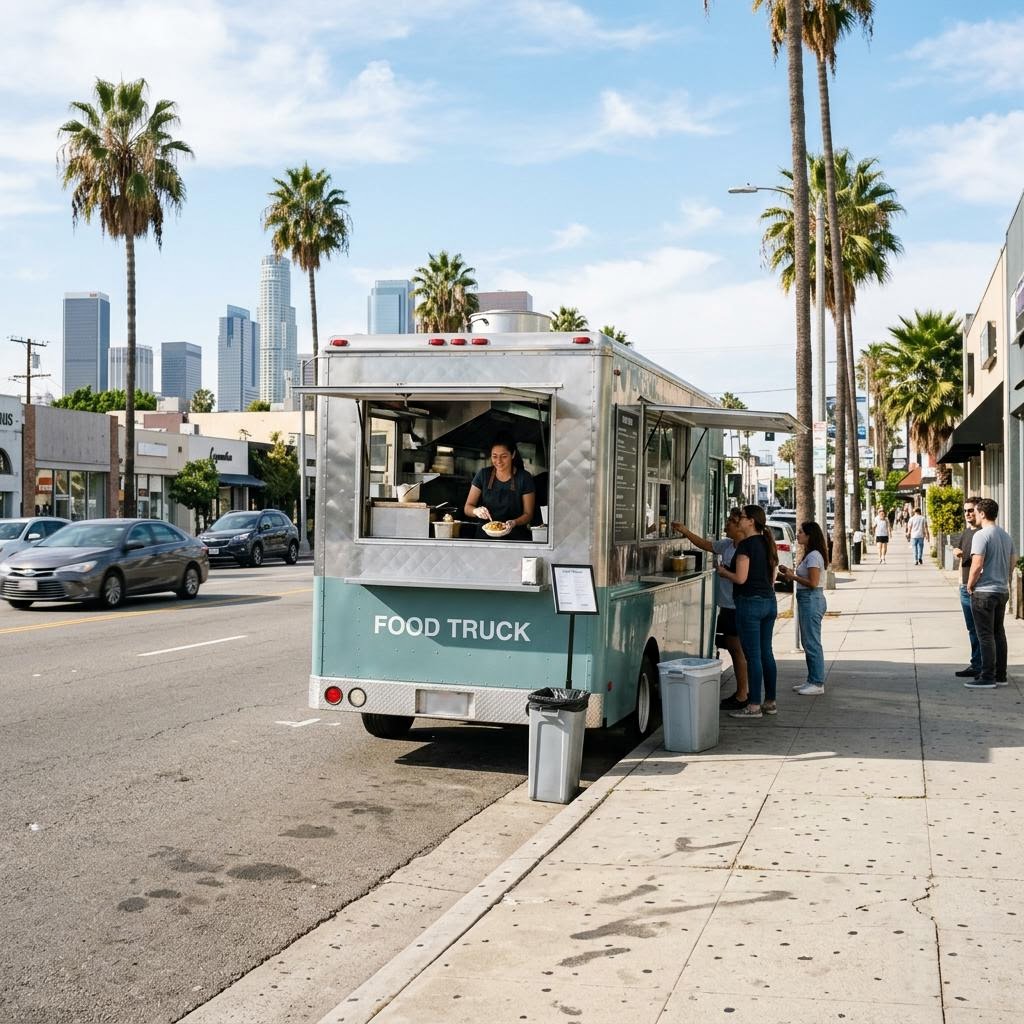
A food truck needs an approved vehicle, an approved place to service it and lawful places to sell. A health permit, a commissary lease and a business tax certificate each answer only one of those questions.
Ocean Permits & Development is a women-owned permit coordination firm helping food truck owners separate health approval, commissary support, business registration and vending-location rules into a clear sequence. We work with owners buying a new custom truck, remodeling an existing unit or taking over a truck that was approved for someone else. Call 213-277-8777 with the truck details, proposed menu, commissary and intended selling locations.
In the City of Los Angeles and most of the County, the Los Angeles County Department of Public Health, Environmental Health, regulates mobile food facilities (MFFs). Pasadena, Long Beach and Vernon operate their own health departments, so a truck selling there must follow that city's requirements rather than assuming County approval covers it. We confirm the health jurisdiction for every place you intend to operate before an owner commits to a route.
This page addresses food trucks, which County fee schedules treat differently from small sidewalk carts and compact mobile food operations. Do not price or plan a truck using cart categories or the reverse. If your concept is a fixed kitchen, a shared kitchen or a delivery-only operation, our ghost kitchen and restaurant permit services are the better starting point.
What the County health permit does and does not authorize
County Environmental Health reviews whether a mobile food facility is built and operated to protect food safety. A new truck, or an existing truck undergoing remodeling, may need a health plan check before construction or modification. Every truck must pass a final inspection before it sells food. An approved truck receives a grade and a decal; operating without the current approval and decal is not a paperwork technicality.
Health approval is not a land-use approval and does not authorize parking. A permitted truck can still be prohibited from stopping on a particular street, in a particular zone or on a private lot that lacks the right permission. Treat the health permit as approval of the unit and its operation, then evaluate each vending location separately.
County Code Section 8.04.403 requires the operator to keep route and schedule information current with the Department. A route described loosely during the application, then changed without an update, undermines the record inspectors rely on. Build route updates into your operating routine from day one.
Menu and risk category drive the truck design
The County classifies mobile food facilities by the food handling they perform. Prepackaged items, limited preparation and full cooking of raw ingredients carry different equipment expectations: handwashing, warewashing, refrigeration, hot holding, potable and wastewater tank capacity, ventilation and surfaces. The menu is the starting point for the design, not something to adjust after the truck is built.
Owners buying a used truck often assume it can serve any menu. A unit approved for a lower-risk operation may lack sinks, tank capacity or cooking equipment required for a higher-risk menu. Adding grills, fryers or raw protein preparation can turn a simple ownership change into a remodel requiring plan check. We compare the proposed menu with the truck's current approval before a purchase or menu launch.
- Write the complete menu, including preparation steps performed on the truck versus at the commissary.
- List every piece of equipment, its power source and its location.
- Confirm potable and wastewater tank capacities against expected service hours.
- Identify grease-producing cooking, which affects health and fire requirements.
Commissary agreements must match actual capacity
A mobile food facility operates in conjunction with an approved commissary or mobile support unit where the truck is stored, cleaned, restocked, supplied with potable water and disposes of wastewater and grease. The County's plan check guideline for mobile food facilities and mobile support units describes these support functions. The agreement must reflect the storage, water and waste, preparation and cleaning capacity your truck actually needs.
A ghost kitchen lease or shared kitchen membership does not, by itself, prove that the facility is approved to support mobile food facilities. Ask for evidence that the site can provide the specific services your operation requires and that it holds the appropriate approval. A commissary already serving many trucks may not have space, dump stations or cold storage for another one. If you are building your own support kitchen, see our ghost kitchen and commissary kitchen permit service.
City business registration is not an operating license
Businesses operating in the City of Los Angeles register with the Office of Finance and receive a Business Tax Registration Certificate (BTRC). Business tax obligations are annual, and amounts and any exemptions depend on the business's classification, gross receipts and eligibility. The BTRC is a tax registration; it does not approve the truck, the menu, the commissary or any vending location.
Plan the BTRC as one item in the opening checklist. Office of Finance processing and mailing of a physical certificate can take time; the City has indicated four to six weeks for certificate delivery. That mailing period is separate from health plan check or inspection timing and should not be used to estimate the permitting schedule.
Sidewalk vending permits are a different program
StreetsLA administers the City sidewalk and park vending permit for vendors operating on sidewalks or in parks. It is an annual permit and requires a BTRC, a California seller's permit and a health permit. It is designed for sidewalk and park activity and is not a blanket permit for a food truck parked in the roadway.
For roadway vending from a truck, confirm the current Los Angeles Municipal Code provisions, including LAMC 80.73, posted parking restrictions and LADOT rules at each location, and any applicable LAPD vehicle-vending enforcement. We do not tell clients there is a universal LAPD food truck permit, or a single parking time limit or distance rule that applies everywhere. Each block, posted sign and code provision is checked for the specific location.
Private lots, events and stationary vending
A property owner's consent is not enough to host a food truck on a private lot regularly. Stationary vending can be a land use, and City Planning determines whether the use is allowed under the parcel's zone and any existing approvals. Ask Planning for a determination before investing in a recurring site.
Site improvements raise the stakes. Electrical service, water connections, decks, shade structures, seating areas and lighting may trigger LADBS building and trade permits and accessibility review. A truck lot with seating begins to look like a restaurant site, and our tenant improvement and restaurant permit services handle that type of buildout. Special events may have their own temporary health and event approvals; confirm with the organizer and responsible agencies.
Fire safety: propane, extinguishers, suppression and generators
Fire safety on a food truck is evaluated by the fire authority serving the place you operate, which in the City of Los Angeles is the Los Angeles Fire Department's Fire Prevention Bureau. Topics typically include propane or LPG cylinder mounting and leak testing, current fire extinguishers, Class K extinguishers and hood suppression where grease-producing cooking requires them, generator placement and fueling, and fire department access at events or lots.
We do not promise a single blanket fire permit for every truck, and we do not publish numeric setbacks or fees that the fire authority has not confirmed for your situation. Contact the serving fire agency for current requirements before events or recurring locations, and keep inspection and service tags current.
1. Define the scope, route and commissary
Send the truck specifications or builder drawings, menu, preparation workflow, intended routes or event types and proposed commissary. We identify each health jurisdiction, the likely County risk category, and whether you are facing new construction, a remodel or an ownership change, then build an approval matrix covering health, business registration, location and fire items.
2. Prepare and submit health plan check where required
For a new custom truck or a remodel, coordinate the plan check package with your builder: equipment layout, specification sheets, finishes, plumbing and tank capacities, ventilation and the commissary information. We track corrections and keep the builder's changes aligned with the approved plans rather than letting fabrication drift from the submittal.
3. Complete construction, inspection and permit issuance
Schedule the final inspection only when the truck matches the approved plans and is fully equipped. Resolve corrections, pay the annual permit fee for the correct category, and confirm the grade and decal are in place. In parallel, complete the BTRC, seller's permit and any fire inspections relevant to the operation.
4. Verify locations and maintain compliance
Before selling at each location, confirm parking and vending rules, private-lot land-use status or event approvals. Keep the route and schedule current with the County, keep commissary records, and calendar annual renewals. Changes in menu, equipment, commissary or ownership should be reviewed before they happen, not after an inspector finds them.
Common mistakes that delay or shut down a food truck
The costliest mistakes happen before plan check: buying a used truck that cannot support the planned menu, ordering a custom build without plan check coordination, or signing with a kitchen that is not approved or not equipped to support trucks. Owners also assume a truck approved in one health jurisdiction can operate in Pasadena, Long Beach or Vernon without their approvals.
After opening, the recurring problems are location-based: treating the health decal as permission to park anywhere, setting up regularly on a private lot without a Planning determination, adding seating or power without permits, relying on a sidewalk vending permit for roadway operations and failing to update the route and schedule. Ocean Permits coordinates the process; we cannot guarantee approvals, waive requirements or authorize operations before agencies do.
Permits, agencies, published fees and renewal
Government fees below are separate from commissary rent, truck construction, design and the Ocean Permits coordination proposal.
| Item | Agency | Published cost or basis | Renewal / note |
|---|---|---|---|
| Mobile food facility annual permit, low risk (code 1309) | LA County DPH Environmental Health | $325 | Annual; truck category, not sidewalk cart |
| Mobile food facility annual permit, moderate risk (code 1310) | LA County DPH Environmental Health | $598 | Annual |
| Mobile food facility annual permit, high risk (code 1311) | LA County DPH Environmental Health | $761 | Annual |
| MFF plan check: low (1757) / moderate (1756) / high (1754) | LA County DPH Environmental Health | $544 / $544 / $741 | Per project submittal, not annual |
| Reinspection (code 1399) | LA County DPH Environmental Health | $145 if billed | Charged when a reinspection is required |
| Business Tax Registration Certificate | LA City Office of Finance | Tax depends on classification, receipts and eligibility | Annual tax obligations; not an operating license |
| Sidewalk and park vending permit | StreetsLA | Current StreetsLA fee | Annual; sidewalk and park activity only |
| Fire inspection items | Serving fire authority, LAFD in the City | Confirm with the agency | Keep extinguisher and suppression service current |
| Private lot use or site improvements | City Planning, LADBS | Agency schedules based on scope | Project-specific |
County amounts from the FY 2026-27 Public Health fee schedule reviewed October 22, 2026. Verify the current category and amount before payment. Cities with their own health departments set their own fees.
Illustrative timeline and dependencies
| Stage | Illustrative coordination allowance | Key dependency |
|---|---|---|
| Scope, route and commissary confirmation | 1-2 weeks | Menu, truck information and a commissary able to support the operation |
| New custom truck design, construction and health review | 8-16+ weeks | Builder schedule, plan check corrections and fabrication matching approved plans |
| Approved existing truck, ownership change | Case-specific | Truck's current approval, condition and whether the menu or equipment changes |
| Final health inspection, fire items and corrections | Before any sales | Truck complete, equipped and matching approval |
| BTRC certificate delivery | City indicates about 4-6 weeks by mail | Independent of health permitting timing |
These are illustrative coordination allowances, not agency service commitments. No total opening date is guaranteed.
Frequently Asked Questions
Who issues the food truck health permit in Los Angeles?
In the City of Los Angeles and most of the County, LA County Department of Public Health, Environmental Health, regulates mobile food facilities. Pasadena, Long Beach and Vernon have their own health departments, so operating in those cities requires their approvals.
Does my County health permit let me park and sell anywhere?
No. Health approval covers the truck and its operation, not land use or parking. Each location is subject to the Municipal Code, posted restrictions, LADOT rules, enforcement and, for private lots, Planning's determination of whether the use is allowed.
How much is the County mobile food facility permit?
Under the FY 2026-27 County fee schedule, the annual truck permit is $325 for low risk, $598 for moderate risk and $761 for high risk. Plan check is a separate per-submittal fee of $544 for low or moderate and $741 for high, and a $145 reinspection fee may be billed. These exclude commissary rent, construction and professional fees.
Can I use my ghost kitchen lease as my commissary?
Only if the facility is approved to support mobile food facilities and has the storage, water, wastewater, preparation and cleaning capacity your truck needs. A kitchen lease alone does not prove approved mobile-support status.
Do I need a StreetsLA sidewalk vending permit for my truck?
The StreetsLA permit covers sidewalk and park vending and requires a BTRC, seller's permit and health permit. It is not a blanket permit for roadway food truck operations, which are governed by separate code, parking and enforcement rules.
How long does it take to open a food truck?
It depends on whether the truck is new, remodeled or an existing approved unit. As an illustrative allowance, a new custom truck through design, construction and health review often takes 8 to 16 weeks or more. Final inspection must be passed before selling, and BTRC certificate mailing runs on its own timeline.
Relevant Ocean Permits Resources
Map your truck's approvals before you buy or build
Call 213-277-8777 for an initial consultation with Ocean Permits & Development, a women-owned permit coordination firm. Bring your truck details, menu, commissary and intended locations for a separate written coordination proposal.
Free Initial ConsultationCall 213-277-8777
Official sources, reviewed October 22, 2026
Agency requirements and fees change. Confirm current rules with each agency for your truck and locations.
LA County Environmental Health: food trucks and carts
County plan check and operational guidelines for mobile food facilities and mobile support units
County Public Health fee schedule, FY 2026-27
LA City Office of Finance: business registration process