_1781464136662-DVw5IPjt.png)
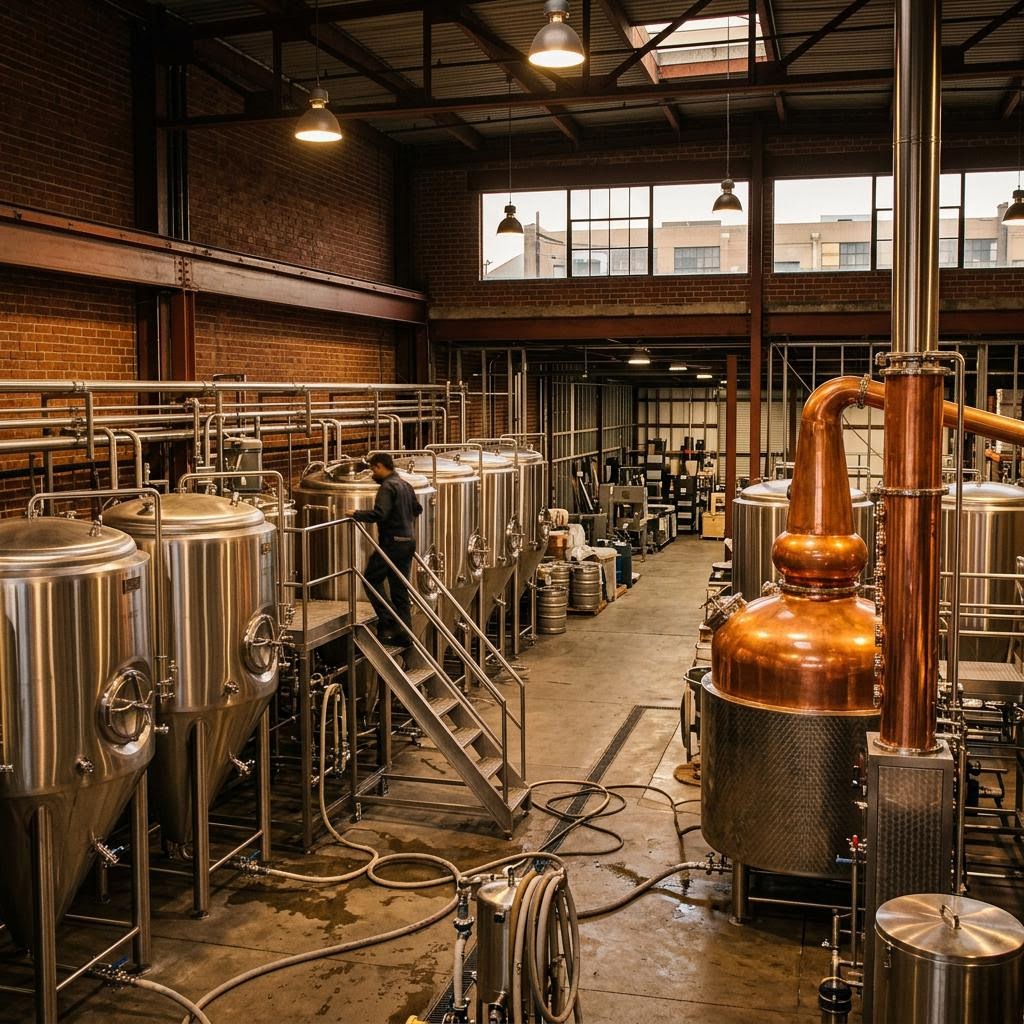
Opening a brewery, winery, or distillery in Los Angeles means satisfying three separate regulatory levels — federal, state, and local — before you can legally produce a single drop for sale. This is a fundamentally different process from a retail liquor license: it's about the right to manufacture alcohol, not the right to sell it across a bar. We manage the local zoning, building, and fire coordination that has to run alongside your federal TTB approval and California ABC manufacturer license so a fully-built production facility isn't left waiting on paperwork.
Manufacturing License vs. Retail Liquor License: Two Different Processes
It's worth being explicit about this distinction because it trips up a lot of first-time operators: a manufacturing permit and a retail liquor license are not the same thing, are not interchangeable, and don't substitute for each other. A manufacturing license — issued by California ABC as a beer manufacturer, winegrower, or distilled spirits manufacturer license — authorizes producing alcohol. It says nothing about whether you can sell that alcohol directly to a customer walking through your door.
Selling alcohol at retail — the kind of license a restaurant, bar, or bottle shop needs — is a completely separate regulatory track. Our Liquor License & ABC Permit Coordination page covers that process in detail: the Conditional Use Permit for alcohol sales, ABC license types like Type 41, 47, and 48, and the local land-use approval that runs alongside them. If your brewery, winery, or distillery wants a public-facing tasting room where visitors can sample or buy product on-site, you're generally looking at needing both tracks — a manufacturing license for production, and direct-sale privileges or a retail authorization for the tasting room itself. Treating these as one application is the single most common planning mistake we see with new production facilities.
Federal Approval: TTB Comes First
Before any production for sale, the federal Alcohol and Tobacco Tax and Trade Bureau (TTB) has to approve your facility. The specific approval depends on what you're producing: breweries need an approved Brewer's Notice, wineries need Bonded Winery approval, and distilleries need a Distilled Spirits Plant (DSP) Permit. In every case, federal approval is required before production can legally begin — not a formality you can work around while construction wraps up.
This is the step we see operators underestimate most consistently in terms of time. Because TTB approval doesn't depend on your local building permit being finished, it's tempting to treat it as something to handle later, in parallel with construction. In practice, initiating the TTB process at the same time you start lease negotiations and design — well before your building permit is even submitted — is what keeps a finished facility from sitting idle waiting on federal paperwork.
State Licensing: California ABC Manufacturer Licenses
Alongside federal approval, California ABC issues the state-level manufacturing license that matches your facility type — a beer manufacturer license for breweries, a winegrower license for wineries, and a distilled spirits manufacturer license for distilleries. ABC also maintains categories aimed at smaller-scale producers, generally referred to in the industry as a small beer manufacturer license and a craft distiller license, which carry different requirements than the standard manufacturer license.
We intentionally don't publish specific production-volume thresholds for these smaller-producer categories here, because these rules are set and periodically revised by California ABC — treat any number you see elsewhere as a starting point to verify, not a fixed rule to plan around. Confirm current thresholds and the correct license type directly with California ABC before finalizing your production plan or business model around a specific category. Separately, remember that your manufacturer's license does not automatically include the right to sell to the public in a tasting room — that typically requires additional direct-sale privileges or a separate retail authorization, confirmed with ABC as part of your license application.
Local Approvals: Zoning, Conditional Use, and LADBS Building Permits
Alcohol manufacturing generally needs to be sited in an industrial or manufacturing zone (commonly referred to as an M-zone) under the Los Angeles Municipal Code. A pure production facility with no public component is the more straightforward case; the complexity increases substantially the moment you add a tasting room or any space where the public gathers to sample or buy product. That assembly-type use, layered onto an industrial zone, can require a Conditional Use Permit (CUP) or Conditional Use Beverage (CUB) authorization — particularly if the site sits near sensitive uses like schools, churches, or residential zones. We verify zoning eligibility for a specific address as the very first step, before a lease is signed, so this isn't discovered after the fact.
On the building side, LADBS reviews production facilities under an occupancy classification appropriate to manufacturing — typically F-1 (factory/industrial) — while any tasting room or assembly space within the same building is generally classified separately, typically as A-2 (assembly). Getting this occupancy split right at the design stage avoids costly redesigns during plan check.
Distilleries face a meaningfully higher bar here because of the high-proof, flammable liquids involved in production. That typically means a more rigorous LAFD Fire Prevention Bureau review, fire suppression system requirements, flammable liquid storage limits, and ventilation requirements that go well beyond what a brewery or winery buildout requires. Budgeting and scheduling for this heightened review from the design phase — not discovering it mid-plan-check — is one of the most valuable things we do on distillery projects specifically.
Wastewater, Health, and the Tasting Room
Breweries in particular generate high volumes of organic wastewater discharge from the brewing process, which commonly requires coordination with LA Sanitation (LASAN) on discharge permitting and, depending on volume, pretreatment infrastructure. This is a frequently underestimated line item — it shapes plumbing design and, if not planned for early, can become a source of costly late-stage rework.
If your tasting room includes food service, or any open public sampling or tasting operation, expect the LA County Department of Public Health to require a health permit as well. This runs as its own parallel track — we coordinate it alongside your building permit and zoning approvals rather than treating it as something to sort out only once the space is built.
Brewery vs. Winery vs. Distillery: Key Differences
| Facility Type | Federal (TTB) | Typical ABC License | Special Risk/Consideration | Typical Zoning |
|---|---|---|---|---|
| Brewery | TTB Brewer's Notice approved before production | Type 01 (Beer Manufacturer) or the small beer manufacturer category — confirm current thresholds and license type directly with California ABC | High-volume organic wastewater discharge; grease/solids pretreatment coordination with LA Sanitation | Typically M-zone (manufacturing/industrial); tasting room open to the public may need separate assembly-use review |
| Winery | TTB Bonded Winery approval before operations begin | Winegrower license — confirm current category and any production-volume distinctions with California ABC | Large liquid storage volumes; wastewater from crush/fermentation; agricultural-adjacent siting considerations | Typically M-zone for urban production facilities; tasting rooms follow the same local assembly-use review as breweries |
| Distillery | TTB Distilled Spirits Plant (DSP) Permit before production | Distilled spirits manufacturer license or the craft distiller category — confirm current thresholds and license type with California ABC | High-proof flammable liquids; LAFD Fire Prevention Bureau review, fire suppression systems, flammable liquid storage, and ventilation requirements | Typically M-zone; flammable-liquid handling can trigger more stringent building and fire code review than beer or wine production |
Agency Checklist
| Agency | What Permit/License | Level |
|---|---|---|
| TTB (Alcohol and Tobacco Tax and Trade Bureau) | Brewer's Notice, Bonded Winery approval, or Distilled Spirits Plant (DSP) Permit — required before any production for sale | Federal |
| California ABC (Department of Alcoholic Beverage Control) | Manufacturer's license matching your facility type (beer, wine/winegrower, or distilled spirits), plus any direct-sale privileges for a tasting room | State |
| LA City Planning | Zoning verification for manufacturing use; Conditional Use Permit (CUP) or Conditional Use Beverage (CUB) if a tasting room open to the public is proposed near sensitive uses | Local |
| LADBS (LA Dept. of Building and Safety) | Building permit for the production facility and any tasting room build-out; occupancy classification (e.g., F-1 for manufacturing, A-2 for assembly/tasting areas) | Local |
| LAFD Fire Prevention Bureau | Fire and life-safety plan check; heightened review and suppression requirements for distilleries handling high-proof flammable liquids | Local |
| LA Sanitation (LASAN) | Wastewater discharge permit and pretreatment coordination, particularly for breweries with high-volume organic discharge | Local |
| LA County Dept. of Public Health | Health permit if food service or a public tasting/sampling operation is part of the business | County |
General Process Sequence
We don't promise a fixed number of days for any of these phases — production facility projects vary too much in scope, zoning history, and agency workload for that to be honest. What we can lay out is the order that avoids the most common and costly mistake: finishing construction before your federal and state approvals are anywhere close to ready.
- 1Federal TTB approval initiated (Brewer's Notice, Bonded Winery, or DSP Permit) — started as early as possible, in parallel with lease and design
- 2California ABC manufacturer license application filed alongside local zoning verification for the address
- 3Local zoning confirmation and, if a public tasting room is planned, Conditional Use Permit or CUB review with LA City Planning
- 4LADBS building permit application and plan check for the production facility and any tasting room build-out, with LAFD Fire Prevention Bureau review run concurrently — especially critical for distilleries
- 5LA Sanitation wastewater coordination and LA County Health Department review if food service or public tasting applies
- 6Final inspections across building, fire, and health as applicable, coordinated against your TTB and ABC approval status
- 7Opening — production and, if applicable, public tasting room operations begin once all federal, state, and local approvals are in hand
Why Ocean Permits
Ocean Permits & Development is a women-owned permit expediting firm based in Los Angeles. Brewery, winery, and distillery projects are exactly the kind of multi-agency work we specialize in — coordinating federal, state, and local requirements on a single project timeline instead of letting each agency operate on its own clock. We manage the local zoning verification, Conditional Use Permit or CUB process where a tasting room is involved, LADBS building permit and plan check, LAFD Fire Prevention Bureau coordination — especially critical for distilleries — and LA Sanitation and County Health tracks where applicable, sequenced against your federal TTB and state ABC application timelines.
For related build-out work, see our tenant improvement, warehouse & industrial permits, and restaurant permits pages, and our broader permit expediting services. Free consultation — call 213-277-8777.
Frequently Asked Questions
Can I sell directly to the public without a separate retail license?
A manufacturing license from California ABC covers production, but selling directly to consumers on-site — a tasting room, a bottle shop counter, on-site pours — typically requires additional direct-sale privileges tied to your manufacturer's license or a separate retail authorization. This is a common point of confusion: manufacturing and retail sale are regulated as different activities even when they happen at the same address, and each needs to be confirmed with ABC before you plan a public-facing tasting room.
How long does TTB approval take for a brewery, winery, or distillery?
We don't quote a fixed number of weeks or months because TTB processing times vary and change over time — this is exactly the kind of underestimated step that can stall an otherwise-ready project. What we do know with certainty is that TTB approval (Brewer's Notice, Bonded Winery, or DSP Permit) has to be granted before you can legally produce for sale, so it needs to be initiated at the earliest possible point in your project, in parallel with lease negotiation and design, not after your buildout is finished.
Do I need a Conditional Use Permit (CUP) if I don't have a tasting room?
A pure production facility with no public-facing tasting or sales component is less likely to trigger a CUP requirement, since CUPs in Los Angeles are generally tied to uses that bring the public onto the site — an assembly-type use. Opening any part of the facility to public tasting or sales changes that analysis and can require a Conditional Use Permit or Conditional Use Beverage (CUB) authorization, particularly if the site is near a school, church, or residential zone. We review your specific address and proposed operations before you assume either way.
What's the difference between a manufacturing license and a liquor license?
A manufacturing license from California ABC — a beer manufacturer, winegrower, or distilled spirits manufacturer license — authorizes producing alcohol. A liquor license, in the sense most people mean it (like a Type 41, 47, or 48 ABC license for a restaurant or bar), authorizes selling alcohol at retail for on-site or off-site consumption. These are separate regulatory tracks with separate applications, and a facility that both manufactures and wants to serve or sell to the public generally needs both a manufacturing license and applicable sale privileges or a retail license. See our dedicated guide to retail alcohol licensing at Liquor License & ABC Permit Coordination for how that side of the process works — it's a genuinely different process from what's covered on this page.
What zoning do I need for a brewery, winery, or distillery in Los Angeles?
Alcohol manufacturing generally requires an industrial or manufacturing zone (an M-zone) under the Los Angeles Municipal Code. If you also want a tasting room open to the public, that assembly-type use layered onto an industrial zone is where additional local review — potentially a Conditional Use Permit or Conditional Use Beverage authorization — comes in, especially near sensitive uses like schools, churches, or residential areas. We verify zoning eligibility for a specific address before you sign a lease, since a great production space in the wrong zone can derail a project before it starts.
Why does a distillery face stricter fire and building requirements than a brewery?
Distilled spirits involve high-proof, flammable liquids, which puts distilleries under heightened scrutiny from the LAFD Fire Prevention Bureau — including fire suppression system requirements, flammable liquid storage limits, and ventilation requirements that go well beyond what a brewery or winery typically faces. This affects both the building permit review timeline and the construction scope, so it needs to be factored into a distillery's budget and schedule from the design phase, not discovered during plan check.
Do breweries need a special wastewater permit?
Breweries generate a high volume of organic wastewater discharge from the brewing process, which commonly requires coordination with LA Sanitation on discharge permitting and, depending on volume, pretreatment infrastructure like an interceptor. This is a frequently underestimated line item in brewery buildouts — it affects plumbing design and can add both cost and permitting time if it isn't planned for early.
What occupancy classification applies to a production facility versus a tasting room?
A pure production area is typically classified under LADBS as an F-1 (factory/industrial) occupancy, while a tasting room or any space where the public gathers to consume is typically an A-2 (assembly) occupancy — a distinction that drives different exit, occupant load, and life-safety requirements for each part of the same building. Getting this classification right early avoids a redesign later in plan check.
Are there simplified license categories for small or craft producers?
California ABC does maintain categories aimed at smaller-scale producers — commonly referred to in the industry as a small beer manufacturer license for breweries and a craft distiller license for distilleries — with different requirements than the standard manufacturer license. Because eligibility thresholds and exact rules can change, we don't publish specific production-volume limits here; confirm current thresholds and the applicable license type directly with California ABC before finalizing your business plan around a specific category.
Do I need a county health permit for my tasting room?
If your tasting room includes any food service or an open public sampling/tasting operation, the LA County Department of Public Health will typically require a health permit in addition to your ABC and local approvals. This runs as a parallel track alongside your building permit and zoning approvals rather than something to address only once construction is complete.
Can Ocean Permits handle the federal TTB and state ABC applications directly?
We coordinate the local land-use and building permit tracks — zoning verification, CUP/CUB where applicable, LADBS building permits, LAFD fire review, and LA Sanitation and County Health coordination — and we sequence that local work against your federal TTB and state ABC application timelines so all three levels land in the right order. Filing the TTB Brewer's Notice, Bonded Winery approval, DSP Permit, or ABC manufacturer's license application itself is typically handled by the business owner or a specialized alcohol-licensing consultant; our role is making sure the local side doesn't become the reason a federally- and state-approved operator still can't open.
What's the general order of approvals for a brewery, winery, or distillery project?
In general: federal TTB approval is pursued first since production cannot legally begin without it, in parallel with your California ABC manufacturer's license application and local zoning verification. Once zoning is confirmed, a Conditional Use Permit or CUB (if a public tasting room is planned) and your LADBS building permit application move forward together, followed by LAFD, LA Sanitation, and County Health coordination as applicable, then final inspections before opening. We don't promise a fixed number of days for this sequence — production facility projects vary too much for that — but this ordering is what avoids the common trap of construction finishing before the federal and state licenses are anywhere close to ready.