_1781464136662-DVw5IPjt.png)
Women-owned, LA-based permit expediting firm. We manage historic-preservation review and the LADBS permit that follows as one coordinated process — from Certificate of Appropriateness filing through final construction sign-off. Free consultation — call 213-277-8777.
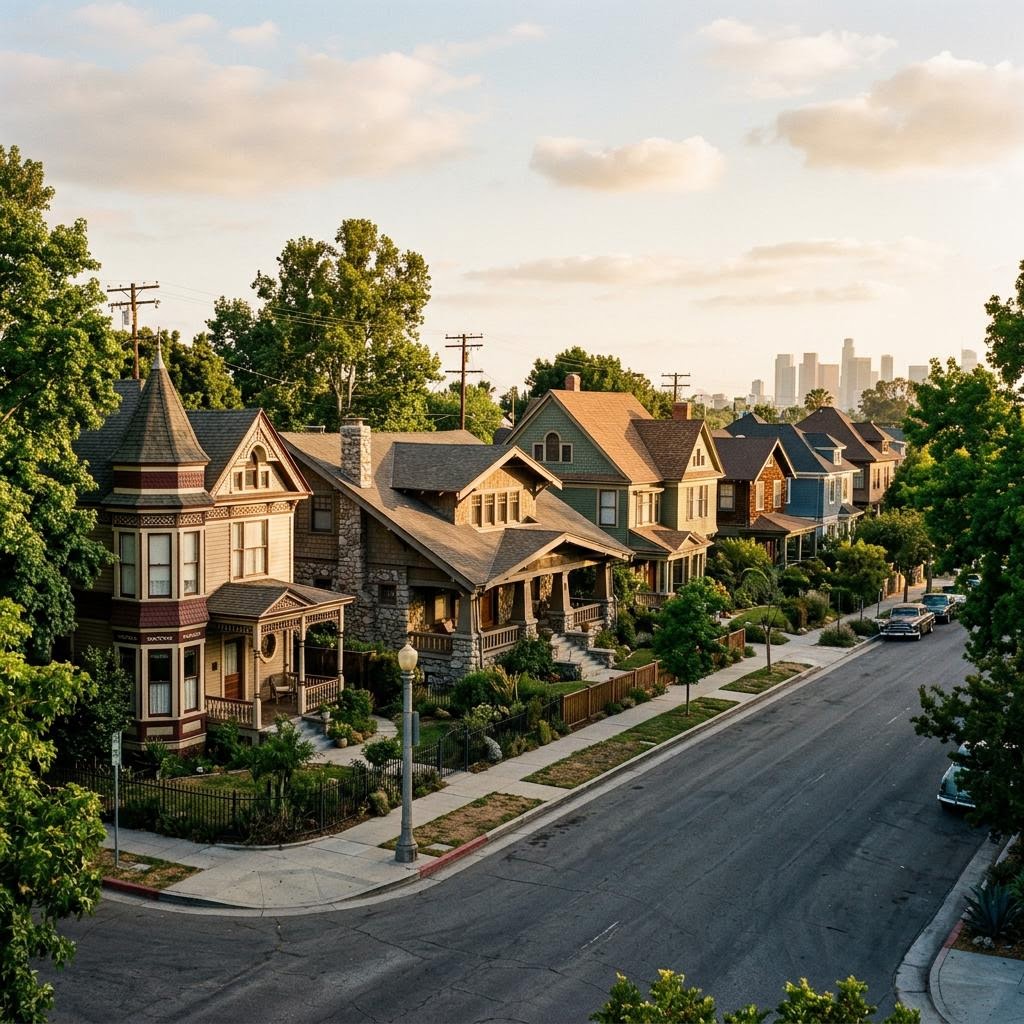
If your Los Angeles property sits inside a Historic Preservation Overlay Zone, changing the exterior — a new roof, replacement windows, an addition, or new construction on the lot — requires clearing a design review hurdle most homeowners never encounter, before LADBS will even consider the building permit.
This guide covers what an HPOZ is, how it differs from an individual Historic-Cultural Monument designation, what kind of work needs a Certificate of Appropriateness versus what's exempt, the rarer Certificate of Economic Hardship path, the review process from the Office of Historic Resources through the neighborhood's HPOZ Board, and how the whole process is explicitly different from our companion guide on the Baseline Hillside Ordinance, which governs grading and mass on hillside lots — a completely separate regulatory concern that happens to sometimes apply to the same property.
What Is a Historic Preservation Overlay Zone?
A Historic Preservation Overlay Zone is a zoning overlay, established under Los Angeles Municipal Code Section 12.20.3, applied to a defined geographic district recognized for its concentration of historically or architecturally significant buildings. Each HPOZ has its own adopted Preservation Plan — a document specific to that district describing its historic context, architectural styles, and design guidelines — and its own HPOZ Board, a body of design professionals and community members who review proposed exterior changes for compatibility with that plan.
Los Angeles has more than thirty designated HPOZs spread across the city, each reflecting a distinct architectural period and neighborhood character:
Angelino Heights
Near Downtown/Echo Park — one of LA's oldest HPOZs, Victorian-era homes
Whitley Heights
Hollywood Hills — Mediterranean Revival homes tied to early film-industry history
Miracle Mile
Mid-Wilshire — early-to-mid 20th century apartment and single-family architecture
West Adams (multiple HPOZs)
West Adams, Harvard Heights, Jefferson Park — Craftsman and Victorian residential districts
Highland Park (multiple HPOZs)
Garvanza, Highland Park — Craftsman bungalow districts
Melrose Hill / Wilshire Park
Central LA — early 20th century residential districts
HPOZ vs. Historic-Cultural Monument: Not the Same Thing
It's easy to conflate an HPOZ with an individual Historic-Cultural Monument (HCM) designation, but they're distinct tools. An HPOZ is a district-wide overlay covering every property within its mapped boundary, with review focused on the collective historic character of the neighborhood. An HCM is an individual designation applied to one specific building or site for its own particular significance — a property can be an HCM outside any HPOZ, sit within an HPOZ without individual HCM status, or in rarer cases be both. Knowing which designation, or combination, applies to your specific property is the first step in scoping the correct review path.
What Triggers HPOZ Design Review — and What Doesn't
HPOZ review under LAMC 12.20.3 is limited to exterior features visible from the public right-of-way. Here's how common scopes of work are typically treated, though the exact review level always depends on the specific district's Preservation Plan and the property's contributing status.
| Scope of Work | Typical Review Level | Why |
|---|---|---|
| Repainting in an already-approved color scheme | Generally no HPOZ review required | Not a visible exterior alteration beyond routine maintenance in an already-approved palette |
| Replacing a roof with in-kind or compatible materials | Often reviewed at staff level (administrative Certificate of Appropriateness) | Visible exterior change, but low-impact if materials match the district's contributing character |
| New windows, doors, or exterior siding changes | Certificate of Appropriateness — staff or HPOZ Board level depending on visibility and scope | Directly affects the street-facing historic character the HPOZ protects |
| Additions visible from the public right-of-way | Certificate of Appropriateness — typically HPOZ Board level | Significant visible change requiring design compatibility review against the district's Preservation Plan |
| New construction on a vacant or non-contributing lot within the HPOZ | Certificate of Appropriateness — HPOZ Board level | New buildings must be compatible in scale, massing, and materials with the surrounding historic district |
| Demolition of a contributing structure | Certificate of Appropriateness (demolition) — HPOZ Board level, with heightened scrutiny | Irreversible loss of a contributing resource; reviewed against the district's Preservation Plan and CEQA |
| Interior-only work with no exterior visibility | Not subject to HPOZ design review | HPOZ review is limited to exterior features visible from the public right-of-way |
Certificate of Appropriateness vs. Certificate of Economic Hardship
These are the two approval paths for HPOZ-regulated work, and they operate on entirely different criteria.
| Tool | What It Does | Decision-Maker | Basis for Approval |
|---|---|---|---|
| Certificate of Appropriateness (COA) | Approves an exterior alteration, addition, new construction, or demolition within an HPOZ as compatible with the district's Preservation Plan and design guidelines | HPOZ staff (administrative-level COAs) or the neighborhood's HPOZ Board (major COAs) | Design compatibility — materials, scale, massing, architectural character |
| Certificate of Economic Hardship (COE) | Allows work the HPOZ Board would otherwise deny on preservation grounds, when the property owner demonstrates that denial would prevent a reasonable economic return on the property | HPOZ Board, with a defined evidentiary hardship showing | Financial/economic hardship — not design preference |
A Certificate of Economic Hardship is a narrow, higher-bar path — it's not a shortcut around design review, it's a specific remedy for the rare case where preservation-driven denial would leave a property owner without any reasonable economic use of the property. Most HPOZ projects proceed through a standard Certificate of Appropriateness.
The HPOZ Review Process, Step by Step
- 01
Confirm HPOZ Status & Contributing/Non-Contributing Designation
We confirm whether the property sits within a designated Historic Preservation Overlay Zone and whether the LA Office of Historic Resources classifies it as a contributing or non-contributing structure to the district — a distinction that shapes how strictly design review applies.
- 02
Pre-Application Review of the District's Preservation Plan
Every HPOZ has its own adopted Preservation Plan with design guidelines specific to that district's architectural character. We review the proposed scope against those guidelines before drawings are finalized.
- 03
Determine COA Review Level
Minor, low-visibility work can often qualify for an administrative Certificate of Appropriateness reviewed by HPOZ staff. More visible alterations, additions, new construction, or demolition require review by the neighborhood's HPOZ Board at a public meeting.
- 04
COA Application Filing
We prepare and file the Certificate of Appropriateness application with the Office of Historic Resources, including required photographs, material specifications, and drawings showing the proposed work in context with the historic structure and streetscape.
- 05
HPOZ Board Review (If Required)
For major COAs, the case goes before the local HPOZ Board — a body of design professionals and community members specific to that district — at a public meeting where the Board evaluates compatibility and can approve, approve with conditions, or deny.
- 06
Certificate of Appropriateness Issued
Once approved, the COA is issued and referenced in the subsequent building permit application — the COA itself does not authorize construction; it clears the design/historic-preservation hurdle that LADBS requires before issuing the permit.
- 07
LADBS Building Permit
With the COA in hand, the project proceeds through standard LADBS plan check and permitting for the physical construction, exactly as it would for a non-HPOZ property, but referencing the COA approval.
The Office of Historic Resources & HPOZ Boards
The Office of Historic Resources, a division of the LA Department of City Planning, administers the citywide HPOZ program — maintaining district surveys, coordinating staff-level administrative COAs, and supporting each neighborhood's individual HPOZ Board. Each HPOZ Board is unique to its district, made up of design professionals and community members familiar with that neighborhood's specific architectural history, and meets on its own public schedule to review major Certificates of Appropriateness. Because every HPOZ Board applies its own district's Preservation Plan rather than a single citywide standard, a project's design strategy has to be tailored to the specific district — what works in Angelino Heights won't necessarily satisfy the design guidelines in West Adams or Highland Park.
How HPOZ Review Fits With Your LADBS Building Permit
A Certificate of Appropriateness is a design-review clearance, not a building permit — it doesn't authorize construction on its own. Once the COA is approved, the project proceeds to standard LADBS plan check and permitting, referencing the COA in the application, exactly as our LADBS permit process guide describes for any Los Angeles project. Treat the two as sequential: HPOZ approval clears the historic-preservation hurdle first, and LADBS handles the construction permitting second.
Fire-Rebuild Context: HPOZ Districts and the 2025 Fires
While Pacific Palisades and Altadena are not themselves designated HPOZs, our work supporting fire-rebuild clients there has sharpened our approach to any project balancing historic or neighborhood-character considerations against rebuild urgency. If your HPOZ property was damaged by fire, water, or other casualty loss, we scope the interplay between historic-preservation review, any hardship arguments available under a Certificate of Economic Hardship, and the standard fire and casualty rebuild permitting pathway at the very start of the project.