_1781464136662-DVw5IPjt.png)
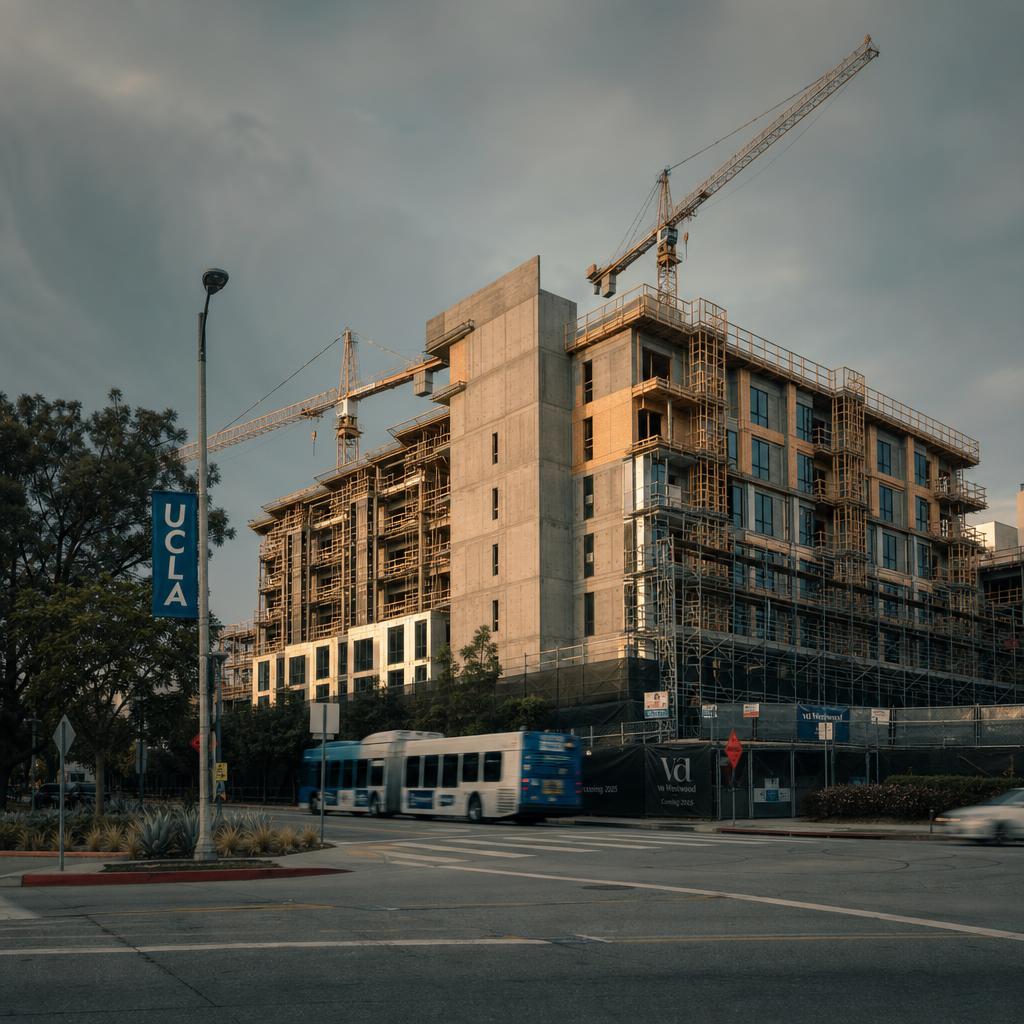
West Los Angeles
& Westwood Permits
LADBS coordination, UCLA-area multifamily housing, planning appeals, and thoughtful permit strategy for West LA’s established residential streets and major commercial corridors.
Women-owned, LA-based permit expediting firm. Ocean Permits & Development coordinates LADBS and City Planning paths for West LA projects, from R1 additions to complex housing applications. We also serve Los Angeles and other CA, AZ, TX, and FL markets, with a fire-rebuild specialty including Pacific Palisades, Altadena, and Executive Order N-4-25 context. Free consultation — call 213-277-8777.
West Los Angeles and Westwood sit inside the City of Los Angeles, near UCLA, with a housing market shaped by university employees, students, graduate students, medical professionals, and long-term residents. That demand makes the difference between a building permit, a ministerial housing path, and a discretionary land-use case especially consequential.
The area is not one uniform permitting environment. Westwood Village, Wilshire Boulevard, Santa Monica Boulevard, and Pico Boulevard concentrate commercial and transit-serving activity; nearby streets retain single-family and lower-scale residential patterns. A property’s zone, community plan designation, parcel history, overlays, access, and proposed use determine the actual route. The right first question is not “how quickly can LADBS issue a permit?” but “what approvals must be complete before LADBS can issue it?”
Ocean Permits & Development helps owners, architects, and operators establish that route early. For a modest remodel, that can mean a clean LADBS submittal. For housing near a commercial corridor, it can mean testing AB 2011 or SB 35/SB 423 eligibility against the current law and objective standards. For a proposal seeking departure from zoning, it can mean planning for a City Planning entitlement, public notice, and possible appeal rather than promising an unrealistic ministerial timeline.
LADBS, City Planning, and the West Los Angeles Area Planning Commission
West LA and Westwood are City of Los Angeles neighborhoods. LADBS administers building, electrical, plumbing, mechanical, grading, and related construction permits; Los Angeles City Planning administers zoning interpretations, entitlements, and land-use procedures. That division matters: a building plan checker cannot waive a use, height, density, parking, or setback issue that requires a Planning decision. Conversely, a Planning approval is not a building permit and must still be translated into a complete code-compliant construction set.
The West Los Angeles Area Planning Commission (West LA APC) is one of the City’s regional planning commissions. It handles certain appeals and discretionary approvals assigned to its geography and procedure. It should not be confused with the Central Area Planning Commission or another regional APC simply because a project is close to the city’s center. Nor is it an LADBS review board. The deciding body can change with the application type, delegated authority, and appeal provisions, so we identify the current decision maker before calendaring hearings or telling neighbors what process applies.
This distinction becomes practical when a multifamily or mixed-use project has both an entitlement record and construction corrections. A discretionary approval may carry conditions that must appear in drawings, operations plans, or covenants. Appeals can affect when the approval is final. We maintain a single checklist of Planning conditions, LADBS requirements, consultant reports, and agency clearances so a project does not clear one counter while quietly missing a condition at another.
Housing near UCLA: AB 2011 and SB 35 / SB 423 screening
The UCLA vicinity has persistent demand for apartments, shared housing, and mixed-income homes. Wilshire, Santa Monica Boulevard, and Pico are natural places to investigate housing strategies because they combine commercial frontage, transit access, services, and established development patterns. But “near transit” or “near UCLA” does not independently create a streamlined approval. The statute, the zoning, and a site’s physical and environmental facts control.
AB 2011—the Affordable Housing and High Road Jobs Act—appears primarily at Government Code sections 65912.100 through 65912.130. It can provide ministerial approval for qualifying housing on eligible commercial sites when the development satisfies its affordability, labor, prevailing-wage and skilled-workforce provisions where applicable, objective design standards, site restrictions, and procedural requirements. AB 2011 is valuable because it can replace a discretionary zoning hearing with an objective review, not because it eliminates plan quality, public improvements, utility coordination, building code, or tenant-protection obligations.
SB 35 created a separate ministerial housing mechanism in Government Code section 65913.4. SB 423 extended and modified the statewide framework through 2036 for qualifying jurisdictions and projects. A complete screening looks at the applicable affordability level, density and zoning capacity, labor requirements, objective standards, location exclusions, demolition or housing-history issues, and the City’s current implementation process. A project that misses one prerequisite may still be viable—but on a conventional entitlement path with a different schedule and risk profile.
For owners exploring apartments, co-living-compatible layouts where lawful, or mixed-income housing, our multifamily apartment permit service starts with this route analysis. We coordinate the architect, land-use consultant, civil engineer, and applicant around the documents that the selected path actually needs. That is preferable to designing to an assumed density and discovering late in plan check that the project needs a discretionary entitlement.
West LA project review paths at a glance
| Project type | Typical LADBS / City review path | Key threshold |
|---|---|---|
| Interior remodel / code upgrades | LADBS building permit; usually ministerial | Scope, existing conditions, and complete trade plans drive review. |
| R1 addition or replacement home | LADBS plan check with BMO and zoning review | Confirm floor area, setbacks, height, and any overlay before design is fixed. |
| Qualifying corridor affordable housing | AB 2011 ministerial review | Government Code §§ 65912.100–65912.130; eligibility and labor rules apply. |
| Qualifying multifamily housing | SB 35 / SB 423 streamlined ministerial path | Government Code § 65913.4 framework; affordability and objective standards are essential. |
| Mixed-use or multifamily outside streamlined rules | City Planning entitlement plus LADBS permit | May involve discretionary approvals, CEQA review, and appeal rights. |
| Project seeking relief from zoning standard | Discretionary variance or other entitlement | A variance requires statutory and local findings; it is not automatic. |
This is a screening tool, not a legal determination. “Ministerial” generally means the agency applies objective standards rather than discretionary findings; it does not mean a permit is instant or that every site qualifies.
Baseline Mansionization Ordinance in West LA’s R1 pockets
Away from the larger corridors, West LA includes established single-family blocks where the citywide Baseline Mansionization Ordinance (BMO) can govern the envelope for additions, major remodels, and new houses. The ordinance was adopted to limit oversized development relative to lot size and neighborhood context. In practice, it makes early floor-area accounting, setback review, height analysis, and treatment of covered areas essential. A beautiful addition can become a costly redesign if its floor area was calculated too casually.
BMO is not a substitute for reading the underlying zone, and it is not the only rule. Specific plans, overlays, hillside conditions where applicable, historic resources, protected trees, driveway work, and construction logistics can add requirements. We ask for the address and preliminary scope before design development, then organize zoning verification and a plan-check readiness review. This is especially useful for properties that appear to have had past unpermitted conversions or additions.
A homeowner considering two units rather than one larger home may also ask about SB 9. California’s SB 9 provisions can allow qualifying urban lot splits and two-unit development on eligible parcels, but owner-occupancy affidavits, tenant and demolition protections, objective local standards, and parcel constraints are important. Read our Los Angeles SB 9 lot split and duplex guide before treating it as a guaranteed solution. It is a separate analysis from a corridor multifamily program.
Not a Coastal Zone: a useful Westside distinction
West Los Angeles and Westwood are inland. They are generally not within the California Coastal Zone, and a Coastal Development Permit is generally not required merely because a project is on the Westside. This is an important clarification for owners who hear “coastal permit” used as shorthand for any Los Angeles project west of the 405. We still verify the parcel’s actual jurisdiction and overlays; permitting should always follow a map and current agency record, not a neighborhood label.
The contrast is real in Santa Monica and Pacific Palisades, where coastal jurisdiction can add California Coastal Commission or local coastal-program issues. Our Coastal Development Permit guide explains that separate track. It is not ordinarily a Westwood or inland West LA requirement, so it should not be inserted into a project schedule without a parcel-specific basis.
A practical West Los Angeles permitting sequence
- 1
Confirm jurisdiction and property facts.
Verify City of Los Angeles jurisdiction, zoning, parcel history, recorded conditions, overlays, access, and the existing legal use.
- 2
Choose the approval route before final design.
Screen LADBS-only work, BMO limits, AB 2011, SB 35/SB 423, and any discretionary City Planning entitlement.
- 3
Build a coordinated submittal package.
Align architectural, structural, MEP, civil, energy, accessibility, and land-use documents so that statements do not conflict.
- 4
Submit, track, and answer corrections.
Manage LADBS and agency comments quickly, document responses, and keep conditions of approval visible to the full consultant team.
- 5
Close out approvals and field changes.
Coordinate issuance, deferred submittals, inspections, and any material field change before construction gets ahead of the permit.
Variances, appeals, and neighboring Westside context
When a proposal cannot meet an objective development standard, a variance may sound like the obvious answer. It is not automatic and requires legally supportable findings, typically tied to special physical circumstances rather than a desire for a larger or more profitable project. It is discretionary, can require notice and hearing, and may be appealed through the applicable City process. Our Los Angeles zoning variance guide explains why feasibility should not be built around a variance without first testing alternatives.
West LA also differs from nearby Bel-Air, where hillside, access, fire, and neighborhood-specific conditions commonly dominate project strategy. Westwood and West LA may have their own challenging sites, but the UCLA-area housing and commercial-corridor context often makes use, density, ministerial eligibility, and construction sequencing the leading questions. We tailor the review plan to the parcel rather than applying a one-size-fits-all “Westside” checklist.
Common Questions
Who issues building permits in West Los Angeles and Westwood?
West Los Angeles and Westwood are within the City of Los Angeles, so building permits are issued by the Los Angeles Department of Building and Safety (LADBS). Land-use entitlement questions are handled by Los Angeles City Planning. Depending on the proposal, other City reviewers can include the Bureau of Engineering, LA Fire Department, Urban Forestry, or the Department of Transportation.
What does the West Los Angeles Area Planning Commission do?
The West Los Angeles Area Planning Commission is one of Los Angeles City Planning's regional commissions. It generally hears certain appeals and discretionary land-use matters assigned to the West Los Angeles planning area. It is not the Central Area Planning Commission, and it is not a second building-permit counter. Whether a particular case goes to the West LA APC, a zoning administrator, the City Council, or another body depends on the entitlement and appeal path.
Can AB 2011 streamline a West LA housing project?
Potentially. AB 2011, codified primarily in Government Code sections 65912.100 through 65912.130, creates a ministerial approval path for qualifying housing developments on eligible commercial corridors. Eligibility, affordability, labor, site, environmental, and objective-standard requirements are detailed and project-specific. A Wilshire, Santa Monica Boulevard, or Pico Boulevard address is not by itself a guarantee of eligibility.
Does SB 35 still apply in Los Angeles?
SB 35 established a ministerial multifamily housing process in Government Code section 65913.4. Its successor framework, SB 423, extends a streamlined path in qualifying jurisdictions through 2036. Projects must satisfy affordability, zoning, labor, and objective planning standards. We evaluate the current statute, City implementation guidance, and the specific site before describing a proposal as streamlined.
Are West Los Angeles and Westwood in the Coastal Zone?
Generally, no. Inland West Los Angeles and Westwood are not in the California Coastal Zone, so a Coastal Development Permit is generally not part of their LADBS or City Planning process. That differs from coastal jurisdictions and neighborhoods such as Santa Monica, Venice, and Pacific Palisades. Parcel-specific overlays should still be verified early.
Does the Baseline Mansionization Ordinance affect West LA remodels?
Yes, in most applicable single-family zones the citywide Baseline Mansionization Ordinance affects floor-area, massing, and related calculations for substantial additions and replacement homes. West LA has many R1 pockets where an early zoning envelope and floor-area review can prevent a plan set from being designed beyond what the code allows.
Can I split a West LA lot and build duplexes?
Some owner-occupied single-family parcels may be candidates for the state SB 9 urban lot split and two-unit provisions, but the rules are highly site-specific. Historic status, tenant protections, setbacks, affidavits, objective standards, and title issues can matter. SB 9 is separate from a multifamily corridor strategy and should be screened before relying on a lot split.
When is a zoning variance needed for a Westwood project?
A variance is not a routine way to obtain more density, height, or floor area. It is a discretionary remedy requiring findings tied to special physical circumstances and can be appealed. If a project cannot meet an objective zoning rule, the appropriate path may be a redesign, another entitlement, or—in limited situations—a variance; the facts determine the answer.
How long does a multifamily permit take near UCLA?
Timing depends on the route. A complete ministerial building-permit project can move differently from an AB 2011 or SB 35/SB 423 application, and both differ substantially from a discretionary entitlement that may involve hearing, appeal, and CEQA work. Complete plans, agency workload, utilities, demolition, tenant relocation, and correction cycles all affect timing.
Why use a permit expediter for a West Los Angeles project?
A West LA project can involve simultaneous building, zoning, housing, public-works, and agency-clearance tracks. Ocean Permits & Development organizes the submittal sequence, tracks LADBS corrections, coordinates consultants, and identifies whether a proposal is truly ministerial or needs a land-use approval before expensive redesign occurs.
Project in West LA?
Women-owned, LA-based. We coordinate LADBS, City Planning, BMO analysis, and multifamily review paths. Free consultation.
Schedule a ConsultationOr call +1 (213) 277-8777